Speaker
Description
Silicon carbide provides significant advantages as a radiation sensor, such as high radiation hardness and wide temperature operation, suitable for application in nuclear energy, accelerator physics research, particle therapy and outer space. Combined with the high spatial segmentation of pixel imagers and noiseless counting response of Timepix chip [1], high-resolution radiation measurement techniques [2] can be exploited also with SiC sensors [3,4]. We apply the spectral-tracking imaging ability of single particles to examine and evaluate the sensitivity and tracking resolving power of SiC to fast neutrons. The active thickness of the sensor, regulated by varying the applied bias [5], determines the particle track morphology and their charge collection as well as the detection efficiency of the fast neutrons.
In this work we experimentally examine the imaging-tracking response of Timepix3 detectors equipped with 4H-SiC sensors to 14 MeV neutrons at various active sensor thicknesses controlled by applied bias. The sensor was prepared from 80 µm thick epitaxial 4H-SiC layer grown on 350 µm thick base 4H-SiC substrate. The sensor bump-bonded to Timepix3 chip is readout as 256 × 256 (65536) pixels of Schottky electrodes with 55 µm pitch. The reverse biasing from 50 to 200 V modifies the active sensor thickness from 38 to 76 µm [5]. The neutrons were generated by DT neutron generator at DANAIDES facility at CEA in Cadarache.
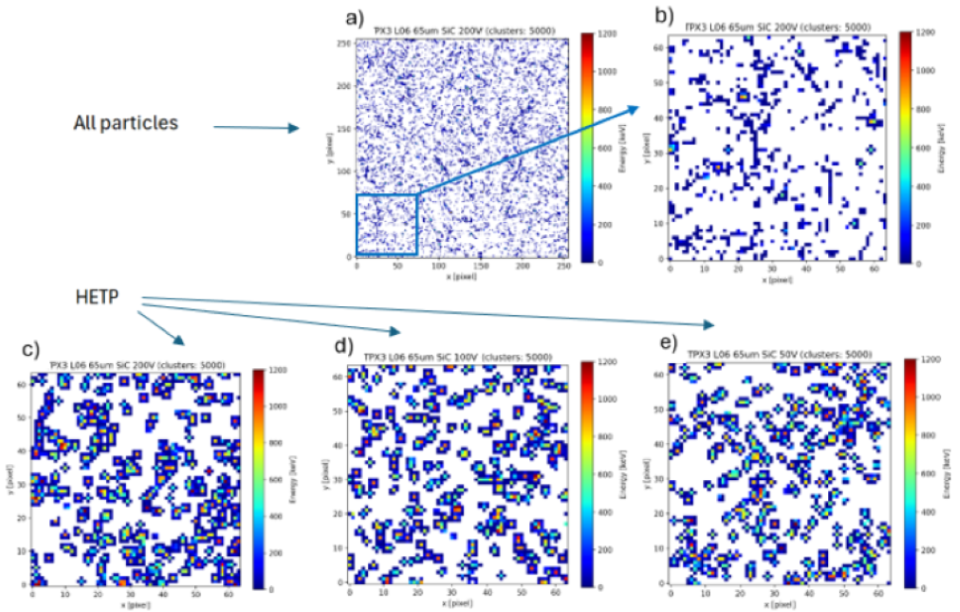
The measured data consisted of a mixed radiation field comprising photons, electrons, protons, ions and alpha particles produced by neutron interactions in the sensor material and surrounding structures including secondary radiation background. The detector raw data were pre-processed at the pixel-chip level with the TraX Engine SW tool [6]. Further post-processing at the detector and radiation environment level were done with customized scripting where single-track morphology and spectral cluster parameters such as deposited energy and track length were further analyzed. Particle discrimination is based on prior experimental calibrations on well-defined radiation fields. Double-parameter functional filters were applied to separate events according to their energy deposition characteristics and spatial properties. Based on these criteria, the events were classified into two groups: high energy transferring particles (HETP), representing the products of neutron interactions with Si and C nuclei, and low energy transferring particles (LETP) representing the background accompanying the neutron source.
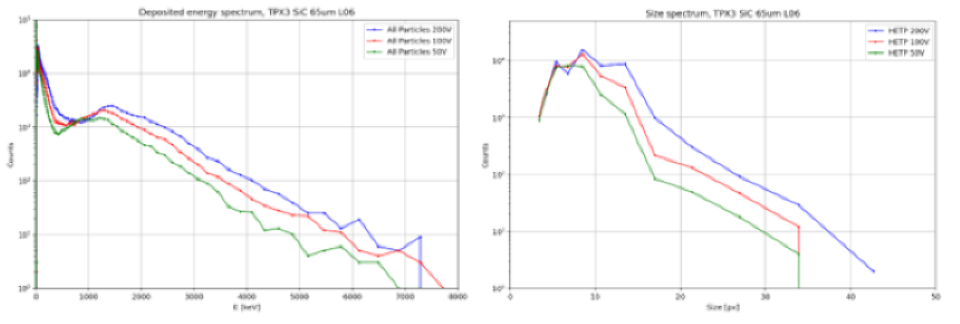
The sensor bias significantly affects the response of the SiC Timepix3 detector to 14 MeV neutrons. The experimental results show increase in the number of detected neutron-induced events with increasing bias, consistent with the enlargement of the depleted region. Moreover, the applied bias influences the morphology of clusters produced by highly ionizing recoil particles originating from neutron interactions in the sensor material. (fig. 1 a - e) With increasing bias, an increase in cluster size is observed. This effect is attributed to the stronger and deeper electric field within the sensor, which enhances lateral carrier transport and charge sharing between neighboring pixels. At higher bias voltages, a saturation effect is observed. This effect manifests as a redistribution of charge within large clusters, where the central pixel exhibits reduced collected charge compared to surrounding pixels. The observed bias dependence of cluster size, charge sharing, and volcano effect demonstrates the strong influence of the electric field configuration on the detector response to neutron-induced heavy recoils. (fig. 2)
[1] E. Heijne, et al., Nucl. Instrum. Meth. A 699 (2013) 198-204
[2] C. Granja et al., Nuclear Instr. Methods A 908 (2018) 60-71
[3] B. Zat'ko et al., JINST 17 (2022) C12005
[4] A. Novak et al, J. of Instrum JINST 18 (2023) C01022
[5] A. Sagatova et al., AIP Conf. Proc. 3054 (2024) 050011
[6] L. Marek et al., JINST 19 (2024) C0
Acknowledgement: This work was partially supported by grants APVV-22-0382 and DS-FR-24-0020 of the Slovak Research and Development Agency and funded by the EU NextGenerationEU through the Recovery and Resilience Plan for Slovakia under the project No. 09I05-03-V02-00073. Carlos Granja was affiliated at Advacam, Prague when the experimental measurements were performed.