Speaker
Description
Low energy neutron spectrometry with Timepix3 SiC detectors
Silicon carbide (SiC) is attracting increasing interest as a sensor material due to recent advances in crystal growth technology and its substantial advantages over silicon, including a wide band gap and a high critical electric field for specific applications. In addition, its high displacement energy makes SiC particularly suitable for operation in harsh radiation environments, such as high-flux neutron fields.
This work presents a method for determining the spatial distribution of "low-energy fast" (below 1 MeV) neutrons from the T(p,n)3He threshold reaction using a pixelated high-granularity detector consisting of a Timepix3 readout chip coupled to a novel 4H-SiC sensor (hereafter referred to as SiC TPX3). The method relies exclusively on well-known elastic scattering cross sections [1,2] and does not require the use of neutron converters.
The measurements were performed at the Van de Graaff accelerator at the Institute of Technical and Experimental Physics of the Czech Technical University in Prague. Neutrons were produced by a high-intensity proton beam with energies Ep=1.4–1.6 MeV incident on a thin tritium target, generating "low-energy fast" neutrons. Two SiC-TPX3 detectors (operated with MiniPIX readout Electronics from Addvacam) were placed at precisely defined distances relative to the neutron source (Figure 1).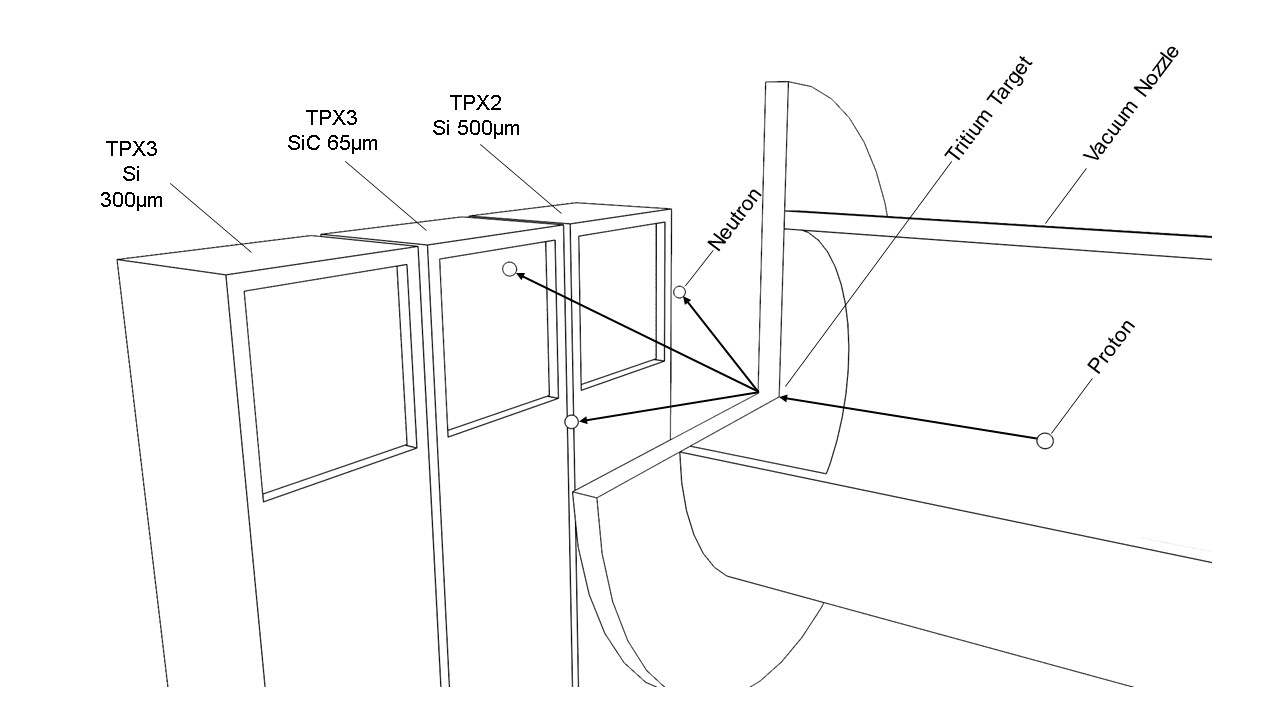
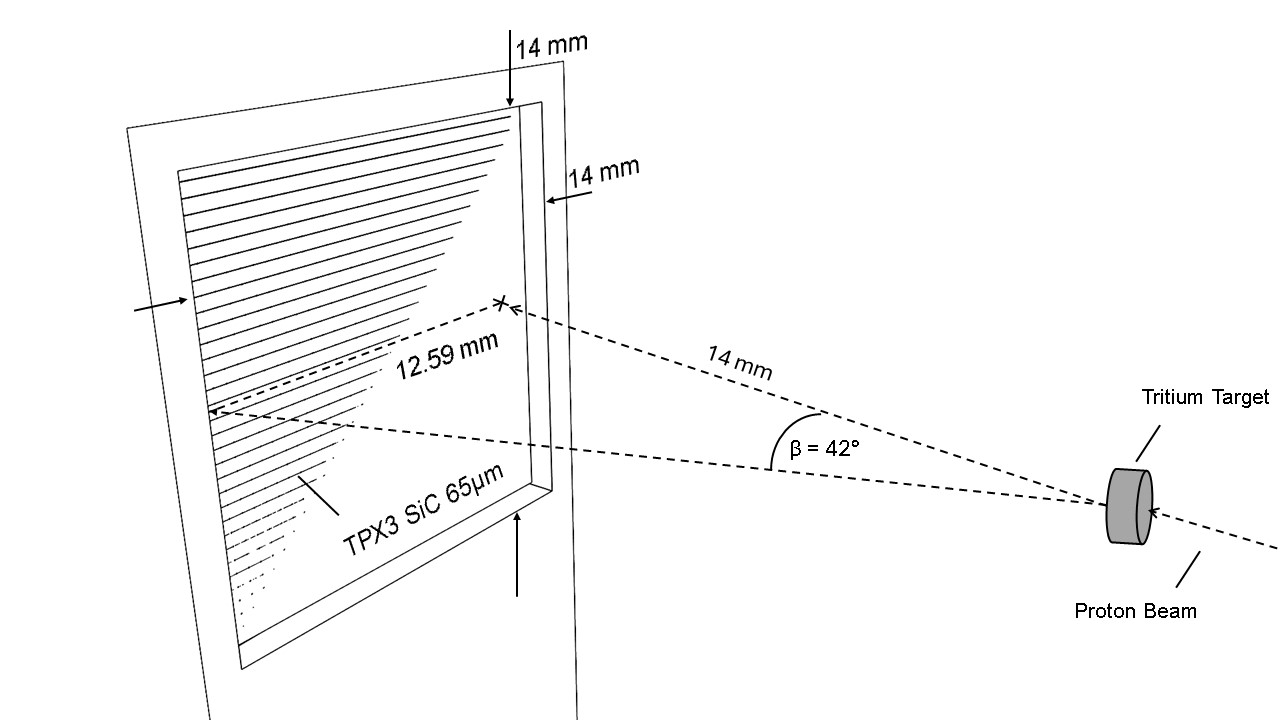
The cluster shape recognition in the SiC pixel sensor allowed for the identification of events corresponding to elastic scattering of neutrons on carbon and silicon nuclei, with a dominant contribution from the silicon scattering resonance at En≈565 keV. The resulting radial scattering patterns corresponding to elastic scattering of neutrons on Si and C were observed at the expected positions as the proton energy changed (Figure 2). The approach and results will be presented demonstrating that the proposed method allows for neutron spectrometry with energies in the range from 200 keV - 1 MeV even in complex n-gamma radiation fields.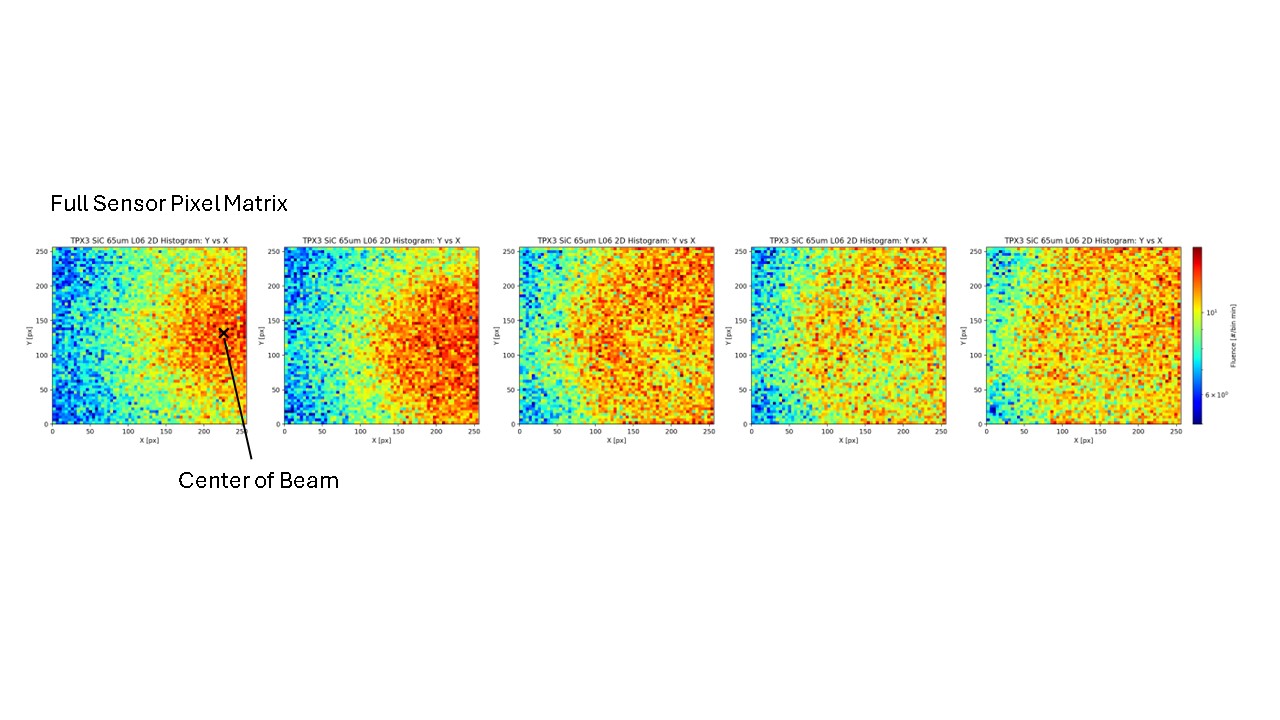
1 B. Zatko et al., From a single silicon carbide detector to pixelated structure for radiation imaging camera, JINST 17 (2022) C12005.
2 C. Granja et al., Detection resolving power of SiC Timepix3 detector to electrons, neutrons, ions and protons, JINST 19 (2024) C11007.
3 H. Liskien and A. Paulsen, Neutron production cross sections and energies for the reactions T(p,n)3He, D(d,n)3He, and T(d,n)4He, Nuclear Data Tables 11, 569-619 (1973)
[4] B. Bergmann et al., Ionizing energy depositions after fast neutron interactions in silicon, IEEE Transactions on Nuclear Science, Journal Name: IEEE Transactions on Nuclear Science Journal Issue: 4 Vol. 63; ISSN 0018-9499
[5] C. A. Bertulani, P. Danielewicz, Introduction to Experimental Nuclear Reactions, CRC Press, 2004
[6] L. Marek et al., Data Processing Engine (DPE): data analysis tool for particle tracking and mixed radiation field characterization with pixel detectors Timepix, JINST 19 (2024) C04026.
Acknowledgements: Work partially supported by funding grants APVV-22-0382 and DS-FR-24-0020 of the Slovak Research and Development Agency and funded by the EU NextGenerationEU program through the Recovery and Resilience Plan for Slovakia under the project No. 09I05-03-V02-00073.