Choose timezone
Your profile timezone:
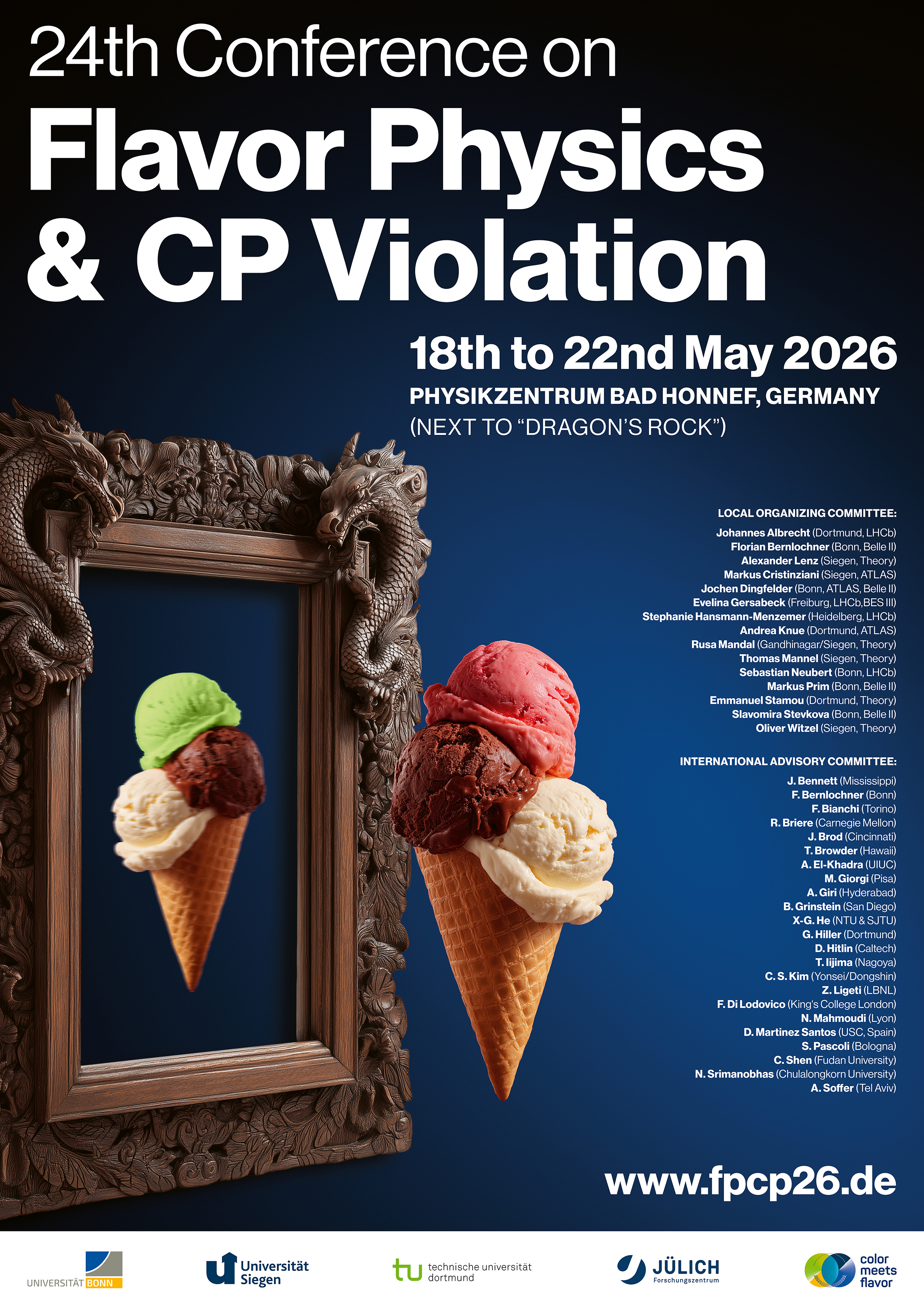
The Flavor Physics and CP Violation (FPCP) conferences are intended for the exchange of new ideas, for presentation of the latest experimental and theoretical results in the areas included in the conference title, and for discussions about future projects in the field. The conference is open
The conference is supported by the Collaborative Research Center TRR 257 and the DFG Cluster of Excellence Color meets Flavor :


I will review the status of rare semileptonic b-hadron decays
Since the discovery of the Higgs boson, no clear signatures of New Physics (NP) have been observed at the LHC. This absence suggests a separation between the scale of NP and the electroweak scale. In this scenario, Effective Field Theories (EFTs) provide a model-independent framework to analyze LHC and low-energy data and search for indirect signs of physics beyond the Standard Model (SM). In particular, Drell–Yan (DY) and Higgs production in association with a gauge boson (VH) are sensitive to NP effects, especially in the high-energy tails of differential kinematic distributions. These energy-enhanced effects enable the extraction of constraints that are competitive with those from flavor observables, such as semileptonic meson decays. In this talk, I will discuss how these processes can probe dimension-six Wilson coefficients in the Standard Model EFT, highlighting the complementarity between high- and low-energy probes. I will also show how the High-Luminosity LHC can shed light on existing flavor anomalies in the extraction of the Cabibbo angle. Furthermore, recent BESIII measurements of $q^2$-binned distributions in $D \to K\mu\nu$, together with the corresponding forward–backward asymmetry, show a mild tension with SM predictions. I will discuss viable NP scenarios that can alleviate this tension while remaining consistent with bounds from high-$p_T$ DY tails.
The LHCb experiment has recorded an unprecedented sample of $B\to K^{(∗)}\mu⁺\mu⁻$ decays during Run 1 and Run 2 of the LHC, enabling for the first time unbinned amplitude analyses of these transitions. Using a model for the strong-phase variation across the phase space, such analyses provide simultaneous determinations of both the real and imaginary parts of the relevant Wilson coefficients. This approach offers exceptional sensitivity to potential new-physics effects and provides insight into the role that hadronic contributions play in the long-standing flavour anomalies observed in $b\to s\mu⁺\mu⁻$ decays.
Charm decays offer a unique window into the dynamics of up-type quark transitions, and therefore stand as an important testing ground for the Standard Model (SM).
Predictions of $D$ mesons into hadronic final states, however, are notoriously challenging. A prospective method to study the amplitudes of such decays employs the approximate SU(3)$_F$ symmetry of QCD accounting for its linear breaking. In the context of SU(3)$_F$ analyses, decays into final states containing the mesons $\eta$ and $\eta’$ have either been neglected or added through a universal $\eta-\eta’$ mixing angle, which has been shown to be inconsistent. As the experimental precision improves, more careful consideration of the SU(3)$_F$ symmetry framework is required in order to interpret the data. In this talk, I will introduce a novel treatment of $\eta-\eta’$ mixing and its direct application to $D \to P \eta’$ decays, where $P = \pi, K, \eta$. I will present a global analysis with which we test the common assumption of 30% SU(3)$_F$ breaking. The results include predictions on branching ratios and CP asymmetries, highlighting their correlations and which measurements drive the tensions with respect to the SM assumptions.
The current experimental data on several observables in $b \to (s,d)\,\mu^+\mu^-$ transitions exhibit persistent deviations from Standard Model (SM) predictions. Motivated by the possibility that these anomalies originate from physics beyond the SM, we investigate a scenario in which a non-universal $Z^{\prime}$ boson provides the underlying new physics contribution. We consider a $U(1)_{B-3L_\mu}$ gauge extension of the Standard Model, which naturally induces additional interactions in the muon sector through generation-dependent gauge charges. Consequently, the associated $Z^{\prime}$ boson couples preferentially to muons providing a natural framework to address the observed deviations in muon-specific flavor observables. Additionally, the flavor-dependent couplings of the $Z^{\prime}$ to quarks can simultaneously affect non-leptonic observables, particularly the $L_{K^{*}\bar{K}^{*}}$ puzzle associated with rare $B_{s(d)} \to K^{*}K^{*}$ decays. Incorporating constraints from current measurements of $b \to (s,d)\mu^+\mu^-$ processes, we examine the implications of the $Z^{\prime}$ model for this non-leptonic observable and assess its potential to reconcile the existing tensions with experimental data.
The decays B->PP, where the pseudoscalar P is a pi or K, have been studied under the assumption of flavor SU(3) symmetry.
The global fit reveals a 3.6 sigma discrepancy with the Standard Model.
Separate fits for Delta S = 0 and Delta S = 1 decays find parameter sets that differ by a factor of 10, suggesting a flavor SU(3) breaking of 1000%, significantly larger than the 20% breaking expected in the Standard Model.
An extended study has been conducted, including final states with eta and eta' mesons.
The resulting global fit, once again under the assumption of flavor SU(3) symmetry, is worse, with a 4.1 sigma deviation from the Standard Model.
When theoretical constraints |C/T| = 0.2 or A = 0 are imposed, the fits worsen, with the discrepancy approaching 5 sigma.
These results provide strong evidence of new physics contributions in these decays.
However, before drawing such a conclusion, it is essential to include SU(3)_F breaking effects into the analysis to determine whether they can explain the observed discrepancy.
Light sterile neutrinos remain one of the most intriguing possibilities for physics beyond the Standard Model, motivated by persistent anomalies in short-baseline experiments such as LSND, MiniBooNE, and reactor measurements. In this work, we investigate the sensitivity of the future experiments MOMENT (medium baseline) and DUNE (long baseline) to light sterile neutrinos within the minimal 3+1 framework, highlighting the complementarity of their experimental setups.
We present a comprehensive analysis of active–sterile mixing constraints and, importantly, the CP-violation discovery potential. We derive exclusion limits and demonstrate the critical role of near detectors in significantly strengthening these bounds. Furthermore, we show that sterile neutrinos can impact CP-violation measurements by introducing additional phase degeneracies, particularly in long-baseline, high-energy experiments.
Our results reveal a strong complementarity between DUNE and MOMENT. While DUNE is sensitive to slow sterile oscillations and matter-enhanced effects, MOMENT retains robust sensitivity across a wide range of sterile masses. It is particularly effective at disentangling CP-phase correlations. Together, these experiments can probe regions of sterile-neutrino parameter space that remain weakly constrained by current global data.
The Super Tau-Charm Facility (STCF) is a new-generation high-luminosity electron-positron collider proposed in China. It will operate in an energy range of 2-7 GeV with a luminosity higher than 0.5*10^35 cm^2 s^-1 at 4 GeV. The STCF can produce a large number of hadrons and tau leptons in a clean environment, serving as a unique and powerful tool for studying how quarks form hadrons to understand the quark confinement, as well as revealing the mystery of the space-time symmetry of fundamental interactions with unprecedented precision. The STCF physics program covers a broad spectrum of physics topics, placing stringent demands on the performance of the STCF accelerator and detector. The STCF detector and accelerator conceptual designs have been completed and published. A full accelerator and detector technology R&D program was established and has been progressing rapidly. In this report, the STCF physics program will be introduced following an overview of the STCF project. The STCF accelerator and detector conceptual designs and R&D progress will then be presented.
Inclusive non-leptonic $B$-meson decays provide a key testing ground for the Standard Model (SM) and for searches for new physics in the flavour sector. In the framework of the Heavy Quark Expansion (HQE), decay widths are expressed in powers of $1/m_b$, where subleading terms become increasingly important as experimental precision improves.
In this talk, I present recent progress toward a more precise theoretical description of inclusive non-leptonic B-meson decays. This includes the computation of dimension-7 two-quark operators corrections in the SM and dimension-6 Darwin-term contributions arising both from SM QCD-penguin operators and from general BSM four-quark operators. I discuss the structure of these subleading contributions and their relevance for achieving a more precise and consistent description of inclusive $B$-meson decays in and beyond the SM.
With the large datasets on 𝑒+𝑒−-annihilation at the 𝐽/𝜓 and 𝜓(3686) resonances collected at the BESIII experiment, multi-dimensional analyses making use of polarization and entanglement can shed new light on the production and decay properties hyperon-antihyperon pairs. In a series of recent studies performed at BESIII, significant transverse polarization of the (anti)hyperons has been observed in 𝐽/𝜓 or 𝜓(3686) to ΛΣ-bar , ΣΣ-bar , ΞΞ-bar .The decay parameters for the most common hadronic weak decay modes were measured, and due to the non-zero polarization, the parameters of hyperon and antihyperon decays could be determined independently of each other for the first time. Comparing the hyperon and antihyperon decay parameters yields precise tests of direct, Δ𝑆 = 1 CP-violation that complement studies performed in the kaon sector.
We utilize the universality of pion--pion ($\pi\pi$) final-state interactions at small invariant masses to understand their enhanced local CP violation in $B^\pm\to K^\pm\pi^+\pi^-$, using a dispersive approach. From the integrated CP-asymmetry data, we predict the Dalitz-plot kinematic distribution of the asymmetry in the low-energy $\pi\pi$ region, including the large local CP violation recently observed by LHCb. An essential role is played by the contributions of isospin 2. This formalism, whose parameters have a physical meaning, should be easy to implement in other systems with CP violation enhanced by final-state interactions.
The $K^{+}\rightarrow\pi^{+}\nu\bar{\nu}$ decay is a golden mode for flavour physics. Using data collected in 2016--2022, NA62 announced the first observation of this decay with a signal significance above $5\sigma$ and the measurement $\mathcal{B}(K^{+}\rightarrow\pi^{+}\nu\bar{\nu}) = \left( 13.0^{+ 3.3}_{- 3.0} \right)\times10^{-11} $. New results from the analysis of the 2023--2024 dataset are presented. This dataset doubles the effective sample size, leading to a $5\sigma$ expected sensitivity for the Standard Model process. Reconstruction and selection algorithms have been improved, boosting sensitivity and reducing the background contamination. An updated measurement of the branching ratio is presented and prospects for the full 2016--2026 dataset are discussed. Results from searches for physics beyond the Standard Model using kaon and pion decays are also presented. These include searches for the decays $K^{+}\rightarrow\pi^{+}X$, probing hidden-sector particles such as dark photons, scalars and axion-like particles, and $\pi^{+}\to e^+N$, constraining the production of heavy neutral leptons in pion decays. Stringent limits on branching ratios, couplings and mixing parameters are reported.
Ultralight dark matter, with masses much below 1 eV, can be searched for using time oscillations of Standard Model parameters. Inspired by a recent construction of a model of ultralight dark matter that solves the strong-CP problem using the Nelson-Barr mechanism, I will present the phenomenology of oscillating CKM matrix elements at flavour factories, with particular emphasis on the K factory NA62. I also present a sketch of a class of models that evade the stringent constraints due to equivalence principle violation that plague the original model.
The total decay widths of heavy mesons can be systematically calculated
in terms of an expansion in the two parameters $1/m_Q$ and
$\alpha_s(m_Q)$, where $Q=c,b$ denotes the heavy quark. The dominant
contributions to meson lifetime splittings stem from terms which are
suppressed by $1/m_Q^3$ with respect to the leading universal contribution
to the total decay width. We calculate three-loop contributions of
order $\alpha_s^2/m_q^3$ to the lifetime ratios $\tau(B^+)/\tau(B_d^0)$, $\tau(D^+)/\tau(D^0)$,
and $\tau(D_s^+)/\tau(D^+)$ in the limit of exact isospin and U-spin
symmetry, respectively. Furthermore, we present new $\alpha_s/m_q^3$
corrections to the Cabibbo-suppressed terms in $\tau(B^+)/\tau(B_d^0)$.
New decay modes of $B$-meson into a baryon and invisible dark antibaryon $\Psi$ are among the most distinctive signatures of the $B$-mesogenesis scenario. We concentrate on the proton mode and consider two versions of the underlying interaction of $\Psi$ with quarks, the so-called models $(d)$ and $(b)$. To estimate the width of the $B^+\to p \Psi $ decay, we obtain the $B^+\to p$ transition form factors, applying QCD light-cone sum rules (LCSRs) with $B$-meson distribution amplitudes with an accuracy up to twist-5, while interpolating the proton with a current. This method is independent of the previously applied one, which was based on the nucleon distribution amplitudes. We estimate the partial width of the $B^+\to p \Psi $ decay as a function of the dark antibaryon mass. Furthermore, we use the ratio of this width to the inclusive $B\to X_N \Psi $ width, the latter predicted earlier using the heavy quark expansion method. This ratio, which is independent of the effective coupling, when combined with the minimal inclusive branching fraction of $O(10^{-4})$, necessary for the feasibility of $B$ mesogenesis,yields lower limits on the $B^+\to p \Psi$ branching fraction. We confront these limits with the most recent upper bounds obtained from BaBar and Belle/Belle II searches for the decays of $B^+$-meson into a proton and missing energy. The comparison indicates that experimental upper bounds on the branching fraction of $B\to p \Psi $ at the level of $10^{-8}-10^{-7}$ are needed for a decisive probe of this invisible mode of $B$ decays.
The Belle and Belle II experiments have collected a $1.2~\mathrm{ab}^{-1}$ sample of $e^+ e^-\to B\bar{B}$ collisions at a center-of-mass energy corresponding to the $\Upsilon(4S)$. The study of hadronic $B$ decays in these data allows the precise measurement of absolute branching fractions and angular distributions of the decay products. We present an amplitude analysis of three-body charmless decays $B\to K\pi\pi$ that provide the inputs to a sum rule in the $B\to K^*\pi$ system, analogous to the one in the $B\to K\pi$ system related to the so-called ``$K\pi$ puzzle''. We present a search for the decay $B\to K^+K^-\pi$. We present the observation of the decays $B^+\to \Sigma_c(2455)^{++} \Xi_c^-$ and $B^0\to \Sigma_c(2455)^0 \Xi_c^0$ and searches for the decays $B^+\to \Sigma_c(2455)^{++} \Xi_c^{-'}$ and $B^0\to \Sigma_c(2455)^0 \Xi_c^{0'}$, and the inclusive decay $B\to \Omega_c X$. We also present a search for the decays $B\to D^{(*)}\eta\pi$. These decays are related to $B\to D^{(*)}\eta\ell\nu$ decays, which could contribute to the gap modes in semileptonic $B$ decays.
The Belle and Belle II experiments have collected a $1.6~\mathrm{ab}^{-1}$ sample of $e^+e^-$ collision data at center-of-mass energies near the $\Upsilon(nS)$ resonances. These samples contain a large number of $e^+e^-\to c\bar{c}$ events that produce charmed mesons and baryons. We present new results including the observation of the radiative decay $D_s(2317)^+ \to D_s^* \gamma$, a search for the electroweak penguin decay $D^+\to \pi^+ e^+e^-$, and a partial-wave analysis of the decay $\Xi_c^+\to \Xi^-\pi^+\pi^+$. Direct $C\!P$ violation is searched for in $D^0\to \pi^+\pi^-\pi^0$ decays and $D^+\to \pi^+\pi^0$ decays. We also present results on $C\!P$ violation in the charm baryon decays $\Xi^+_c\to \Sigma^+h^+ h^-$ and $\Lambda_c^+\to ph^+ h^-$.
The COMET (COherent Muon to Electron Transition) experiment, conducted at J-PARC (Japan Proton Accelerator Research Complex) using a high-intensity muon beam, aims to search for the neutrinoless conversion of a muon into an electron in the field of an atomic nucleus, where the nucleus remains in its ground state, and the electron is emitted with an energy close to the muon mass, slightly reduced by binding and recoil effects, producing a distinct experimental signature that helps separate signal from background processes such as ordinary muon decay in orbit.
The goal of the experiment is to probe the possibility that μ⁻N → e⁻N conversion occurring at rates far below current experimental limits by improving single-event sensitivity of μ⁻N → e⁻N conversion, 10^-15 in the first phase of the experiment and 10^-17 in the second phase. This process, if observed, would be clear evidence of charged lepton flavour violation and point to the physics beyond the Standard Model.
This talk will provide an overview of the experimental concept, current status on detector subsystems and facility construction as well as future prospects of COMET, highlighting its role in the global effort to uncover physics beyond the Standard Model.
Beauty-to-open-charm decays provide a rich laboratory for studying CP violation, including but not limited to precise measurements of the CKM angle gamma in tree-level B -> D0 h decays, where h denotes a kaon or pion; studies of CP violation in mixing and from potential new physics in Bs -> Ds pi decays; and searches for direct CP violation in double-charm decays. This talk will present recent progress at LHCb.
While CP violation (CPV) is well established in meson decays, its observation in baryon decays remains an open challenge. The LHCb experiment, designed to study CP violation in particles containing bb quarks, has collected an unprecedented dataset, offering a unique opportunity to probe CP asymmetries in baryon decays. This talk will present the latest LHCb results on CPV in baryon decays, with a focus on charmless beauty decays.
Semileptonic b-hadron decays proceed via charged-current weak interactions and provide a powerful laboratory for precision tests of the Standard Model. Their experimental reach benefits from large branching fractions and clean signatures, while theoretical interpretations rely on increasingly robust determinations of the relevant hadronic form factors. Measurements of these modes constrain key Standard Model parameters and dynamics, including CKM matrix elements and b-hadron production properties. This contribution presents a selection of recent LHCb results on charged-current semileptonic b-hadron decays and highlights their impact on current phenomenology.
The NA62 experiment at CERN, designed to measure the highly-suppressed decay $K^{+} \to \pi^{+}\nu\bar{\nu}$, has the capability to collect data in a beam-dump mode, where 400~GeV protons are dumped on an absorber. In this configuration, New Physics particles may be produced in the absorber and decay in an instrumented volume beginning approximately 80 m downstream of the dump. Preliminary results from a search for Heavy-Neutral leptons decaying in flight to semi-leptonic final states are reported, based on an analysis of a sample of $6.2 \times 10^{17}$ protons on dump collected in 2021, 2023, and 2024.
The Belle and Belle II experiment have collected samples of $e^+e^-$ collision data at center-of-mass energies near the $\Upsilon(nS)$ resonances. These data have constrained kinematics and low multiplicity, which allow searches for dark sector particles in the mass range from a few MeV to 10 GeV. We present new searches in a $600~\mathrm{fb}^{-1}$ sample collected by Belle II, including searches for a light dark photon decaying to a pair of muons, an axion-like particle decaying to two photons, and a $Z^{\prime}$ boson that decays invisibly. Using a $711~\mathrm{fb}^{-1}$ sample collected by Belle, we search for $B\to h + \mathrm{invisible}$ decays, where $h$ is a $\pi$, $K$, $D$, $D_{s}$ or $p$, and $B\to Ka$, where $a$ is an axion-like particle.
The Compressed Baryonic Matter (CBM) experiment at the Facility for Antiproton and Ion Research (FAIR) is dedicated to studying the properties of strongly interacting matter under extreme conditions. Operating with the SIS100 synchrotron, which accelerates protons up to 29 GeV and heavy ions up to 10 GeV/nucleon, the experiment will reach unprecedented interaction rates of up to 10 MHz. These extraordinary beam intensities and the resulting extreme particle fluxes strictly demand highly radiation-hard detector technologies. Under these harsh conditions, precise online monitoring of instantaneous luminosity and beam background is critically important to ensure safe and stable data taking. Drawing on the extensive experience of the Institute of Nuclear Research (NASU) in the field of metal foil detectors (MFD), the technology for which was utilised in the development of Radiation Monitoring System (RMS-R3) for the LHCb experiment, we present the development of a novel monitoring system adapted for the CBM setup.
The primary objective of this work was to adapt the established MFD technology to the specific geometric, constraints and severe radiation environment of the CBM setup. The methodology included 3D modeling of the detector modules, Monte Carlo simulations to estimate theoretical sensitivity, and LTspice simulations to optimize the front-end electronics. Based on these designs, functional prototypes were successfully assembled. Comprehensive laboratory testing was conducted, including baseline stability measurements and detector response evaluation using a radioactive source. The obtained results confirmed the operability, high precision, and stability of the new modules, proving that the developed MFD-based prototypes offer a reliable solution for online radiation monitoring in the CBM experiment.
The PADME experiment at the Frascati National Laboratory of INFN has performed a
search for the hypothetical X17 particle, by observing the product of the collisions
of the positron beam from the BTF facility of LNF on a diamond fixed target.
The beam energy has been varied in the range
265–300 MeV, corresponding to values of √s between 16.4 and 17.5 MeV,
completely covering the CoM region identified by the
ATOMKI collaboration as significant for observing the postulated X17 particle.
The result of the analysis shows an about 2-sigma excess corresponding to the mass indicated by
the ATOMKI experiment. A new data taking campaign, with an improved detector
has been carried out during the summer and fall of 2025, with the aim of pushing forward the
sensitivity of the search.
We present a study of the rare baryonic decay $\Lambda_b \to \Lambda \tau^+ \tau^-$ as a probe of new physics (NP) coupled preferentially to third-generation fermions. Within the Standard Model, we evaluate the branching ratio and the lepton-flavour-universality (LFU) ratio $R_{\Lambda}^{\tau/\mu}$, including both perturbative and long-distance charm contributions. We show that the LFU ratio can be predicted with an uncertainty below 10%. Possible NP effects arising from lepton non-universal dynamics are analysed within an effective field theory framework motivated by the current anomalies in $b \to c\tau\nu$ and $b \to s\mu^+\mu^-$ transitions. In this context, $R_{\Lambda}^{\tau/\mu}$ can be enhanced by several orders of magnitude, offering a clear target for upcoming searches. The implications for the related mode $\Lambda_b \to pK\tau^+\tau^-$ are also briefly discussed.
To search for physics beyond the Standard Model (BSM) some of the most promising and sensitive observables are constituted by flavour-changing neutral-current $B$-meson decays mediated by $b \to s \ell \ell$ transitions. While several hints for deviations from the Standard Model have emerged over the recent years, it has also become clear that a more thorough theoretical understanding of non-local charm-loop effects, possibly mimicking BSM physics, is mandatory to turn these hints into robust results. To achieve this, experimental inputs can be combined with the fundamental principles of unitarity and analyticity via dispersive techniques to constrain the non-local hadronic form factors as tightly as possible. In our work we demonstrate that the expected analytic structures of these form factors, in particular including anomalous thresholds, can also be found in and matched onto perturbative partonic calculations. This further justifies the use of quark–hadron duality to provide additional theoretical constraints.
Theory predictions of heavy-hadron lifetime ratios critically depend on precise determinations of the dimension-six spectator effects arising from the double insertion of the weak effective $|\Delta B| = 1$ Hamiltonian.
In the presence of beyond-standard-model (BSM) operators, the resulting $\Delta B = 0$ Hamiltonian features additional four-quark operators whose matrix elements need to be determined using non-perturbative methods.
We present for the first time results for the non-perturbative hadronic matrix elements of the four-quark operators relevant for the description of the meson lifetime ratio $\tau\left(B^+\right) / \tau\left(B_d\right)$, obtained using heavy-quark effective theory (HQET) sum rules with the full BSM effective Hamiltonian.
In addition, we recompute and update the bag parameters for the Standard Model operators.
We present updated predictions for the lifetimes of doubly heavy baryons, incorporating newly computed $\alpha_s$ corrections within the heavy quark expansion. While both the operator product expansion and the perturbative $\alpha_s$ series exhibit good convergence in the $b$-quark sector, we discuss potential issues related to their convergence in charm decays. Numerical predictions are provided for doubly bottom baryons ($\Xi_{bb}^0$, $\Xi_{bb}^-$, $\Omega_{bb}^-$), doubly charm baryons ($\Xi_{cc}^{++},\,\Xi_{cc}^+,\,\Omega_{cc}^+$), and $bc$ baryons ($\Xi_{bc}^+$, $\Xi_{bc}^0$, $\Omega_{bc}^0$). In particular, future measurements of $bc$ baryon lifetimes may offer valuable insight into their internal spin structure; accordingly, we present results for the two possible spin configurations.