Speaker
Description
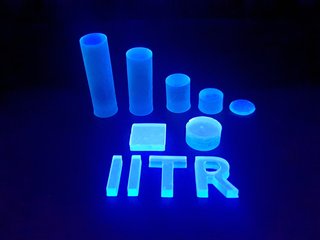
The advent of additive manufacturing has opened new avenues in the fabrication of radiation detectors with complex and application-specific geometries, overcoming limitations of traditional thermal polymerization in terms of shape, scalability, and cost. In this contribution, we will present the formulation, fabrication, and comprehensive characterization of plastic scintillators produced using Digital Light Processing (DLP)-based 3D printing, and evaluate their applicability in radiation detection, and as filler components in hetero-structured scintillators for Time-of-Flight Positron Emission Tomography (TOF-PET).
The 3D-printed scintillators, formulated using a combination of vinyl toluene and a photo-curing monomer as base doped with 2,5-diphenyloxazole (PPO), demonstrates excellent optical and timing performance. Emission spectra centered at 427 nm, decay times as low as 1.52 ns, and a rise time of 0.88 ns are measured, outperforming commercial plastics such as EJ-200 in timing response. A light output of up to 70% of
EJ-200 is achieved depending on PPO loading and co-monomer composition. The plastics also exhibit good linearity in response to α, β, and γ radiation. Good pulse shape discrimination (PSD) performance using a 252Cf source is achieved (FoM=1.55), which is critical for security and nuclear nonproliferation applications. Additional studies are performed to investigate performance optimization and long-term stability. Ethanol post-treatment effectively mitigates dye leaching at high PPO concentrations, ensuring optical clarity and stable light output. Surface polishing has minimal effect on light output, indicating the feasibility of using as-printed surfaces for complex detector designs. Increasing layer thickness during printing reduces internal scattering, improving light output. Long-term stability tests show less than 5% degradation in light output over six months, supporting their deployment in field environments.
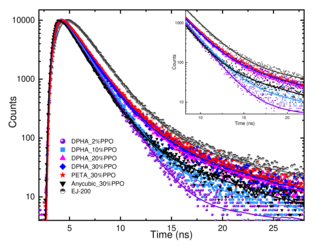
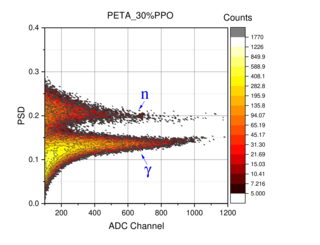
Geant4 Monte Carlo simulations are conducted to validate the advantages of 3D-printed scintillators as filler materials in hetero-structured detector designs for ToF-PET. The simulations of complex sinusoidal plastic fillers embedded in dense matrices (e.g., BGO) demonstrate up to 12% improvement in equivalent stopping power and 20% enhancement in energy sharing for sinusoidal designs compared to straight geometries. These results underscore the advantages of using 3D printing to fabricate complex filler geometries that are otherwise impractical with conventional methods. Prototype sinusoidal scintillators are 3D-printed as a proof-of-concept. Coincidence Time Resolution (CTR) is measured using a γ–γ setup with a 22Na source, yielding a CTR of 225±12 ps, compared to 210±13 ps of EJ-200 measured under the same conditions, thereby validating the suitability of the 3D-printed scintillator as a fast-timing filler in heterostructures.

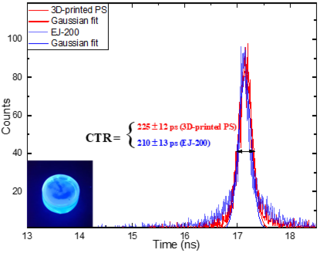
Interesting preliminary results on the radiation hardness of scintillators under γ-ray irradiation will also be presented, demonstrating their potential for long-term deployment in high-radiation environments.
Our findings highlight the viability of 3D-printing as a versatile and cost-effective tool for producing fast, stable, and application-tailored plastic scintillators. These developments mark a significant step towards next-generation radiation detection systems with improved performance, modularity, and design freedom.
References:
- V. Anand, et al, "Development and Characterization of Digital Light
Processing-Based 3D-Printed Plastic Scintillator for Radiation
Detection," in IEEE Transactions on Nuclear Science, vol. 72, no. 6,
pp. 1947-1958, June 2025, doi: 10.1109/TNS.2025.3567872 - V. Anand, et al., "3D-Printed Plastic Scintillator: A Potential
Avenue for Hetero-structured Radiation Detectors," in IEEE
Transactions on Nuclear Science, doi: 10.1109/TNS.2025.3580284
| Position | PhD Research Scholar |
|---|---|
| Affiliation | Indian Institute of Technology Roorkee |
| Country | India |