Choose timezone
Your profile timezone:
|
The TIPP conference series started in Tsukuba, Japan in 2009 and followed by multiple such wonderful conferences focusing on all the areas of detector development and Instrumentations in physics. The upcoming TIPP conference is going to held at the Tata Institute of Fundamental Research (TIFR) Mumbai, India during Feb 2 to 6, 2026. Conference details are given in web page https://www.tifr.res.in/tipp2026 Registration fee for the conference is accepted only in Indian Rupee (INR). The registration fee is 45260 INR, which is equivalent to 450 EURO (based on the conversion rate as on 4th July 2025, 1EURO=100.58INR) provided the payment is made before 5th Dec 2025. Extra charge of 100 EURO will be added for late payment and will be accepted till 31st December 2025. Registration fee for the accompanying person is 22630 INR. A Confirmation of registration will be sent by email after the payment is completed. Partial waiver of registration fee and hostel accommodation may be available for limited participants, where preference will be given to the needy students. Please, write to the organiser after submitting the registration form. A valid stamped visa is required to enter TIFR premises for all foreign nationalities. Please wait for the invitation letter to apply for a stamped conference VISA. E-VISA holders are not allowed to enter TIFR premises. |
|
As part of the Wireless Allowing Data and Power Transfer (WADAPT) consortium, we have undertaken a pioneering study to explore the feasibility of using laser-based wireless power systems in experimental setups. The study centers around a 10W laser coupled with a dedicated photovoltaic cell (PVC), designed to convert laser energy into electrical power efficiently. The system was rigorously tested at varying distances between the laser source and the PVC to understand the influence of distance on power transmission efficiency and over-
all performance.
To ensure practical application, the system was successfully integrated with a voltage and power regulator, enabling it to power a silicon photomultiplier (SiPM). The SiPM, known for its sensitivity and precision in detecting low levels of light, is a critical component in many high-energy physics experiments. Using a precise light source, we conducted a comprehensive series of tests to evaluate how this novel power source affects the sensor’s performance. Key parameters such as power conversion efficiency, noise levels, signal stability, and overall sensor functionality were carefully analyzed to ensure that the wireless power system meets the rigorous demands of experimental physics.
The results of this groundbreaking demonstration of wireless power
transmission for a silicon sensor will be presented, highlighting its potential to transform the way power is delivered in complex experimental environments.
The Spin Physics Detector (SPD) has been designed to enable comprehensive studies of both unpolarized and polarized components of the nucleon. Its primary objective is to measure the polarized gluonic structure of protons and deuterons through the production of charmonium, open charm, and direct photons. The detector is situated at one of the two interaction points of the new NICA collider complex at the Joint Institute for Nuclear Research in Dubna. The collider is anticipated to receive its first hadron beam by late 2025. It aims to reach a luminosity of 1032 cm-2 s-1 for colliding proton-proton beams at their maximum collision energy of 27 GeV. In its final configuration, the inner region of the SPD detector will include a silicon vertex tracker and a straw tube drift chamber. Charged particle identification for momenta up to 1 GeV/c will be performed using a time-of-flight system. Higher-momentum particles, up to 6 GeV/c, will be identified via focusing aerogel Cherenkov detectors placed in the endcaps. These systems are embedded within a shashlyk-type electromagnetic calorimeter for measuring electromagnetic showers. Two pairs of plastic scintillator beam-beam counters provide measurements for local polarimetry and luminosity control. All these detector elements are encased inside a superconducting solenoid magnet, providing a magnetic field strength of 1.2 Tesla in the center. Additionally, the steel yoke surrounding the magnet is instrumented with mini drift tubes for detecting muons and neutral hadrons. This presentation provides an overview of the ongoing development of the detector's design. Commissioning activities are scheduled in two phases, with initial data collection planned toward the end of this decade.
Crilin is an innovative semi-homogeneous electromagnetic calorimeter designed as the baseline solution for the MUSIC detector at the future Muon Collider.
Its architecture features multiple layers of Lead Fluoride (PbF$_2$) crystals, each read out by an array of UV-extended SMD Silicon Photomultipliers (SiPMs).
The detector is engineered to withstand the demanding conditions of the collision environment: it is compact, longitudinally segmentable with adjustable depth depending on the application, fast, and radiation-tolerant.
Crilin’s high-granularity structure, featuring a 13 mm transverse cell size and a 4 X$_0$ layer depth in the Muon Collider configuration, is essential for disentangling the physics signal from the intense beam-induced backgrounds (BIB). Simulations predict that the BIB consists mainly of photons with low average energy, requiring precise timing and fine segmentation to suppress out-of-time background contributions. To address this, Crilin leverages the fast Cherenkov response of PbF$_2$ crystals for accurate time-of-arrival measurements, enabling effective background rejection and supporting full 5D particle flow reconstruction with high jet energy resolution. The detector must operate in a harsh radiation environment, facing up to 10 kGy/year of Total Ionizing Dose (TID) and neutron fluences of 10$^{14}$ n$_{1MeVeq}$/cm$^2$/year. Extensive radiation hardness studies on both the crystals and the SiPMs have validated the chosen design up to these target conditions.
A prototype (Proto-1), composed of two layers of 3$\times$3 crystals, has undergone comprehensive testing and demonstrated a timing resolution better than 50 ps for energy deposits down to 1 GeV. The mechanical layout, front-end electronics, and test beam results of this prototype are discussed in detail.
Ongoing R&D is focused on developing a full-containment prototype comprising five layers of 7$\times$7 crystal matrices. While beam tests of this advanced version are planned for Spring 2026, preliminary results from a smaller-scale prototype, incorporating key mechanical and electronic upgrades, will be presented.
The SiSMUV (SiPM-based Space Monitor for UV-light) project develops a compact, modular ultraviolet detector for space-based astroparticle telescopes. Each unit integrates a SiPM matrix, custom ASIC-based front-end electronics, and FPGA logic for local control, triggering, and real-time data processing. This architecture achieves low power consumption, reduced mass, and modular scalability—key requirements for focal surface instruments in future missions targeting fluorescence and Cherenkov emission from cosmic rays.
The current prototype employs Hamamatsu S13361-3050 SiPM arrays, a RADIOROC ASIC with per-channel bias tuning and dual-gain capability, and a Xilinx Artix FPGA. The system provides fine gain calibration, sub-photoelectron triggering, and linearity up to 2000 photoelectrons. The mechanical design supports spherical focal surfaces, withstands launch stresses, and operates under extended thermal-vacuum conditions. Signal routing via micro-coaxial cabling minimizes dead area, enabling dense packing of detector modules.
Functional characterization with a dark-box setup, integrating sphere, and pulsed laser confirms photon detection efficiency in agreement with specifications and validates gain, crosstalk, and afterpulse performance. Parallel Geant4 simulations, benchmarked with prototype data, further support detector modeling and response studies.
Initially conceived as a technology demonstrator, SiSMUV is now under consideration for integration into the Cherenkov Camera of the POEMMA-Balloon with Radio mission. Its modularity, robustness, and high sensitivity make it a promising solution for next-generation space-based UV and Cherenkov detectors.
The ALICE Collaboration has proposed a completely new apparatus, ALICE 3, for LHC Run 5. ALICE 3 will be an all-silicon, ultra-low-mass detector capable of tracking over a large pseudo-rapidity range with excellent pointing resolution, particle identification, and high-speed capabilities, based on the state-of-the-art technologies and innovative detection approaches. This design will give access to an ultra-soft region of phase space, allowing the measurement of very low transverse momentum lepton pairs, photons, and hadrons, enabling novel studies of the quark–gluon plasma as well as other key questions in QCD and beyond.
The apparatus is centered on a large, ultra-low-mass, all-silicon tracker consisting of pixel-based layers arranged to achieve the best possible impact parameter resolution for decay vertex reconstruction. The vertex detector is designed to be integrated into a retractable structure inside the beam pipe, and cutting-edge technologies are being developed to achieve a track-point resolution better than 10 microns for particles with transverse momentum above 200 MeV/c. Particle identification over a broad momentum range is provided by a Time-Of-Flight (TOF) detector in combination with an aerogel-based Ring-Imaging CHerenkov detector (RICH) covering barrel and end-cap regions, as well as a dedicated Muon IDentifier (MID). The compact design of the experiment imposes stringent requirements on the TOF system, including a time resolution of 20 ps, which exceeds the capabilities of current state-of-the-art silicon-based technologies. Additionally RICH detector faces challenges related to the radiation tolerance of the silicon sensors and noise mitigation through innovative techniques. The ambitious R&D effort required to meet these stringent technological demands is not only crucial for ALICE 3 but will also drive innovation in silicon detector technologies with broad applicability in future applications and experiments in High-Energy Physics and beyond.
This contribution will present a comprehensive overview of the future ALICE 3 apparatus, focusing on the innovative detector concept and on the ongoing R&D efforts: key results and future directions in the development of the main technologies under investigation will be outlined.
The High Granularity Calorimeter (HGCAL) will replace the existing Calorimeter Endcaps of the CMS detector as part of the upgrade program for HL-LHC. Proposed for the High Luminosity era, HGCAL’s design addresses its challenges by taking advantage of the radiation tolerance of silicon sensors and advances in the fields of mechanical and electrical engineering. Two main areas of the calorimeter – the electromagnetic and the hadronic sections – are made up of interchanging layers of dense absorber and active sensor. In addition, each active layer is further divided into smaller segments, making the whole structure a highly granular imaging calorimeter. Active layers of the whole electromagnetic section and part of the hadronic section consist of silicon cells smaller than 1 $cm^2$. The rest of the calorimeter is constructed using small scintillator tiles (4 – 30 $cm^2$) coupled to silicon photo-multipliers – the SiPM-on-tile technology. The two sections make up more than 6 million cells, which are small enough to provide good signal-to-noise ratio throughout the detector’s lifetime. The HGCAL will be operated at -30°C to keep the electronics noise sufficiently low. The fine segmentation provides the ability for reconstruction of narrow jets and pile-up rejection, further aided by the timing capabilities of the silicon sensors. The SiPM-on-tile technology is a cost effective method to achieve high granularity in the region of the detector, where the estimated radiation levels do not exceed a fluence of 8x$10^{13}$ $n_{eq}$/$cm^2$. For this region, 280 000 scintillator tiles are being produced, characterized and assembled into the sensitive layer units – tile modules – in the collaborative efforts of US and German institutes. Tile module production is ongoing and estimated to be complete at the end of 2026. In the talk, general design, as well as the status of production of the SiPM-on-tile components will be discussed.
The Water Cherenkov Test Experiment (WCTE) is a prototype water Cherenkov detector built as a testbed for the Intermediate Water Cherenkov Detector (IWCD) of the Hyper-Kamiokande (Hyper-K) experiment. It is equipped with 97 multi-PMTs (mPMTs) and was operated at the CERN East Area T9 beamline between October 2024 and June 2025. The WCTE detector was tested with a sub-GeV beam of electrons, muons, pions and tagged photons. These data will provide essential input on sub-GeV particle behavior in water Cherenkov detectors, supporting future efforts in electron/gamma separation, pion identification, and high-efficiency electron/muon discrimination, relevant not only to IWCD but also to experiments such as ESSnuSB. This presentation will provide an overview of the WCTE detector, its deployment timeline, key operational insights, and the physics goals of the test beam campaign. Preliminary results from the ongoing WCTE data analysis will also be presented.
The Apparatus for Mesons and Baryon Experimental Research (AMBER, NA66) is a high-energy physics experiment at CERN’s M2 beam line, with a broad physics program extending beyond 2032. Its goals include studies of antiproton production cross-sections on protons, helium, and deuterium; the proton charge radius; and Kaon and Pion PDFs via the Drell–Yan process.
As part of medium- and long-term upgrades, the aging Multi-Wire Proportional Chambers (MWPCs) will be replaced with Micro-Pattern Gaseous Detectors (MPGDs). The chosen technology is the resistive bulk MICRO-MEsh GAseous Structure (Micromegas, MM). The MM detector, composed of three independent modules, will cover an acceptance comparable to the present MWPC, with each module featuring an active area of 1 × 0.5 m², making it a large area resistive bulk MM. Each detector includes two readout planes in a face-to-face configuration, enabling XUV coordinate measurements. Cathodes are implemented on a 500 µm-thick central PCB. For the lateral modules, a uniform 10 MΩ/sq Diamond-Like Carbon (DLC) resistive layer is used.
The first full-size prototype of the lateral module was produced in October 2024, together with the mechanical structure. Tests comprising in-beam operation are currently ongoing both at CERN and in Torino.
In parallel, a 64-channel mixed-signal front-end ASIC, named ToRA (Torino Readout for AMBER), is being developed at INFN Torino, optimized for AMBER’s large-area Micromegas (LMM) detector while also foreseeing suitability for wire gaseous detectors such as the MWPC trackers. The chip will provide time and energy measurements, building upon results from simulations and earlier Micromegas tests with TIGER ASIC-based electronics. First characterization tests of the ToRA ASIC are expected to start in September 2025. The ASIC characterization will be carried out with a dedicated custom data acquisition system based on the Genesys2 FPGA board. This system will serve as the basis for the development of a stand-alone DAQ architecture for AMBER’s LMM detector. Finally, this DAQ will represent the starting point for the integration of the LMM readout into the global AMBER data acquisition system.
Current efforts focus on characterizing detector performance, noise behavior, and integration with the ToRA ASIC. Both detector and readout system developments will be presented.
In 2024 the Belle II experiment resumed data taking after its Long Shutdown 1, which was required to install a two-layer pixel detector and upgrade components of the accelerator. We describe the challenges of this upgrade and report on the operational experience during the subsequent data taking. With new data, the SVD confirmed high hit efficiency, large signal-to-noise and good cluster-position resolution. SuperKEKB’s instantaneous luminosity is expected to increase significantly, resulting in a larger SVD occupancy caused by beam-related background. Considerable efforts have been made to improve the SVD-reconstruction software by exploiting the excellent SVD hit-time resolution to determine the collision time and reject out-of-time hits caused by the beam-related background. A novel procedure to group SVD hits event-by-event, based on their time, has been developed by using the grouping information during reconstruction, significantly reducing the fake rate, while preserving the tracking efficiency. The front-end chip (APV25) is operated in “multi-peak” mode, reading six samples. During data taking, we tested a 3/6-mixed acquisition mode, based on the timing precision of the trigger, that reduced background occupancy, trigger dead-time and data size. Studies show a moderate radiation-induced increase in sensor current and strip noise. However, such damage will not degrade the performance during the lifespan of the detector.
The silicon part of the High Granularity Calorimeter (HGCAL) of the CMS will have approximately 6 million readout channels. Each of these modules will be readout by a front-end board, called the hexaboard, using a dedicated readout chip called the HGAL Readout Chip (HGCROC). Before these hexaboards can be approved for use in the HGCAL post assembly, it is essential to know whether all the ball grid array (BGA) pins of the HGCROCs are properly soldered to the pads on the Hexaboard. Given the large volume of the production, nearly 30,000 hexaboards in a relatively short production cycle, a dedicated system has been designed referred to as the charge injection (CI) system using the principle of capacitive injection of an external signal on the wire-bond pads of the hexaboard to be able to meet this requirement. This system has already been used to test the pre-production batch of nearly 600 hexaboards and has performed as per expectations. In this talk we will present the design, and performance of the CI system for the quality control of these hexaboards.
For the HL-LHC operations, the CMS tracker is required to be replaced with an improved tracking system to achieve the unique objectives associated with the CMS Physics program. The CMS Phase 2 tracker have been designed with high granularity for the track reconstruction in the challenging HL-LHC environment consisting large number of pile-up events. Additionally, the new CMS tracker would be enhanced with the ability for track-triggering at the hardware level, along with less material budget within the CMS tracking volume. At present the production of the Inner Tracker (IT) and Outer Tracker (OT) modules are being carried out in different CMS institutes/universities across the world, while the integration and commissioning of the tracking detectors into the CMS experimental cavern is planned to start in 2028. This presentation would be a highlight of the uniqueness and novelty of the CMS Phase 2 tracker.
Authors: Anup Kumar Sikdar1,∗, Arun Kumar Yadav1,3, Sanjib Muhuri1,3,
Jogender Saini, Zubayer Ahammed1,3, Anamika Pallavi1, Subikash Choudhary4,
Sudhirsinh Vala5
1 EHEPAG, Variable Energy Cyclotron Centre, Kolkata - 700064, INDIA
2 Bhabha Atomic Research Centre, Mumbai - 400085, INDIA
3 Homi Bhabha National Institute, Mumbai - 400064, INDIA
4 Jadavpur University, Kolkata - 700032, INDIA
5 Institute for Plasma Research, Gandhinagar - 382428, INDIA
∗Corresponding Author: anup.ks@vecc.gov.in
Abstract: The intense particle flux at the HL-LHC poses a significant challenge to the ALICE detector’s technology and advanced electronics, especially in the forward region where granular segmentation is essential for probing the unexplored low-x physics domain. To address this, ALICE plans to install a forward calorimeter (FoCal) consists of electromagnetic (FoCal-E) and Hadronic (FoCal-H) parts, designed to cover pseudorapidities in the range of 3.4< η <5.8. The FoCal-E will be a silicon-tungsten (Si+W) sampling calorimeter with a hybrid architecture, incorporating two types of silicon readout technologies: pad layers with transverse cell dimensions of approximately 1 × 1 cm2, and pixel layers with cell sizes around 30 × 30 μm2 [1]. P-type silicon pad layer detectors are designed, developed and fabricated by INDIA-ALICE collaboration where VECC has played a pivotal role to each aspect of the project.
This study focuses on the radiation tolerance of p-type silicon detectors,
specifically with 4 single-pad test detectors each with an area of 1 × 1 cm2 taken from same wafer of 8 × 9 detector array meant for the experiment. These test detectors were exposed to different irradiation doses of neutron to mimic the damage expected during HL-LHC data-taking from 2029 to 2035. We performed quality assessments of the detectors like thickness and resistance uniformity along with temperature sensitivity and evaluated their performance by analyzing leakage current behavior under varying bias voltages. Performance of the irradiated sensors over time under different bias scheme are measured and compared to non-irradiated reference sensors. This investigation provides insights into the radiation-induced degradation of silicon sensors throughout the operational period and supports strategies for mitigating these effects to maintain long-term detector stability and reliability. Additionally, the analysis includes a quality check of the front-end electronics, with the latest version of the HGCROC’s capability for fast signal processing in high-radiation environments. A detailed technical aspects of detector and its performance against radiation damage along with the current status of the project will be presented.
References
[1] ALICE Collaboration. “Technical Design Report of the ALICE Forward
Calorimeter (FoCal)”. In: ALICE-TDR-022. Ed. by CERN-LHCC-2024-
004. July 17, 2024. url: https://cds.cern.ch/record/2890281/files/
ALICE-TDR-022.pdf.
The muon's anomalous magnetic moment (g-2) is a sensitive probe for new physics beyond the Standard Model, as it can be both experimentally measured and theoretically predicted with high precision. The consistency between experimental measurements and theoretical predictions is a subject of ongoing discussion, and validation from both sides is desired. The J-PARC muon g-2/EDM experiment aims to provide a new measurement of the muon g-2 based on an independent concept from previous experiments conducted at CERN, BNL, and FNAL. A $300\,\mathrm{MeV}$ low-emittance muon beam, generated using muon cooling and acceleration technology, is stored in a compact storage ring with a highly uniform $3\,\mathrm{T}$ magnetic field. The muon g-2 is measured from the muon's spin precession frequency, which is determined by detecting decay positrons within a specific momentum window. The muon EDM can also be searched for by measuring a tiny tilt of the spin precession axis relative to the storage B-field.
To achieve these goals, a positron tracking detector is being developed. It will be placed inside the muon storage orbit, which has a radius of $33\,\mathrm{cm}$. Forty silicon strip layers are arranged symmetrically around a central pole to measure the trajectories of approximately $200\,\mathrm{MeV}$ positrons. Each layer is composed of four detector sub-modules, known as quarter-vanes, each housing four $10 \times 10\,\mathrm{cm^2}$ silicon strip sensors (HPK S13804). To realize this, we have developed an assembly procedure for the quarter-vanes. Each component is glued using an adhesive dispensing robot and a dedicated jig. Wire bonding has also been performed to transfer silicon signals from sensors to ASICs. Prototypes of the quarter-vanes have been assembled and are currently undergoing operation tests.
Precise relative alignment between sensors is crucial for the muon EDM search to prevent any tilt of the measured spin precession axis caused by detector misalignment. Specifically, the rotation of each vane must be controlled with a precision of $10\,\mathrm{\mu rad}$, corresponding to a $1\,\mathrm{\mu m}$ alignment precision for each sensor. To achieve this, several complementary sensor alignment techniques are under development: precise sensor assembly using a coordinate measuring machine, a laser interferometer-based alignment monitor, and positron track-based alignment.
This paper reports on the developed quarter-vane assembly procedure and sensor alignment techniques.
The LHCb (Large Hadron Collider Beauty) experiment is a dedicated machine for precision measurement of CP (Charge Parity) violation and rare processes in heavy flavour physics. For operation during Runs III and IV at the LHC, a complete overhaul of the VELO (VErtex LOcator) was installed and commissioned in 2022. The VELO was completely redesigned replacing the original strip detector with a hybrid-pixel design using 130 nm CMOS to survive the new luminosity and radiation targets---being exposed up to $8.0 × 10^{15} MeV n_{eq}/cm^2$ by the end of Run IV. The Upgrade I VELO has now been operating at the LHC since 2022, receiving a fluence does of $\mathcal{O}(10^{15}) MeV n_{eq}/cm^2$ in its most inner regions; doubling the dataset available to analysts. New results on the operational characteristics of the Upgrade I after 3 years of operation will be presented prioritising key performance metrics. Alongside this, novel techniques for characterising radiation damage with the digital readout will be presented showcasing through life performance of the detector. These novel results will support detector development as we reach the next radiation and luminosity frontiers in high energy physics.
NA60+/DiCE is a new fixed-target experiment designed to study the phase diagram of the strongly interacting matter at high baryochemical potential from 200 to 550 MeV at the CERN SPS. The experimental setup includes a vertex spectrometer based on large-area stitched Monolithic Active Pixel Sensors (MAPS), a muon spectrometer based on Multi Wire Proportional Chambers, two dipole magnets, a two-stage absorber system and a target system. This contribution focuses on the experimental apparatus and the detector developments - in particular the wafer-scale stitched MAPS based on 65nm CMOS imaging process. The fabrication of the first full scale stitched MAPS called the MOSAIX is underway. The contribution will also touch upon the qualification and implementation plan of these sensors in NA60+/DiCE.
The Tile Calorimeter (TileCal) is a sampling hadronic calorimeter covering the central region of the ATLAS experiment, with steel as absorber and plastic scintillators as active medium. The High-Luminosity phase of LHC, delivering five times the LHC nominal instantaneous luminosity, is expected to begin in 2030. TileCal will require new electronics to meet the requirements of a 1 MHz trigger, higher ambient radiation, and to ensure better performance under high pile-up conditions. Both the on- and off-detector TileCal electronics will be replaced during the shutdown of 2026-2030. PMT signals from every TileCal cell will be digitized and sent directly to the back-end electronics, where the signals are reconstructed, stored, and sent to the first level of trigger at a rate of 40 MHz. This will provide better precision of the calorimeter signals used by the trigger system and will allow the development of more complex trigger algorithms. The modular front-end electronics feature radiation-tolerant commercial off-the-shelf components and redundant design to minimise single points of failure. The timing, control and communication interface with the off-detector electronics is implemented with modern Field Programmable Gate Arrays and high speed fibre optic links running up to 9.6 Gb/s. The TileCal upgrade program has included extensive R&D and test beam studies. A Demonstrator module with reverse compatibility with the existing system was inserted in ATLAS in July 2019 for operating in actual detector conditions. The ongoing developments for on- and off-detector systems, together with expected performance characteristics and results of test-beam campaigns with the electronics prototypes will be discussed.
ePIC will be the first experiment at the upcoming Electron-Ion Collider (EIC) at Brookhaven National Laboratory. The EIC will probe the internal structure of nucleons and nuclei with unprecedented precision, shedding light on confinement and on the intriguing behaviour of QCD in the non-perturbative regime.
The detector is designed to provide large acceptance, with its tracking system that combines Silicon trackers with Micro Pattern Gaseous Detectors (MPGDs). For the Endcap Trackers the G-RWELL (hybrid GEM/$\mu$-RWELL) technology will be used to cover the forward and backward regions ($|\eta| > 2$). Stringent requirements on material budget ($\simeq 1\% X_0$), timing (10 ns), and spatial resolution ($ 150\,\mu$m) are set for the subsystem.
A test beam campaign on G-RWELL prototypes with $10\times 10$ cm$^2$ active area and two-dimensional strip readout was carried out in November 2024 at the PS-T10 beamline at CERN. Data acquisition relied on the Scalable Readout System (SRS) with APV25 frontend electronics, driven by the mmDAQ3 software. Event reconstruction was performed through custom-built modules within the Corryvreckan framework and the subsequent analysis focused on assessing spatial resolution and efficiency at different angles of incidence.
These results demonstrate the highly satisfactory performance of the G-RWELL technology, marking the first step in the R\&D campaign to confirm its capability to meet ePIC’s efficiency and resolution requirements on larger-area detectors with optimised readout, in line with the experiment’s final design.
The Indian Dark matter search Experiment (InDEx) has been initiated at Jaduguda Underground Science Laboratory (JUSL) at UCIL, Jaduguda mine, Jharkhand. InDEx uses Superheated Liquid Detector (SLD) in the form of droplets in a gel matrix. The signal read out is through the acoustic sensors coupled to the detector gel matrix and stored in FPGA and LabView based DAQ system. Few runs have been completed by InDEx and the first result for a 7.2kg-days of exposure has been released at 1.92 keV threshold [PRD 112, 042003 (2025)]. The sensitivity of InDEx is of the order of 10^(-40) cm^2 for SI interaction at a WIMP mass of 20.4 GeV. The SLD detector and related instrumentation all are fabricated at the surface laboratory and calibrated with standard radiation sources as well as in cyclotron facility. Presently R & D is going on to lower the detector threshold and to increase the mass of the active liquid. The challenges lies in the fabrication of larger mass detector with reduced intrinsic backgrounds and several measurements as well as simulations are in progress to address these issues.
Advanced organic scintillators with pulse shape discrimination (PSD) are critical for neutron detection in applications demanding portability, safety, and stability. While liquid scintillators like BC-501A have long served as the benchmark for PSD performance [1], their flammability, toxicity, and handling complexities limit deployment in field applications such as neutron spectroscopy, reactor technology and fusion diagnostics. The EJ-276D plastic scintillator addresses these drawbacks by offering PSD capabilities alongside enhanced safety and mechanical robustness [2], positioning it as a promising alternative.
In our prior work [2], we characterized EJ-276D’s PSD performance, time resolution, detection efficiency, and stability, demonstrating its viability for large-volume neutron detection systems. However, a critical gap remains: the light output (LO) of EJ-276D. LO has not been empirically quantified for large-volume EJ-276D. LO governs the non-linear relationship between deposited energy and measured signal amplitude (pulse height), primarily due to ionization quenching effects. For neutron spectroscopy, this parameter is essential. Accurate energy reconstruction via pulse height unfolding relies on precise knowledge of the detector’s light output response to recoil protons.
This work presents a direct comparative study of a 5-inch diameter by 5-inch length EJ-276D plastic scintillator and a dimensionally identical BC-501A liquid scintillator. The detectors were irradiated with quasi-monoenergetic neutrons in the 2-9 MeV energy range, produced via the ${}^{11}B(p,n){}^{11}C$ and ${}^{7}Li(p,n){}^{7}Be$ reactions using a proton beam from the K-130 cyclotron at the Variable Energy Cyclotron Center Kolkata. A VME-based data acquisition system was used to record pulse height, zero-crossover time, and time-of-flight data on an event-by-event basis. The functional dependency of the scintillation light output on recoil proton energy, $L(E_{p}) = aE_{p} - b[1-\exp(-cE_{p})]$, and its coefficients $a,b$ and $c$ were experimentally determined for both the detectors. Here L is the light output and $E_{p}$ is the ptoton energy. The detector's relative energy resolution, ΔL/L, was modeled as a function of the light output, L, as $\left(\frac{\Delta L}{L}\right)^2 = \alpha^2 + \frac{\beta^2}{L} + \frac{\gamma^2}{L^2}$ where $\alpha, \beta, \gamma$ are the coefficients.
Our results confirm that while the BC-501A liquid scintillator produces a higher overall light output, the EJ-276D plastic scintillator demonstrates a superior pulse height resolution. This enhanced resolution is a key advantage for high-precision spectroscopic measurements. Furthermore, these high-precision experimental data are crucial for benchmarking detector response. This dataset and the derived functional forms will be used to generate a neutron response function, which is required for unfolding the pulse height distribution. A detailed Geant4 simulation of our experimental setup is currently in progress to validate the light output functions and detector resolution parameters obtained in this work.
[1] K. Banerjee et al., Variation of neutron detection characteristics with dimension of BC501A neutron detector, Nucl. Instrum. Methods A 608 (2009) 440-446.
[2] Pankaj Pant et al., Characterization of EJ-276D plastic scintillator and its comparison with EJ-299-33A and BC-501A 2024, JINST 19 (2024) P10036.
Out of the total mass-energy density of the universe, about 27% is non-baryonic and non-standard constituent referred as Dark Matter (DM). Our present theory of the universe at fundamental scales is challenged by the missing observation of a particle candidate of DM. A multidisciplinary effort for direct detection of such a candidate is being pursuit globally. Liquid argon has become one of the leading candidates among noble cryogenic liquids for direct detection of particle DM.
The DarkSide-20k (DS-20k), an effort of Global Argon DM Collaboration (GADMC), is being constructed as a dual phase time projection chamber (TPC), relying on light + charge signals, to explore a wide parameter space of WIMP candidate(s). The sensitivity of DS-20k to WIMP-nucleon interaction, over 10 years of data taking, will be able to probe the parameter space very close to the neutrino fog, an irreducible background. The experiment is employing noble techniques in various aspects including, careful selection of materials for detector construction, use of argon procured from underground sources, integrated neutron veto, deployment of ~ 27 m$^2$ area of low-noise cryogenic SiPM arrays in form of photo-detector units (PDUs) and a state of the art DAQ system. The physics reach of the experiment includes low-mass WIMP search, supernova neutrino detection, and sensitivity to other BSM mediators of DM-nucleon interaction. The current status of the detector construction, reconstruction algorithms and sensitivity projections shall be discussed in the presentation.
A new era of hadron collisions will start around 2030 with the High-Luminosity LHC which will allow to collect ten times more data than what has been collected during 10 years of operation at LHC. This will be achieved by higher instantaneous luminosity at the price of a higher number of collisions per bunch crossing.
In order to withstand the high expected radiation doses and the harsher data taking conditions, the ATLAS Liquid Argon Calorimeter readout electronics will be upgraded.
The electronic readout chain is composed of four main components.
1: New front-end boards will allow to amplify, shape and digitise the calorimeter’s ionisation signal on two gains over a dynamic range of 16 bits and 11 bit precision. Low noise below Minimum Ionising Particle (MIP), i.e. below 120 nA for 45 ns peaking time, and maximum non-linearity of two per mille is required. Custom preamplifiers and shapers are being developed to meet these requirements using 65 nm and 130 nm CMOS technologies. They shall be stable under irradiation until 1.4kGy (TID) and 4.1x10^13 new/cm^2 (NIEL). Two concurrent preamp-shaper ASICs were developed and, “ALFE”, the best one has been chosen. The test results of the latest version of this ASIC will be presented. “COLUTA”, a new ADC chip is also being designed. A production test setup is being prepared and integration tests of the different components (including lpGBT links developed by CERN) on a 32-channels front-end board are ongoing, and results of this integration will be shown.
2: New calibration boards will allow the precise calibration of all 182468 channels of the calorimeter over a 16 bits dynamic range. A non-linearity of one per mille and non-uniformity between channels of 0.25% with a pulse rise time smaller than 1ns shall be achieved. In addition, the custom calibration ASICs shall be stable under irradiation with same levels as preamp-shaper and ADC chips. The HV SOI CMOS XFAB 180nm technology is used for the pulser ASIC, “CLAROC”, while the TSMC 130 nm technology is used for the DAC part, “LADOC”. The latest versions of those 2 ASICs which recently passed the production readiness review (PDR) with their respective performances will be presented.
3: New ATCA compliant signal processing boards (“LASP”) will receive the detector data at 40 MHz where FPGAs connected through lpGBT high-speed links will perform energy and time reconstruction. In total, the off-detector electronics receive 345 Tbps of data via 33000 links at 10 Gbps. For the first time, online machine learning techniques are considered to be used in these FPGAs. A subset of the original data is sent with low latency to the hardware trigger system, while the full data are buffered until the reception of trigger accept signals. The latest development status of the board as well as the firmware will be shown.
4: A new timing and control system, “LATS”, will synchronise with the aforementioned components. Its current design status will also be shown.
The power over fiber (PoF) technology can power sensors and electrical devices delivering electrical power by sending laser light through an optical fiber to a photovoltaic power converter. The advantages offered by this technology are robustness in a hostile environment, removal of noise induced by power lines, spark free operation when electric and magnetic fields are present and no interference with electromagnetic fields.
R&D for the application of PoF for the DUNE Vertical Drift detector was motivated by the need to operate the Photon Detector System on the high-voltage cathode surface immersed in liquid argon (87 K). In this framework, the Cryo-PoF project developed a cryogenic power over fiber line, based on optoelectronic devices and a single laser input line, to power both the photon detectors (SiPMs) and their electronic amplifier, and control the SiPMs bias.
The Cryo-PoF setup employs a commercial GaAs laser source with 2 W maximum power and a photovoltaic power converter with efficiency of ∼ 30% at liquid nitrogen temperature (77 K). Tests for the use of the set up at lower temperature (till 7 K) was also performed.
The results of the project will be presented with emphasis on performance at LAr temperature and potential application in extreme cryogenic physics.
The electron–positron phase of the Future Circular Collider (FCC-ee) aims to deliver electroweak precision measurements at an unprecedented level and to open new windows for physics beyond the Standard Model through rare processes and indirect signatures. Meeting these requirements demands detector technologies that go significantly beyond the state of the art. ALLEGRO is a proposed detector concept specifically designed for FCC-ee, with a strong focus on innovative calorimetry solutions.
The calorimeter design, pursued within the DRD Calo Collaboration, introduces straight, multilayer readout electrodes that achieve fine segmentation. This innovation enables advanced reconstruction methods, such as particle flow and machine-learning algorithms, and represents a significant step beyond traditional noble liquid calorimeters. Prototype measurements with custom PCBs, supported by detailed simulations, demonstrate both feasibility and performance potential.
The mechanical R&D program introduces additional innovations: absorber plates, support structures, and spacers are being optimized not only for robustness and manufacturability but also for maximizing compactness — critical aspects for integration in a precision FCC-ee detector. These studies directly feed into the design of the first large-scale beam-test prototype now in preparation.
The ALLEGRO geometry, digitization, and reconstruction chain is fully integrated into the key4hep software framework, enabling comprehensive end-to-end simulations in the FCC-ee environment. This provides a powerful platform for assessing detector performance, benchmarking reconstruction algorithms, and guiding design optimization.
The contribution will highlight the unique aspects of the ALLEGRO calorimeter R&D — its electrode design, mechanical solutions, and software integration — and will present the expected performance in the FCC-ee context.
This contribution highlights recent progress in developing innovative Micromegas detectors for future collider experiments, aimed at precision tracking and muon systems, with a particular focus on scalability and robust performance. The core technology is based on single-stage pixelized resistive Micromegas detectors, featuring resistive spark-protection layouts implemented through different schemes and integration strategies, optimized for various operating conditions.
Results for these detectors in the high-rate configuration show that efficient operation up to 10 MHz/cm2 can be achieved, with excellent spatial resolution (below 100 μm) and good timing resolution (about 5 ns). This performance is made possible by fast charge evacuation and pad-based readout with mm2 scale granularity. It is worth highlighting that the concept has been realised in large-area prototypes, demonstrating its scalability towards the employment in future collider experiments.
Building on these achievements, low- and medium-rate versions targeting applications for muon systems at FCC-ee have been developed, aiming at simplifying the design and reducing the number of readout channels, while still preserving the key functional and performance characteristics of the high-rate version. This has been realized through the implementation of the charge-sharing technique, which can drastically reduce the readout channel count while maintaining adequate spatial precision.
Comprehensive results will be presented from measurements on large-area modules and on detectors employing different capacitive-sharing configurations.
RNC "Kurchatov institute" – IHEP actively took part in the creation of the MDT (monitored drift tube) chambers for the ATLAS muon spectrometer at the LHC. Drift tubes of these chambers are housed inside round aluminium tubes with 30 or 15 mm diameter and wall thickness 0.4 mm. Many years of successful operation of the ATLAS detector proves that developed design and production technology of the ATLAS MDT chambers are really good for muon registration tasks. In order to be able to use ATLAS-like MDT chambers for registration also charged hadrons and electrons, we have redesigned the drift tube by such a way that, to diminish amount of passive material (aluminium), its aluminum body is changed to one made of 0.125 mm thickness mylar film aluminized from both sides. Technology of mylar body manufacturing is described: a mylar strip is wrapped around the mandrell of needed diameter, then the long sides of the strip are welded together using ultrasonic welding installation. The pipe made in this way is airtight and has the correct round shape. A single drift tube is self-supported structure withstanding 350 grams tension of 50 microns sense wire without supports and internal overpressure. About 50 drift chambers totally consisting of more than 7’000 mylar drift tubes with length up to 2.5 m are successfully operating in the experimental facilities on 70-GeV proton accelerator of RNC "Kurchatov institute" – IHEP. Some their technical and physical characteristics are presented.
The 10 sq. m muon hodoscope made of drift tubes housed in aluminium body with length 3.7 m and diameter 52 mm is under development and construction in NRC “Kurchatov institute” – IHEP. Totally 768 drift tubes are grouped into 6 identical multilayers, each consisting of two tube layers with parallelly placed tubes. Tube orientation in adjacent multilayers is orthogonal, thus the hodoscope has six X and six Y tube layers. Such hodoscopes can be used for the tasks like monitoring the fluxes of cosmic ray particles or cosmic ray muon tomography of large-scale objects. Expected characteristics and some test results are presented.
The GRAPES-3 experiment, located at 2200 m above sea level in Ooty, India, operates the world’s largest tracking muon telescope, designed to study the influence of cosmic rays on Earth and their interactions with the near-Earth environment [1]. In a major recent upgrade, the effective area of the telescope was doubled by refurbishing nearly the same number of proportional counters as in the original system [2]. These new counters were constructed using more than fifty-year-old iron pipes that had remained almost-buried underground for decades. Their successful reuse required the development of a systematic approach to restore, evacuate, and fill the steel pipes, while maintaining strict operational reliability standards. Central to this effort was the design and fabrication of custom stainless-steel vacuum manifolds at different stages of the program. The first version, introduced in 2011, was a 1500 mm, 10+4 port asymmetric manifold that established the dual functionality of evacuation and gas filling in a single system. In 2012, a more compact 1250 mm version with the same 10+4 port arrangement was developed to improve throughput while optimizing laboratory space. By 2016, the requirements had shifted toward frequent filling, leading to the creation of a 1000 mm, 14-port symmetric manifold in a 7+7 configuration, which provided both compactness and efficiency. All manifolds were constructed from SS316 stainless steel to ensure vacuum integrity and gas compatibility, mounted on SS304 frames for robust support. Helium leak-detection systems were deployed throughout to guarantee long-term reliability. This achievement, made possible through collaboration between TIFR and Fillunger (Pune), highlights the feasibility of sustainable practices in high-energy astrophysics [3]. The successful adaptation of aged materials not only enhanced detector sensitivity but also provided a scalable, resource-efficient model for future experimental upgrades.
References:
1. P.K. Nayak et al., Enhancing the capability through Recycling: Doubling the World's Largest Muon Telescope with almost-buried Iron tubes, Zastita Materijala 66 (2025) (in press).
2. PK Nayak, M. Muthuvinayagam, P.K. Mohanty, Characterization of half-century-old iron tubes and their use in the construction of a next-generation large-area tracking muon telescope, Int. Conf. on NCD, Springer Proc. Mater., (2025) (in press).
3. PK Nayak et al., Enhancing the capability through Recycling: Doubling GRAPES-3 Muon Telescope with almost-buried Iron tubes, Springer Proc. Physics., 432 (2025) (in press).
Active Target Time Projection Chamber (AT-TPC) can be a powerful detection system in low-energy nuclear physics experiments, offering its active medium as the target. along with three-dimensional tracking of candidate-nuclei. Thus, the working principle of an AT-TPC may be advantageous in studying nuclear reaction kinematics with better precision [1]. One important application is the investigation of α-cluster decay of the Hoyle state of $^{12}$C, which plays a crucial role in understanding the abundance of $^{12}$C
and formation of heavy elements during astrophysical nucleosynthesis [2]. We developed and tested the Saha Active Target TPC (SAT-TPC) prototype equipped with a bulk Micromegas (MICRO-MEsh GAseous Structure) [3] with 128 μm amplification gap as its endplate readout. The setup was characterized using 5.9 KeV X-rays from 55Fe and 5.48 MeV α-particles from 241Am operating it with Ar:CO₂ (90:10) and Ar:C₄H₁₀ (95:5) gas mixtures. Key performance parameters, such as gain, energy resolution, and tracking were studied from the measured data acquired with both continuous and segmented anode readout. Preliminary results show stable Micromegas operation, clear α-track imaging, and good energy resolution in both the gas mixtures, demonstrating the suitability of SAT-TPCs for future low-energy nuclear reaction studies related to the study of Hoyle state decay mechanism.
References
[1] D. Suzuki et al., Nuclear Instrumentation. Methods A 691 (2012) 39–54.
[2] M. Tsumura et al., Physics Letters B 817 (2021) 136283
[3] I. Giomataris et al., Nuclear Instrumentation Methods A 560 (2006) 405–408.
[4] Pralay Kumar Das et al., Journal of Instrumentation, vol. 20,(2025), P001008.
The Electron Ion Collider (EIC) at Brookhaven National Laboratory (BNL) and ePIC, its first experiment, aim to advance the nuclear physics frontier starting from 2035.
Studying the collisions between the EIC’s polarized beams will allow to probe the internal structure nucleons and nuclei with unprecedented precision, to shed light on the origin of spin in the nucleons, and to investigate the phenomenon of gluon saturation at high energies.
The central detector has a compact, hermetic design and provides a unique platform to develop and test new advancements in detector technologies 10 years before the scheduled start of the Future Circular Collider’s physics program.
The tracking system of ePIC consists of silicon and micropattern gaseous detectors (MPGDs). Two world-first technologies will be implemented here, one of them being the hybrid GEM/μ-RWELL detectors of the Barrel Outer Tracker (BOT) and Endcap Tracker (ECT).
This contribution will present the preliminary design of the ECT G-RWELL disks, discuss their physics and integration constraints, and showcase the solutions adopted to meet them. A report on the status of production and testing of the first engineering test articles (ETA) of the disks’ base modules will also be provided, together with a description of tooling and procedures developed for their realization.
Gaseous detectors are widely used in High Energy Physics (HEP) experiments for their moderate to high rate handling capability, good position and time resolution, and cost-effectiveness. At Bose Institute, Kolkata, performance studies are carried out on several gas filled detectors such as Gas Electron Multiplier (GEM), Resistive Plate Chamber (RPC) and Straw Tube detector, under controlled laboratory conditions.
For GEM chambers and Straw Tube detectors, stability studies are performed using a strong radiation from $^{55}\mathrm{Fe}$ source having characteristics energy of 5.9 keV with Argon and CO$_2$ gas mixtures in different volume ratios, focusing on the influence of ambient parameters and impact of continuous radiation on gain and energy resolution. X-rays from a radioactive source are used both to irradiate the detector and to monitor the energy spectra for gain and energy resolution estimation. Variation of gain and energy resolution in Argon/CO$_2$ gas mixture under X-ray irradiation is discussed, and the time resolution achievable with cosmic rays as a trigger for the same gas mixture is also estimated.
In HEP experiments, Resistive Plate Chambers are used as tracking devices for their good timing resolution (ns). A new fabrication technique is introduced, where linseed oil coating is applied to the bakelite plates before assembling the gas gap. A prototype RPC is tested in avalanche mode with $100\%$ Tetrafluoroethane gas and cosmic rays, and its efficiency, noise rate, time resolution, effect of radiation are measured using conventional NIM electronics. The details of the experimental setup, methodology and results will be reported here.
The measurement of the cosmic ray spectrum has been carried out for several decades to improve our understanding of its composition, energy spectrum, and angular dependence. These observations are strongly influenced by the geographical location of the detector due to variations in the geomagnetic field and atmospheric conditions. Among the secondary cosmic ray particles, muons play a crucial role, as their observed spectrum provides an important input for tuning Monte Carlo event generators used in atmospheric neutrino simulations.
A prototype of the magnetised Iron CALorimeter (ICAL), known as mini-ICAL, was constructed near Madurai, Tamil Nadu, India (9°57′N, 77°16′E, 160 m above sea level). The detector consists of 11 layers of 4 m × 4 m, 5.6 cm thick iron plates, interleaved with 4 cm gaps to house 10 layers of Resistive Plate Chambers (RPCs) of active area 1.74 m × 1.85 m.
Using this setup, cosmic muon data were collected and analysed to study the dependence of the muon spectrum on momentum, zenith angle, and azimuthal angle, separately for μ⁺ and μ⁻. Notably, only a limited number of such measurements exist near the geomagnetic equator, where the cutoff rigidity varies from 17 GeV to 30 GeV for the inclination angle from 0 to 60 degree zenith angle on eastern direction. The results obtained from mini-ICAL are compared with simulations of extensive air showers using CORSIKA, and tuned parameters of different phenomenological hadronic interaction models will be presented in this paper.
The Liquid Argon Calorimeters are employed by ATLAS for all electromagnetic calorimetry in the pseudo-rapidity region |η| < 3.2, and for hadronic and forward calorimetry in the region from |η| = 1.5 to |η| = 4.9. They also provide inputs to the first level of the ATLAS trigger. In 2022 the LHC started its Run 3 period with an increase in luminosity and and resulting in a pile-up of up to 65 average interactions per bunch crossing.
To cope with these harsher conditions, a new trigger readout path was installed over Long Shutdown 2. This new path significantly improves the electromagnetic object trigger performance by maintaining or improving their efficiency without raising pT thresholds, and providing appreciable rate reductions. This was achieved by increasing the granularity of the objects available at trigger level by up to a factor of ten.
The installation of this new trigger readout chain also required the update of the legacy system. More than 1500 boards of the precision readout were extracted from the ATLAS cavern, refurbished and re-installed. The legacy analog trigger readout that remained during the first years of Run 3 as a backup of the new digital trigger system was also updated.
For the new system, 124 new on-detector boards have been added. Those boards that are operating in a radioactive environment are digitizing the calorimeter trigger signals at 40 MHz. The digital signal is sent to the off-detector system and processed online to provide the measured energy value for each unit of readout. In total up to 31 Tbps are analyzed by the processing system and more than 62 Tbps are generated for downstream reconstruction. To minimize the triggering latency the processing system had to be installed underground. The limited available space imposed a very compact hardware structure. To achieve a compact system, large FPGAs with high throughput have been mounted on ATCA mezzanine cards. In total no more than 3 ATCA shelves are used to process the signal from approximately 34000 channels.
Given that modern technologies have been used compared to the previous system, all the monitoring and control infrastructure is being adapted and commissioned as well.
This contribution will present the challenges of the commissioning and operation of the new digital trigger and its performance over the first four years of Run 3 operation, which allowed the complete retirement of the legacy analog trigger.
Fast Forward Detector (FFD) is a two-arm Cherenkov modular detector registering high
energy charged particles and photons. The FFD plays an essential role in the MPD/NICA
experiment providing fast interaction trigger signal with determination of interaction point
position. Its other important task is generating a start pulse for TOF detector. The FFD trigger
pulses are formed as a coincidence of the subdetectors pulses which are fed to MPD trigger
module. The interaction point position is determined by measuring of time difference between
the pulses in two arms. Besides the modular detectors, the FFD includes several subsystems
which ensure the detector operation with stated characteristics. This report is mainly focused
on description of FFD fast electronics: front-end electronics, trigger logic units, read-out
scheme, monitoring tools, and synchronization method for detector pulses. The
characteristics obtained in test measurements are also discussed.
An RPC detector stack of 12 layers is operational at TIFR, Mumbai. A cosmic muon veto detector (CMVD) is under development around the RPC detector. This is part of a study to assess the feasibility of constructing a shallow-depth neutrino detector. The CMVD employs extruded plastic scintillator (EPS) strips as the active medium. Muon interactions within the EPS are registered by silicon photomultipliers (SiPMs) coupled to two wavelength-shifting fibres embedded in each strip.
The system is being designed to achieve a muon detection efficiency exceeding 99.99%. Reliable muon identification necessitates precise measurement of the SiPM charge output. The analogue signals from the SiPMs are converted into voltage pulses using trans-impedance amplifiers and subsequently sampled by a DRS4 chip operating at 1 GS/s. The samples are digitised using a fast ADC. Signal sampling and digitisation is initiated upon receiving the cosmic muon trigger in the RPC stack, after which the data are zero-suppressed and transmitted to a back-end server. The back-end can further analyse the waveform samples to ascertain the charge of the SiPM signal.
Data acquisition control is implemented on an AMD Spartan-7 FPGA, hosting a MicroBlaze soft-core processor for process management. The FPGA-based DAQ board under design integrates five DRS4 ASICs along with a network interface. A 32-channel board consisting of 4 DRS4 chips, an AMD FPGA and a network interface is being designed. This paper describes the prototype development of the SiPM waveform digitising readout board incorporating the DRS4 ASIC and Spartan-7 FPGA.
We present the design, construction, and characterization of a compact, fully indigenous plastic scintillator-based test and trigger system employing silicon photomultipliers (SiPMs) and custom-developed electronics. The system uses Extruded Plastic Scintillator (EPS) paddles integrated with wavelength-shifting (WLS) fibers, with SiPMs coupled to both ends for photon detection. The choice of SiPMs over traditional photomultiplier tubes (PMTs) significantly reduces size and power requirements, contributing to the system’s compact form factor while maintaining high detection efficiency. In particular, the scintillators, operated with the custom bias source and front-end electronics, have demonstrated more than 99% efficiency under test conditions.
A custom dedicated bias supply ensures stable SiPM operation, providing regulated bias voltage with integrated digital control and monitoring. Signal readout and processing are handled by in-house front-end electronics incorporating transimpedance amplifiers, threshold discriminators, and pulse shapers, followed by digital logic for three- and four-fold coincidence detection. Data acquisition (DAQ) is managed by an STM32 microcontroller, which performs real-time event counting using hardware counters. This microcontroller-based approach offers a cost-effective and flexible alternative to FPGA-based systems, simplifying both development and deployment.
The system adopts a modular architecture, with each unit functioning as an independent module, and offers user-friendly controls via knobs, buttons, and display screens. The integrated design approach provides a reliable and scalable solution for compact cosmic-ray detection and trigger applications.
The Monitored Drift Tube Trigger Processor (MDT-TP) is a major advancement in
the upgrade of the first-level muon trigger of the ATLAS Experiment during the
operation of the High-Luminosity LHC.
The MDT-TP interfaces the MDT front-end electronics with the ATLAS Trigger and
Data acquisition systems and helps to improve the muon trigger momentum
measurement reducing in parallel the fake muon trigger rate up to 70%. The
MDT-TP handles up to 240 optical links and introduces a unique design that
extends trigger capabilities to include Front-End configuration, environmental
monitoring, and data readout. One of the main challenges of the MDT-TP is to
meet the trigger performance requirements within a tight latency constraint.
These functionalities and requirements impose a demanding gateware design in
terms of FPGA hardware resources and timing closure.
Using a first prototype of the MDT-TP, extensive validation tests have been
carried out. The latest data acquired from the MDT cosmic stand for muon track
reconstruction and results from the prototype hardware testing, together with
recent firmware and software developments, will be presented
The Large Hadron Collider (LHC) at CERN provides the world's highest
center-of-mass energy proton–proton collisions. The ATLAS detector, located at
one of the collision points, aims to discover phenomena beyond the Standard
Model by observing particles produced in these collisions. From 2030, the
High-Luminosity LHC (HL-LHC) will begin operation, increasing the instantaneous
luminosity by about a factor of three. In preparation for HL-LHC, we report on
studies of firmware optimization for the first-level muon trigger in the HL-LHC
ATLAS experiment. Real-time muon track detection is implemented around a
“Coincidence Window,” which projects hit combinations across three detector
stations into momentum space through a predefined mapping. This is realized
with RAM resources of FPGAs, where the input addresses correspond to hit
patterns and the output to the associated track parameters. In the endcap
region, the reconstruction principle is based on the point-angle measurement,
and the reconstructed tracks are expected to follow straight-line trajectories.
Non-straight combinations are rejected with null outputs, thereby serving as a
pattern-finding mechanism. Optimization is performed, respecting different
tasks for the three stations: while the first and third stations mainly
determine the momentum, the second station serves as a confirmation layer.
Relaxing the straight-line constraint in the second station within a controlled
range improves efficiency in the presence of multiple scattering and maintains
robust performance against detector misalignments. As a result, the platecu
efficiency for transverse momentum improves from 93.7% to 94.5%, and, in the
case of misalignments, from 85.9% to 93.5%. This optimization achieves a
significant performance gain without increasing FPGA resource usage or latency.
Moreover, it contributes to overall resource reduction and design
simplification of the trigger system. In this presentation, we present this study's
concept, motivation, optimization methodology, and performance improvements.
The current ATLAS Inner Detector will be upgraded to an all-silicon Inner Tracker (ITk) for the Phase 2 upgrade of the experiment.
The innermost part of the ITk will consist of about 10k pixel modules, totaling more than 5 gigapixels that should be controlled and read out by the upgraded DAQ system.
The basic read-out chain includes a PC sever hosting a dedicated PCIe FPGA-based board (FELIX) that provides the interface between the back-end DAQ software (ITkSW) and database on one side, and the on-detector hardware on the other side.
On the detector side, FELIX provides 24 bidirectional high-speed links through which the configuration and control commands are sent to the front-ends on the downlink.
The on-detector optobox performs optoelectrical conversion of these signals and distributes the data to the front-end chips (ITkPix) via the lpGBT aggregator ASIC at 160 Mbps.
The hit data response is output at 1.28 Gbps and again bundled by the lpGBT into the uplink high-speed link at 10.24 Gbps, to arrive back in FELIX for processing by the ITkSW.
To develop and test the read-out chain building blocks, we proposed an FPGA-based platform that can replace all the on-detector complex hardware parts through intensive utilisation of hardware emulators of the front-ends and lpGBTs.
The first version was implemented on two FPGA development boards allowing to fully populate the FELIX 24-fiber links.
To benefit from the existence of extra FELIX boards and their software tools, a second version (named FELIG-Pixel) was developed using the very same FELIX Phase-1 board, with the ITkPixV1 and ITkPixV2 front-end emulator choices made available.
In particular, this includes modelling different module configurations, where in the extreme cases either 4 ITkPix chips share one uplink lane, or where one ITkPix chip occupies 4 uplink lanes, to adapt the bandwidth to the data rate requirements.
A complete ITk-Pixel read-out chain can be thus built with two FPGA boards (FELIX and FELIG) in one or two servers, simply connected by fiber trunk cables, which provides a valuable asset for the Phase-2 ITk DAQ system development.
The FELIG firmware is included in the FELIX firmware distribution, where it uses common code shared with the data generator designs of other subdetectors, such as ITk Strips.
Such a set-up was demonstrated and installed at CERN where DAQ developers can access it remotely through an on-line booking system. The versatility of this FPGA-based solution allows adding other test use cases during the Phase-2 ITkSW development but also data taking later.
The Accelerator Neutrino Neutron Interaction Experiment (ANNIE) is a neutrino detector at the Booster Neutrino Beam (BNB) at Fermilab. It is a gadolinium-doped water Cherenkov detector, designed to measure the neutron multiplicity in neutrino-nucleus interactions and the charged-current cross section of muon neutrinos. Additionally, ANNIE has a strong focus on testing new detector technologies, amongst which is Water-based Liquid Scintillator (WbLS), which allows for the simultaneous detection of scintillation and Cherenkov light. WbLS promises to combine advantages of a scintillator such as a low energy threshold with the directionality, high transparency and metal-loading capabilities of a water-Cherenkov detector. To test the detection capabilities of WbLS, a 366 L cylindrical vessel named SANDI, filled with WbLS was deployed twice in ANNIE. The first deployment was done with a pure WbLS and the subsequent analysis demonstrated the simultaneous detection of scintillation and Cherenkov light from a neutrino beam. The second deployment was done with a Gd-loaded WbLS for an enhancement of neutron capture signals. To fully explore the hybrid event detection with WbLS for GeV neutrinos, the WbLS volume in ANNIE will be increased to 8 m³. For this purpose, a nylon vessel is currently being designed and will be deployed in summer 2026. Here, an overview of the WbLS activity in ANNIE is presented.
The SLAC Experiment 320 collides 10~TW-class laser pulses with the high-quality, 10~GeV electron beam from the FACET-II RF LINAC. This setup is expected to produce a sizable number of $e^+e^-$ pairs via the nonlinear Breit-Wheeler mechanism in the strong-field tunnelling regime, with an estimated yield of ∼0.01−0.1 pairs per collision. This small signal rate typically comes along with large backgrounds originating, e.g., from dumping the high-charge primary beam, secondaries induced by the beam halo, as well as photons and low-energy electrons produced in the electron-laser collision itself. These backgrounds may reach densities of 𝑂(100) charged particles per cm$^2$ (and even more neutral particles) at the surface of the sensing elements, making it a tremendous challenge for an unambiguous detection of single particles. In this talk, we will demonstrate how detectors and methods adapted from high-energy physics experiments, can enable this measurement. The solution presented is based on a highly granular, multi-layer, radiation-hard pixel detector paired with powerful particle-tracking algorithms. Using a detailed simulation of the existing experimental setup (beamline and detector), we show how the false-positive rate due to background processes can be reduced by more than an order of magnitude relative to the expected signal after full reconstruction. Furthermore, we show that the high spatial tracking resolution achievable (<10 𝜇m) allows for positron momentum measurements with a resolution of <2%, enabling spectral characterization of the nonlinear Breit-Wheeler process. Based on our extensive simulation, with a conservatively large background assumption, we show that it is possible to measure single Breit-Wheeler positrons in the coming data taking campaign of E320. That would be the first statistically significant observation and characterization of this elusive process in the (deep) tunneling regime. This prospective work is based on arXiv:2506.04992.
We will also discuss the data campaigns with our prototype detector that was installed at the FACET-II tunnel in Aug 2024. We took preliminary data in Nov 2024, Feb 2025 and May 2025, where the detector has shown excellent behavior and was effectively taking data continuously with E320 and as a standalone. We demonstrate that starting with ∼2000 pixels/sensor/shot with resulting from the electron beam hitting a thin (50 𝜇m) Beryllium foil (positioned next to the E320 interaction point) and only ∼10−100 without this foil, we can reconstruct a signal rate of ∼0.4 positron-like tracks per shot with the foil, or ∼10^{−4} without it. The former case includes both the signal Bremsstrahlung positrons and large beam plus Bremsstrahlung-induced background components. The particle density in this case is ∼1.7 mm^{−2} (clusters per chip per shot divided by the chip area). This density is already twice higher than those expected in the upgraded ATLAS and ALICE tracking detectors.
The Compressed Baryonic Matter (CBM) experiment at the Facility for
Antiproton and Ion Research (FAIR) is designed to explore the QCD phase diagram
in the regime of high baryon densities using high-intensity heavy-ion beams. Main goal of CBM is to detect and study the properties of the fireball of the highly
dense matter created in these collisions using the rare penetrating probes, such as dileptons. As part of its detector suite, the Muon Chamber (MuCh) is being installed for the detection of dimuon pairs and employs Gas Electron Multiplier (GEM)-based tracking detectors for first and second station.
A comprehensive Quality Assurance (QA) and Quality Control (QC) framework is being developed, incorporating steps such as foil defect inspection, leakage current measurement, mechanical tolerance verification, optical alignment checks, gas-tightness validation, and gain uniformity scanning. Ensuring the quality and uniform performance of production modules are essential step for a faithful operation of the detectors. The mass production of GEM detectors for the MuCh is in initial stage. Key stages in the fabrication process include the preparation of readout and drift PCBs, inspection and electrical testing of individual GEM foils, and the precise stacking of foils under clean room conditions will be highlighted.
To evaluate the detector performance under realistic operational conditions, a dedicated high-intensity X-ray test facility has been established. This facility is designed to simulate the radiation effect on the branch current as expected in actual CBM experiment and will be used for gain uniformity and leakage current across the active area of modules. Status of ongoing production of GEM modules and QA/QC mechanism will be discussed.
The POEMMA-Balloon with Radio (PBR) mission is a NASA super-pressure balloon experiment designed as a pathfinder for future space-based multi-messenger observatories. A central instrument of PBR is the Cherenkov Camera (CC), a 2048-pixel SiPM array optimized for detecting optical Cherenkov signals from extensive air showers. The CC features a curved focal surface tailored to the telescope optics, a wide field of view (12° × 6°), and high angular resolution (0.2° per pixel). Its bi-focal optical design suppresses false triggers by requiring spatial coincidence, significantly enhancing event identification reliability.
The readout electronics are based on ASICs, notably the MIZAR chip, with ongoing parallel development using the Radioroc ASIC for low-power, dual-gain operation. These ASICs integrate fast front-end amplification, on-chip digitization, and programmable triggering, enabling 10 ns-scale time resolution with minimized dead time. A modular architecture of Photo Detection Modules, each managed by FPGA controllers with real-time trigger logic and SiPM bias regulation, ensures scalability and robustness for balloon-borne operation.
Mechanically, the CC is integrated into a Schmidt-type telescope with UV-transparent optics and a segmented reflective mirror assembly. A precision support structure conforms the SiPM arrays to the spherical focal surface, while thermal regulation and shielding ensure stable performance in stratospheric conditions. Current prototype tests of the SiPM matrices confirm compliance with manufacturer specifications for photon detection efficiency, linearity, and noise characteristics, and Geant4-based simulations predict an energy threshold near 0.5 PeV.
The PBR Cherenkov Camera thus combines advanced photodetectors, custom low-power readout electronics, and innovative optical design into a compact, high-sensitivity instrument. Its successful deployment will validate critical technologies and raise the technical readiness of space-based Cherenkov observatories targeting ultra-high-energy cosmic rays and neutrinos.
As alternative to the FCC-ee, Linear Colliders have been identified by the European Strategy Group in 2025 as the only mature and technically feasible projects offering a flagship-level physics programme. Since several decades, a global design and R&D effort for baseline Linear Collider detectors, ILC, SiD and CLICdp, allowed drawing up the main specifications for the detector performance. Intentionally, detector concept groups did not make specific choices and keep various options for technologies open to realize the individual sub-detectors. This has an advantage that the technologies can be further matured until specific choices will be made once the project is approved. Several promising new ideas for improved sensors and detector systems that can be integrated into linear collider detector concepts have emerged meantime. Recent developments are ongoing to adapt elements of ILD that might need to be changed, should ILD operates at other circular Higgs Factory colliders.
In addition, future accelerator projects require a long-term vision across all aspects, including a decarbonization pathway for the Research Infrastructures, which demonstrates the laboratory’s commitment to sustainability. This talk will highlight the challenges and necessary technological advances for detector R&D and optimization, and address sustainability aspects for future collider facilities.
The FELIX readout system for the ATLAS experiment has been introduced in the
LHC Run 3. The high granularity timing detector (HGTD) imposes strict timing
requirements that pose significant challenges to the timing distribution
performance expected from the FELIX card FLX-155, equipped with AMD Versal
Premium VP1552 FPGAs. This novel FPGA technology requires a careful scrutiny of
the clock recovery techniques required in conjunction with timing distribution
to the front-end electronics. To address this issue, an efficient solution
called Knypaegje was developed. This algorithm leverages the ARM processor
within the FPGA to configure transceiver registers and manage the startup
calibration sequence deterministically. Our findings indicate that Knypaegje
effectively resolves the timing challenges associated with the FELIX cards,
ensuring reliable synchronization for precise time measurements in ATLAS
subdetectors. This work also highlights the importance of adapting
configuration methodologies to maintain system robustness amidst technological
upgrades. In conclusion, Knypaegje not only addresses current FPGA-related
timing issues but also provides a scalable solution for future advancements
within the FELIX architecture.
Mostly all operating and planned large-area space detectors for charged cosmic rays (CCR) and γ -ray (GR) measurement require solid state tracking systems based on Si-microstrip (SiMS) sensors. In the context of the Pentadimensional Tracking Space Detector project (PTSD), we are currently developing a demonstrator to increase the Technological Readiness Level of LGAD Si-microstrip tracking detectors for applications in space-borne instruments.
The Low Gain Avalanche Diode (LGAD) Si-sensor is a consolidated technology developed for particle detectors at colliders which allows for simultaneous and accurate time (<100 ps) and position (~ 10 µm) resolutions with segmented Si sensors. The space-qualification of 5D detectors based on LGAD Si-microstrips with O(100ps) timing capabilities will provide a breakthrough technology for charged particle tracking, enabling unprecedented solutions for future space experiments. LGADs also feature thinner thickness while achieving signal yields similar to those of SiMs currently operating in space, thus opening possible application for low-material budget GR converter trackers.
This contribution will present the study performed at the Italian Space Agency - Concurrent Engineering Facility (ASI-CEF), addressed to the design of a LGAD-tracker flight-demonstrator to be housed in a 6U-XL CubeSat platform (Space LGAD for Astrophysics mission, SLA). The CubeSat payload is designed on the performances of the “space LGAD sensor” currently being developed by the PTSD team. This demonstrator will serve as a proof-of-concept for 5D tracking in space (concurrent precision position, charge and time measurements with the same tracking detector). The successful operations in space of the demonstrator will confirm the Technological Readiness Level (TRL) of SiMS LGAD-trackers to 9, making it a viable and available technology for future mission opportunities for charged CR and γ-ray instruments.
The anomalous magnetic moment ($g-2$) of the muon can be determined with high precision both theoretically and experimentally, providing a sensitive test of the Standard Model. The consistency between theoretical predictions and experimental results is still under discussion and requires further verification on both sides. The electric dipole moment (EDM) of the muon, which violates time-reversal symmetry, is predicted to be vanishingly small in the Standard Model. Therefore, the observation of a finite value within experimental sensitivity would be a clear signal of new physics. Although it has not yet been observed, improving the experimental upper limit can place stringent constraints on various new physics scenarios.
The J-PARC muon $g-2$/EDM experiment aims to provide an independent measurement of the muon $g-2$ from previous results of BNL and FNAL by employing a new experimental approach. In addition, it seeks to measure the muon EDM with a sensitivity of $10^{-21}\,e\cdot\mathrm{cm}$, thus enabling either the discovery of new physics or significant constraints on theoretical models.
In this experiment, using muon cooling and acceleration, we generate a $300\,\mathrm{MeV/c}$ low-emittance muon beam and store it in a compact storage ring with a highly uniform $3\,\mathrm{T}$ magnetic field. The decay positrons from the stored muons are detected by a silicon strip detector installed inside the storage region. The detector consists of 40 modules arranged radially around the center of the ring. The reconstructed trajectories of the positrons enable precise measurements of the anomalous spin precession of the muon, from which $g-2$ and the EDM are extracted.
The detector system must satisfy stringent requirements, including high-rate capability, minimal disturbance of the magnetic field, and precise sensor alignment. The readout component of the detector consists of ASIC boards, FPGA-based Readout Boards for the SliT detector (FRBS), mirror-symmetric FRBS, and DC-DC converters. The detector is installed in a low-vacuum region ($<0.1\,\mathrm{atm}$), separated from the high-vacuum muon storage region by a Kapton window. Since the readout components are expected to dissipate a total of $8.5\,\mathrm{kW}$, an active cooling system is required to maintain the detector below the operational temperature limit of the ICs, while ensuring temperature stability within $\sim 8\,{}^\circ\mathrm{C}$ to prevent thermal deformation that would affect the EDM sensitivity of $10^{-21}\,e\cdot\mathrm{cm}$.
We report the design of the cooling system and its performance assessment based on both experimental measurements and finite element analysis.
The Compressed Baryonic Matter (CBM) experiment is currently under development at Facility for Antiproton Ion Research (FAIR) in Darmstadt, Germany. It is a fixed-target heavy-ion experiment designed to explore the Quantum Chromodynamics (QCD) phase diagram at high net baryon densities and moderate temperatures in a triggerless, free-streaming data-acquisition mode. Its Micro-Vertex Detector (MVD), placed inside vacuum and located 5$-$20 cm downstream of the target, provides precise tracking and vertex reconstruction in the high track-density and radiation environment close to the interaction point, requiring a low material budget with each layer contributing only 0.3$-$0.5$\%$ X$_{0}$.
CMOS Monolithic Active Pixel Sensors (MAPS), specifically the MIMOSIS derived from ALPIDE (TJ-180 nm), will be employed for all MVD stations. It features a 1024 $\times$ 504 pixel matrix (26.88 $\times$ 30.24 $\mu$m$^{2}$ pitch) with a nominal 5 $\mu$s frame time and about 5-6 $\mu$m single-hit spatial resolution. Additionally, MIMOSIS prototype includes standard and modified pixel variants, two epitaxial options (25/50 µm) and AC/DC-coupled front-ends, which provide a comprehensive design phase space. The sensors are required to withstand a Total Ionizing Dose (TID) of about 5 Mrad and Non-Ionizing Energy Loss (NIEL) fluences up to 7 $\times$ $10^{13}\ \mathrm{n_{eq}}\,\mathrm{cm}^{-2}$ per year of CBM operation. Several prototype generations have been developed through a joint R$\&$D effort by IPHC Strasbourg, Goethe University Frankfurt and GSI Darmstadt. Performance benchmarks and validation of design specifications were established by testing these prototypes both in the laboratory and with minimum-ionizing particles during beam tests. Furthermore, comprehensive tests of radiation tolerance, robustness against heavy-ion impacts and response to inclined tracks have been performed. Beam tests show $>$ 99$\%$ detection efficiency and 5$-$6 $\mu$m spatial resolution after a mixed radiation (TID+NIEL) of 5 Mrad and 1 $\times$ $10^{14}\ \mathrm{n_{eq}}\,\mathrm{cm}^{-2}$.
Baseline integration mounts sensors, wire-bonded to thin flex cables, on Thermal Pyrolytic Graphite (TPG; 380$\mu$m) carriers, which provides stiff, low-X$_{0}$ support and high in-plane thermal conduction ($\sim$1500 W/m.K) within the acceptance. These carriers are clamped to Aluminum (Al) heat sinks for active cooling outside the acceptance. Sensors are integrated on both sides of carrier to achieve 100$\%$ fill factor.
In this contribution, we present recent results from MIMOSIS sensors and outline the plan for pre-production as we progress toward station assembly and Day-1 readiness for first beam.
At the Large Hadron Collider, the experiments sensitive detector components are at risk of being damaged during adverse beam conditions. Thus, the beam-induced backgrounds are closely monitored at multiple locations at the collider. At the LHCb experiment, a Beam Conditions Monitor (BCM) is mounted around the beam pipe at two stations, upstream and downstream of the interaction point. It is built of eight polycrystalline diamond sensors per station and integrated into the LHC Beam Interlock System to trigger beam dumps if unsafe beam conditions are detected. The BCM system has operated reliably during Runs 1 and 2 of the LHC. During the Long Shutdown 2, the LHCb detector underwent a major upgrade to maintain its performance in Run 3 at a fivefold instantaneous luminosity with respect to Run 2. Within this upgrade, the BCM was equipped with new diamond sensors and a new FPGA-based readout system. Additionally, the mechanical support of the BCM upstream station was adjusted to make space for the installation of the PLUME luminometer. This talk gives an overview of the upgraded BCM detector and its performance during Run 3 operation until 2025.
Finding the answers to the long-standing questions, such as, emergence of mass and spin of the proton from partons, saturation of gluon density, and gluon momentum distribution inside the proton and nuclei, motivated the EIC [1] under construction at Brookhaven National Laboratory, USA. The first EIC detector, ePIC (electron Proton-Ion Collision experiment), consists of a central barrel detector, as well as extensive beamline detectors in the outgoing electron (far-backward) and hadron (far-forward) beam directions. The far-forward (FF) detectors include Roman pots, which are placed inside vacuum and are intended to detect protons and ions scattered at very small angles (~ 5 mrad) in the forward direction, at ~30m downstream from the interaction point. The main goal of the FF detectors is to tag exclusive and diffractive events and to reconstruct their transverse momentum with a resolution of ~ 10 MeV/c. This is obtained relying on a new generation of 4D tracking sensors, pixelated AC-LGADs (capacitively-coupled Low-Gain Avalanche Diode, pixel of 500$\times$500 $\mu$m$^2$) [2][3] capable of providing the required spatial (less than 50 $\mu$m from charge sharing among neighboring pixels) and timing (~ 30 ps) resolutions. To read-out these novel LGADs exploiting their charge sharing capability, an optimized read-out large scale chip, EICROC (32$\times$32 pads), is being designed at OMEGA. The first ASIC prototype, EICROC0_v0 (4x4 pads) [5], is a system-on-chip with analog and digital processing including for each of the 16 channels a fast low-noise trans-impedance preamplifier, followed by two paths: a fast path with a discriminator connected to a 10-bit Time-to-Digital Converter (CEA/Irfu) for time measurement (ToA) with a 25 ps accuracy; and a slow path with shaper connected to an 8-bit 40 MHz successive approximation Analog-to-Digital Converter (AGH Krakow) providing amplitudes. The performance results obtained at IJCLab with pixelated AC-LGAD sensors read out by the EICROC0_v0 ASIC, including preamplifier response and digital data from the TDC and ADC, will be presented. These results rely on measurements performed using the internal charge injection system, a beta source, and an infrared laser. Special emphasis will be placed on quantifying the charge-sharing ratio between adjacent pixels, together with evaluating the timing and spatial resolutions achievable with the EICROC0_v0 ASIC. Perspectives of next EICROC0 chip iterations will also be discussed.
Acknowledgement:
This work is benefitting from support from the French Agence Nationale de la Recherche (ANR), under grant ANR-24-CE31-5571 (project ROAD_4_EIC).
References:
[1] R. Abdul Khalek et al., “Science Requirements and Detector Concepts for the Electron-Ion Collider: EIC Yellow Report”, Nucl. Phys. A 1026 (2022).
[2] G. Giacomini et al., “Fabrication and performance of AC-coupled LGADs”, JINST 14 (2019), P09004.
[3] S. Kita et al., “Optimization of capacitively coupled Low Gain Avalanche Diode (AC-LGAD) sensors for precise time and spatial resolution”, NIM A 1048 (2023) 168009.
[4] A. Verplancke et al., “EICROC: an ASIC to read-out the AC-LGAD sensors for the Electron-Ion Collider (EIC)”, contribution to the proceedings of the Topical Workshop on Electronics for Particle Physics, Sept. 30th – Oct. 04th, 2024, Glasgow, UK, JINST 20 C04014.
This study aimed to develop a machine-learning approach for early failure detection in custom low-voltage power supply (LVPS) electronic boards within a quality control process. Neural Networks (NNs) were applied as an anomaly detection model to classify the data between two distinct Quality Control (QC) tests, focusing on the performance metrics of the boards. The QC tests occur before and after the boards are subjected to a burn-in test and are referred to as initial and final testing, respectively. The experimental setup includes configuring both test stations, along with a burn-in station, to capture relevant measurement data. The proposed method effectively used measured parameter features to predict potential failures, by distinguishing the patterns in the test bench datasets, improving the reliability of the LVPS boards. The accuracy of the NNs demonstrates the impact of our approach on the quality control procedure, indicating its potential viability for use within quality control procedures.
LUX-ZEPLIN (LZ) is a dark matter direct detection experiment operating 1.5 km underground at the Sanford Underground Research Facility in Lead, South Dakota, USA. LZ uses a 7 active-tonne dual-phase xenon time projection chamber primarily designed to detect weakly interacting massive particles (WIMPs), a well-motivated class of dark matter candidate. LZ has published dark matter search results covering an exposure of 4.2 tonne-years and plans to record 1000 live days of data through 2028. This talk will
present the latest advances in LZ's search for WIMPs and other rare
physics phenomena.
Diagnostic methods using near-infrared light (NIRS) are widely used due to their non-invasiveness and safety. However, traditional systems based on continuous-wave light face a fundamental limitation—strong scattering of light in biological tissues, which reduces their resolution and probing depth. This work aims to develop an experimental time-domain near-infrared spectroscopy system to overcome the limitations of classical NIRS and enable deep, non-invasive probing of biological tissues, particularly the brain. The proposed solution utilizes picosecond light pulses and single-photon detection with high temporal resolution. An inexpensive light source based on a laser diode driven by a signal generator was developed to create picosecond pulses at various wavelengths. The detection system is implemented using silicon photomultipliers (SiPMs), providing a temporal resolution of better than 50 ps. A cost effective TDC (Time-to-Digital Converter) chip with an accuracy of tens of picoseconds is used for high-precision time-of-flight measurement of photons. The developed hardware platform allows for the registration of the time-of-flight of individual photons, enabling the extraction of a signal that has passed through deep layers of diffuse media (e.g., through the skull). This paves the way for creating rapid diagnostic systems for cerebral circulatory disorders (including strokes) and for real-time monitoring of brain oxygenation during surgical operations. The results demonstrate the feasibility of building an effective time-resolved spectroscopy system using a combination of inexpensive laser diodes, SiPM detectors, and modern TDC chips. The presented development is a foundation for a new generation of non-invasive medical diagnostic complexes.
The CSES mission, coordinated by China National Space Administration (CNSA) and Italian Space Agency (ASI), aims to probe the near-Earth environment through coordinated electromagnetic, ionospheric, magnetospheric, and cosmic-ray observations.
The High-Energy Particle Detector 02 (HEPD-02) was developed by the Italian Limadou collaboration for the CSES-02 satellite, launched in June 2025., HEPD-02 measures electron fluxes from 3 to –100 MeV and proton fluxes from 30 to –200 MeV. Building on the experience of HEPD-01 experiment, operating aboard CSES-01 since February 2018, HEPD-02 features a redesigned tracker with monolithic active pixel sensors (MAPS) that achieves <10° angular resolution forat 103 MeV electrons and aimproved new trigger and calorimeter detectors made of plastic and crystal scintillator layers read-out by PMTs optimized to contain electrons up to 100 MeV. As one of the few instruments currently in orbit dedicated to this energy range, HEPD-02—like its predecessor— is expected to deliver measurements that will significantly advance our understanding of the radiation environment around the Earth. This presentation reports the technological solutions and in-flight performances of the HEPD-02 instrument.’s in-flight performance and outlines the scientific return anticipated over a ≥6-year mission spanning the current solar maximum and the subsequent declining phase of solar activity.
Muon tomography exploits the natural flux of cosmic-ray muons to probe dense and shielded structures non-invasively. Using the scattering and absorption of muons, material properties and arrangements can be identified. Precise reconstruction of muon trajectories, and hence scattering angles, serves as the basis for muon scattering tomography. Achieving high spatial resolution in such systems requires precise tracking detectors and fast, reliable data acquisition.
We present the development of a Silicon Photo-Multiplier (SiPM) strip detector prototype designed as a potential building block of a hybrid muon tomography stack. The detector modules employ plastic scintillator strips read out by SiPMs, offering compact geometry, high light yield, and scalability. A dedicated FPGA-based data acquisition (DAQ) system has been used to handle multi-channel operation and is compatible with both gaseous and scintillator detector layers. The system integrates NINO ASIC front-end electronics for fast signal shaping and discrimination, followed by direct LVDS processing on an Altera MAX-10 FPGA with 500 MHz sampling capability. This architecture enables high precision in timing and signal processing across multiple detector channels, enhancing the tracking accuracy.
Preliminary results from characterization and efficiency studies of the SiPM modules demonstrate promising performance, validating the design choices. The presentation will discuss detector optimization, DAQ integration, and system-level performance, highlighting the potential of this approach for building efficient, scalable muon scattering tomography setups.
A new high-sensitivity water quality monitoring system has been developed and successfully operated for the Water Cherenkov Test Experiment (WCTE) at CERN. It uses a sub-nsec pulsed LED with wavelengths of 235nm to 500nm focused onto an 8.5m-long water column by a parabolic mirror. Stable remote operation within 1% is demonstrated while running through the sampled water. When the water is kept in the acrylic water column pipe, chemical leaching from the acrylic caused 20% per day of degradation in light transmission for the wavelengths below 300nm. This is consistent with 150 ppb per day of formaldehyde leaching from the acrylic pipe, and we would replace the pipe with a stainless steel pipe. We also develop a light scattering water monitor using the ring imaging Cherenkov counter technology, which will measure the forward diffraction angle to measure individual particle size. The Rayleigh scattering background will be overcome by linearly polarized light.
This water monitoring technology is a few orders of magnitude more sensitive than the commercially available water quality monitoring system, thanks to the long sampling length of the water and the precise photon counting technique that we use. The sensitivity reaches the drinking water limit of the cyanotoxin (Mixrocystine) due to the blue-green algae growing in the source water lake. organic mercury from the melting permafrost, and Selenium from the coal mine, for example. The scattering detector will be sensitive to the E.coli bacteria and microplastics in the water. An interdisciplinary research collaboration with the water engineers and the water treatment facility is being developed.
Neutron detection technology is undergoing a significant transformation. Gas Electron Multiplier (GEM) based neutron detectors are being considered as suitable candidates to meet the demands of next-generation neutron facilities and experiments as they offer high-rate capability ($\text{MHz/cm}^2$), large-area coverage ($\sim \text{m}^2$), and good spatial resolution ($\sim \text{mm}$). In addition to this, it can also work as substitute for traditionally used $^3\mathrm{He}$ based detectors, which are becoming expensive due to the limited availability of $^3\mathrm{He}$ gas. In this context, we have developed a new position-sensitive GEM detector based on a Boron-10 coated drift cathode for neutron detection.
We report the testing of a triple GEM detector with neutrons from $^{252}\mathrm{Cf}$ source. A 10 cm x 10 cm GEM detector prototype consisting of more than 500 pads, each with 4 mm x 4 mm dimension was built at VECC. The cathode plane of the detector was divided into borated and non-borated regions, each of 3 cm x 3 cm area, respectively. $Ar:CO_2$ in 70:30 gas mixture was used for the experiment. A 10 cm thick High Density Polyethylene (HDPE) block was used as the moderator for the incoming neutrons. The actual experimental layout will be discussed in detail. Pad signals were read via 128 channel with self-triggered CBM-MUCH XYTER electronics coupled to a free streaming DAQ. At certain operating conditions, a clear distinction in the hits from the two regions were observed. A systematic study over a range of voltages was carried out and hits in borated and non-borated region have been compared to understand the impact of the gamma background. The gamma rejection capability of this detector at low gain will be highlighted. In addition to this, extensive Monte Carlo simulations with GEANT4 have been performed after appropriate detector modelling to optimize the $^{10}\mathrm{B}$ thickness. A neutron detection efficiency of 1.7% has been estimated for an applied voltage of 3500 V.
The detector configuration, its response in terms of neutron detection efficiency and cluster size variation with voltage for the two regions will be reported and discussed in detail. By Comparing the 2D response for borated and non-borated regions, the imaging capability of this detector for neutron radiography applications will be highlighted.
The Compressed Baryonic Matter (CBM) experiment is a fixed-target experiment designed to explore the properties of nuclear matter under extreme densities. It will be hosted at the upcoming Facility for Antiproton and Ion Research (FAIR), Darmstadt, Germany. The CBM Muon Chamber (MuCh) detector system will comprise four stations of gaseous detectors interleaved with absorber layers. Each station will consist of three layers of detectors. The first two stations employ advanced Gas Electron Multiplier (GEM) technology, capable of operating at very high interaction rates. As part of the FAIR Phase-0 program, the mini-CBM (mCBM) experiment has been conducted using the SIS18 beamline at GSI.
During the mCBM campaign in May 2025, two detector modules, one from Station-1 and one from Station-2 were installed and tested with high-intensity beams, along with other CBM subsystems. The Station-1 module was of pre-series type, while the Station-2 module represented the first prototype, commissioned for tests with nucleus–nucleus collisions during this beamtime. The active detector lengths were 80 cm for Station-1 and 100.5 cm for Station-2. A moulded cooling plate, developed for thermal management of the Front-End Boards (FEB), was also tested.
In this campaign, 209Bi(68+) ions at 1.7 AGeV (18.4 Tm) were collided with a 2.5 mm thick gold (Au) target, with beam intensities reaching up to 8 × 10^8 ions per 6 s spill. The MuCh system successfully recorded data across a range of operating voltages and beam intensities for both stations. A maximum MuCh data rate of ~600 MB/s was achieved. Preliminary analysis indicates a time correlation of ~23 ns with respect to the Time-of-Flight (TOF) reference detector, which remained stable throughout entire run. Furthermore, the MuCh modules demonstrated clear digi linearity with respect to TOF signals, confirming their stable and linear response.
Muon scattering tomography is a non-destructive evaluation technique used to probe the structure and composition of static objects, with wide-ranging applications in civil, industrial, and nuclear engineering, as well as in homeland security. The method relies on measuring the scattering of cosmic muons by reconstructing the tracks from the hit information collected from tracking detector layers. Thus information about the density, atomic number and shape of the objects can be extracted.
For real-field applications, the technique requires precise muon tracking over a large coverage area, combined with portability and environmentally safe operation. Thick Gas Electron Multiplier (THGEM) detectors emerge as a promising option due to their robust design, relative ease of fabrication, good position resolution, and high detection efficiency.
In this work, a systematic study has been conducted to optimize the performance of THGEM prototypes for cosmic muon detection. The potential benefits of multi-stage configurations in improving detector performance have also been investigated. The variation of gain with different combinations of drift, induction, and multiplication fields has been measured for both single and double-layer operation. The experimental data has been compared with the detector simulation results. Simulation has been performed in Garfield++ with imported electric field values from COMSOL Multiphysics Software, transport properties using MAGBOLTZ, and primary ionisation using HEED. The cosmic muon detection efficiency has been evaluated as a function of THGEM voltage in both configurations, yielding maximum efficiencies of 99% for the single layer and 99.5% for the double layer, both under stable operating conditions. In addition, the position resolution of the detector has been measured for single-layer operation. Although the final analysis is ongoing, preliminary results shows a resolution better than 0.2 mm.
The muon spectrometer of the ATLAS detector will undergo a substantial upgrade during the Phase-II upgrade to meet the operational demands of the High- Luminosity LHC. Most of the electronics for the Monitored Drift Tube (MDT) chambers, Resistive Plate Chambers (RPC), and Thin Gap Chambers (TGC) will be replaced to ensure compatibility with the higher trigger rates and extended latencies required for the new level-0 trigger.
The MDT chambers will be integrated into the level-0 trigger to sharpen the momentum threshold. New RPC chambers, with 1 mm gas gap, will be installed in the inner barrel layer to enhance the acceptance and robustness of the trigger. Some MDT chambers in the inner barrel layer will be replaced with new small-diameter MDTs to optimize performance. New TGC triplet chambers will be installed in the barrel-endcap transition region, replacing the current TGC doublets to reduce the high trigger rate caused by random coincidences in this area.
Additionally, the power systems for the RPC, TGC, and MDT chambers, along with their associated electronics, will be replaced due to component obsolescence, ageing, and radiation damage.
This contribution will provide an overview of the upgrade challenges, the current status of the projects, prototype and production results.
The K-Long and Muon (KLM) detector is the largest subsystem of the
Belle II experiment, dedicated to muon and neutral hadron detection.
This paper presents the development and implementation of the KLM
Control System, a critical infrastructure engineered to ensure
detector safety, operational stability, and high-quality data
acquisition. The architecture is structured into three principal
domains: Run control, High Voltage (HV) control, and passive
monitoring. We detail the system upgrades within Run control,
specifically the transition from legacy electronics to the PCIe40
readout interface. The design of the HV system is discussed, covering
the integration of hardware-based safety interlocks, dark current
monitoring for background assessment, and a custom test bench
framework developed to validate control logic and automatic recovery
procedures. Passive monitoring tools are also described, including the
implementation of the Resistive Plate Chamber (RPC) gas flow
monitoring system and its integration with the central alarm system.
Finally, we demonstrate the robustness of these developments by
evaluating live Data Quality Monitoring (DQM) metrics, error-frequency
distributions, and their correlation with muon reconstruction
efficiency.
The Future Circular Collider for electron–positron collisions (FCC-ee) requires a high-performance detector, for which the Innovative Detector for Electron-positron Accelerator (IDEA) has been proposed. The micro-Resistive WELL (µ-RWELL) technology is under development for the muon system, offering compact design, cost-effectiveness, and scalability to large surfaces (>1500 m²).
The R&D program focuses on detector optimization and readout electronics to meet the muon system’s requirements, including a spatial resolution of about 400 µm. Various readout schemes, such as strips, capacitive sharing, and top-readout, are under study, alongside performance comparisons between TIGER and APV-25 electronics, with test-beam results at CERN SPS providing crucial inputs.
Recent activities include exploring alternative layouts to maximize the properties of the resistive DLC layer, optimizing surface resistivity and signal uniformity. Simulation tools are being leveraged to integrate the µ-RWELL with new readout electronics and to guide the design of a dedicated ASIC.
Simulations validated against experimental data, together with the full implementation of the µ-RWELL muon system in the IDEA DD4HEP framework, enable precise evaluation of detector performance in the FCC-ee environment.
This contribution presents the latest updates on detector R&D, electronics optimization, simulation studies, and new design activities, outlining the roadmap toward the final µ-RWELL configuration for the IDEA muon system.
A Cosmic Muon Veto detector (CMVD) is being built at TIFR for the feasibility study of shallow depth Neutrino experiments. In this experiment, a Resistive Plate Chamber (RPC) stack is the primary muon detector and its performance is vital for the success of the CMVD results.
Since 2008, a 12 layered 1 m x 1 m Cosmic Muon tracker, based on Resistive Plate Chamber (RPC) has been operational at TIFR. An in-house developed Data Acquisition (DAQ) chain has been configured to collect data using a VME backend. The stability of the long-term operation was hampered due to sudden pick-up of electronic noise in the stack and instability of the front-end amplifiers. A permanent solution was needed to improve the data quality with new age technology. One way is to design and mount amplifier cum discriminator boards as close as possible to the detector and transmit the differential logic signals to the digital front-end. Upgradation was also needed to improve the power consumption of the electronics. A compact 8-in-1 NINO amplifier-cum-discriminator boards and adaptor boards have been specially designed and developed for this purpose.
All HMC based front-end amplifier boards and analog front-end boards have been replaced with new front-end electronics. Performance of each RPC layer has been thoroughly tested after the installation of the NINO amplifier boards along with the adaptor boards before inserting it in the stack. A scheme of modified DAQ system, integration, and RPC performance in terms of efficiency and noise rate will be discussed in the presentation.
The NICA (Nuclotron-based Ion Collider fAcility) project at JINR (Dubna, Russia) aims to investigate hot and dense strongly interacting matter in heavy-ion collisions at center-of-mass energies up to 11 GeV per nucleon pair. One of the flagship experiments of the project is the Multi-Purpose Detector (MPD), which employs a large Time Projection Chamber (TPC) as its main tracking device. The efficient and reliable operation of the TPC requires a dedicated Data Acquisition System (DAQ) capable of sustaining high data rates, ensuring precise synchronization, and providing robust online monitoring.
The TPC DAQ system features a modular architecture comprising 95,232 readout channels, implemented with 1,488 Front-End Cards (FECs) grouped into 24 sectors of 62 FECs each. Each FEC communicates via a dedicated full-duplex multi-gigabit channel with a Readout and Control Unit (RCU), which manages 1/24 of the TPC volume. Data from RCUs are transferred through high-speed optical links to Local Data Concentrator (LDC) computers, where every four optical links are aggregated by a Data Concentrator Unit (DCU) card. Each DCU serves four RCUs and delivers data to the LDC memory via a PCIe interface. The LDCs form the interface between the TPC DAQ and the global MPD DAQ framework.
The system is optimized to process raw TPC events of up to 37 MB per central heavy-ion collision, corresponding up to 2000 reconstructed tracks, at trigger rates of up to 7 kHz in zero-suppression mode. Results from prototype testing confirm stable operation, low dead time, and compatibility with the overall MPD DAQ architecture.
Many facilities employ beam loss monitors that report time-averaged loss rates and do not support precise time-of-arrival measurements. We developed an FPGA-based readout system that, in combination with plastic scintillator detectors, enables beam loss measurements with sub-nanosecond time resolution over multi-second acquisitions. We commissioned this system at the (50 - 500 MeV) booster synchrotron of the Karlsruhe Research Accelerator (KARA). This measurement campaign demonstrated the potential of this new technique. First, we characterized the beam background with nanosecond-level timing precision. Second, we acquired the accelerator clock and injection triggers, in order to correlate the beam background with beam injection, storage and extraction. In addition, we showed versatility of the readout system to sample the signals of a stripline sensor at the KARA main ring. In this contribution, we present our FPGA based data acquisition system, highlight first commissioning results and discuss future applications of this technique.
The CMS endcap calorimeter upgrade for the high-luminosity LHC, the High Granularity Calorimeter (HGCAL), is starting a major test programme for large pieces of the detector, which includes beam and cosmic testing. The asynchronous nature of cosmic and beam triggers relative to the detector’s reference clock poses challenges in capturing signal peaks accurately with consequences for system validation and characterization. This work presents the development, testing and proposed updates of a system that has been designed for these HGCAL large-scale tests, allowing both external and self-triggering. The external trigger system aims to accurately measure trigger particle arrival times with respect to the detector reference clock. The trigger originates from PMT-coupled plastic scintillators placed in the beamline upstream of the detector or above the stack of production units. An innovative external trigger capture and time-of-arrival recording system was developed using CERN’s Low-Power GBT (LpGBT) ASIC, avoiding the need for dedicated TDC hardware or FPGA-based processors. The LpGBT is widely used across LHC experiments and typically records digitized data from front-end ASICs at up to 1.28 Gbps, transmitting it over high-speed electrical links to the back-end electronics with a jitter-optimized, fixed-phase recovered clock. In the test system, the external trigger capture uses a discriminated scintillator signal in place of the ASIC data, resulting in the signal being sampled with ~800 ps resolution. It uses a custom setup including an lpGBT development board and a level translator circuit. In the back-end, firmware implements windowed rising-edge detection, programmable delay chains, timestamp extraction, and re-trigger suppression via veto logic. The external trigger system has been successfully deployed in recent HGCAL beam test campaigns, demonstrating precise timing and reliable operation. It offers a versatile, low-latency solution for precise external timing and triggering in HGCAL operations and its integration with existing lpGBT infrastructure simplifies deployment and scalability. Complementing this, a self-trigger firmware module generates triggers based on applying thresholds to local sums of the HGCAL recorded energy, with capabilities for channel masking and latency matching across the detector. The self-trigger functionality enables the study of spurious events and system performance, such as non-Gaussian noise tails, independent of the external trigger.
Future developments will enhance capabilities for complex multi-unit systems and include next-generation DAQ hardware common across CMS, contributing to optimizing the eventual full-size HGCAL performance in CMS.
The CSES/Limadou mission arises from the collaboration between the China National Space Administration (CNSA) and the Italian Space Agency (ASI). It is the first to implement a satellite constellation aimed at monitoring ionospheric parameters, potentially correlated with seismic activity.
This contribution focuses on the scintillator counters and the photomultiplier tube (PMT) read-out and trigger generation electronics of the High-Energy Particle Detector (HEPD-02) on board CSES-02 satellite, launched in June 2025. This detector, developed by the Italian Limadou collaboration, is designed to measure the flux of electrons, protons, and nuclei in the range of 3–100 MeV for electrons, 30–200 MeV for protons, and up to a few hundred MeV/nucleon for light nuclei.
The scintillation counter system of HEPD-02 plays a central role in the experiment: it generates the signals that are processed by dedicated electronics responsible for trigger generation and data acquisition. Compared to HEPD-01, the new design introduces two main improvements: the use of segmented LYSO bars, read-out at both ends by PMTs to improve light collection and reduce passive material, and the addition of a thin (2 mm) top trigger plane that extends the detectable energy range to lower values and enhances particle identification.
The PMT read-out and trigger generation system is an upgraded version of the one used in HEPD-01, incorporating several key enhancements. A major improvement is the integration of a new-generation ASIC (CITIROC) for the amplification, shaping, and digitization of PMT signals. Its peak detector functionality ensures optimized signal acquisition across components with varying time profiles, such as plastic scintillators and LYSO crystals.
The trigger logics has also been enhanced, now supporting up to six simultaneous trigger patterns, including one dedicated to Gamma Ray Burst (GRB) detection. To handle the increased particle rates in high-background regions, such as the poles or the South Atlantic Anomaly (SAA), up to four trigger patterns can be prescaled to prevent data bandwidth saturation.
The Data Acquisition systems are an integral part of the readout electronics of high energy physics experiments. Conventional data acquisition (DAQ) systems that rely on server polling of distributed clients suffer from high latency, wasted bandwidth, and inefficient resource usage. Polling results in delays that relate to the frequency of the queries and does not scale well as the number of clients increases. As the client count grows, polling becomes inefficient and leads to delays that are proportional to the query interval. This paper introduces a proactive, client-focused, event-driven architecture that overcomes these shortcomings.
Texas Instruments TM4C1294 microcontrollers are used as client nodes within the proposed system. It detects events and promptly transmits data packets to a central server. The server, built using Python and LabVIEW, is constantly monitoring to process incoming data in real time.
In comparison to a polling baseline of 100 ms, performance assessments clearly demonstrate advantages.
The event-driven approach achieves a 94.7% reduction in average latency (from $53.2 ,\text{ms}$ to $2.8 ,\text{ms}$), a 96.21% reduction in jitter (from $29 ,\text{ms}$ to $1.1 ,\text{ms}$), and a 80% decrease in server CPU usage (from $5%$ to $1%$), with comparable memory consumption.
These results confirm that the client-push model enables faster, scalable, and resource-efficient DAQ systems, meeting the stringent requirements of modern distributed and industrial applications.
Small cubic scintillators have been successfully employed in the SuperFGD segmented neutrino detector with a mass of 2 t [1], which was assembled, installed in the T2K neutrino beamline [2], and began full data taking in 2024. The development of larger volume detectors imposes strict requirements on key parameters such as a light yield, an optical crosstalk, and geometric precision.
A 5 x 5 x 5 array of cubic scintillators was tested using a 730 MeV/c pion beam at the SC-1000 synchrocyclotron (PNPI, Gatchina, Russia). Each cube is 1 cm on a side. Signals from each cube are read out by three orthogonal wavelength-shifting (WLS) fibers and detected by micropixel photosensors MPPC [3]. A high-resolution tracking system enabled the construction of detailed light-yield maps with a spatial resolution of 0.5 mm. Data from all cubes were combined to produce an average light-response map. Optical crosstalk was systematically measured for adjacent cubes in four primary directions.
The dependence of light yield and optical crosstalk on the particle interaction position in the scintillator cube will be presented. The results demonstrate the high performance and reliability of the cubic scintillator design. These measurements provide important information for optimizing event reconstruction algorithms in next-generation neutrino detectors.
[1] Yu. Kudenko, 3D segmented neutrino detector SuperFGD, Nat. Sci. Rev. 2 (2025) 100304.
[2] K. Abe et al., The T2K Experiment, Nucl. Instrum. Meth. A659 (2011) 106–135.
[3] A. Blondel et al., A fully active fine-grained detector with three readout views, JINST 13 (2018) P02006.
The recently established Detector R&D (DRD) program at CERN supports the development of technologies for future particle physics experiments, as outlined in the ECFA roadmap. The DRD8 collaboration focuses on low-mass mechanics and cooling solutions for future vertex and tracking detectors. In addition to addressing core engineering challenges, two work packages are dedicated to developing tools in support of this effort.
The first work package aims to consolidate and expand the knowledge base on properties of new and existing materials, with a focus on mechanical and thermal characteristics, as well as their survivability in extreme radiation environments.
The second work package explores the integration of engineering design tools with physics simulation software, enabling seamless data exchange between the two. It also delves into Extended Reality applications, converting design models into virtual entities for integration into planning and training tools. This facilitates efficient maintenance and installation interventions for technical personnel.
These efforts promise to enhance the reliability and innovation of detector technologies, aligning with long-term particle physics goals.
ANAIS-112 is a dark matter search experiment that uses 112.5 kg of sodium iodide (NaI) crystals at the Canfranc Underground Laboratory (LSC) in Spain to study the expected annual modulation in the galactic dark matter signal, in order to confirm or reject the modulation observation of DAMA/LIBRA in the past at the Gran Sasso Underground Laboratory (LNGS) in Italy. Latest ANAIS-112 results corresponding to 6yrs+ are compatible with the absence of modulation within 1 σ and incompatible with DAMA/LIBRA signal at 4.0σ (1–6 keV) and 3.5σ (2–6 keV), with an overall sensitivity of ~4σ [1]. Building on ANAIS-112, the next-generation ANAIS+ project aims to improve the sensitivity of NaI scintillators by replacing traditional photomultiplier tubes (PMTs) with silicon photomultipliers (SiPMs), offering enhanced light collection and reduced background. This could allow a reduction in energy threshold below 0.5 keV which can result in competitive dark matter searches, especially for spin-dependent interacting light WIMPS. Within the ANAIS+ project, a test set-up with a cryogenic facility has been prepared at Zaragoza for characterization of crystals and SiPMs and for the study of light collection from room temperature down to 100 K. The preparation and test of a first ANAIS+ prototype is underway in collaboration with colleagues from LNGS. As a next step, it is proposed to operate these prototypes at approximately 85 K inside a liquid argon environment within a dedicated cryostat. The liquid Ar will act as a thermal bath and veto system for ANAIS+, allowing detailed characterization of both the scintillation light yield and scintillation time constants at cryogenic temperatures, as well as the performance of SiPMs under these conditions at LSC in collaboration with CIEMAT (Spain). The last results of ANAIS-112, as well as status and prospects of both, ANAIS-112 and ANAIS+, will be presented.
Reference
[1] Amaré, J., et al. Towards a robust model-independent test of the DAMA/LIBRA dark matter signal: ANAIS-112 results with six years of data. Physical Review Letters 135 (2025) 051001, arXiv:2502.01542.
Scintillators and Cherenkov crystals are widely used to build compact electromagnetic calorimeters (ECALs), but their lattice effects are usually neglected. When a charged particle impinges along crystallographic planes or axes, it experiences a coherent interaction with the Coulomb field of the lattice atoms averaged along the plane or axis [1]. At high energies, in high-Z crystals, this interaction results in a harder radiation emission and enhancement of the pair production probability, which significantly accelerates the shower development [2].
The ORiEnted calOrimeter (OREO) project, within the DRDCALO collaboration, exploited these effects to realize the first prototype of an ultra-compact ECAL composed of two layers of 3x3 oriented PWO-UF crystals [3]. The OREO calorimeter is the outcome of seven years of intense R&D studies and has achieved significant results in advancing the understanding of particle interactions in ECALs [4].
This contribution presents an overview of the R&D phase of the OREO project; the performance of the OREO calorimeter as obtained in several beam tests performed at CERN PS and SPS, and the prospects for the future application of this novel technology.
[1] V. N. Bayer, et. al., Electromagnetic Processes at High Energies in Oriented Single Crystals
[2] L. Bandiera, et. al., PRL 121, 021603 (2018)
[3] L. Bandiera, et. al., NIMA 936 (2019) 124–126
[4] L. Bandiera, et., al., Front. in Phys. 10.3389/fphy.2023.1254020
The long baseline T2K neutrino experiment in Japan obtained a first indication of CP violation in neutrino oscillations. To get better sensitivity, T2K will accumulate more statistics with a higher intensity beam and the upgraded near detector ND280 which allows us to reduce systematic uncertainties in oscillation measurements. The upgraded detector will have the full polar angle coverage for muons produced in neutrino charged current interactions, a low threshold for proton detection, good electron/gamma separation, and will be able to measure neutrons using time-of-flight. A new 3D highly granular scintillator detector called SuperFGD with a mass of about 2 tons is constructed and serves a key element of the ND280 complex. SuperFGD consists of about two millions of small optically-isolated plastic scintillator cubes with a 1 cm side. Each cube is read out in the three orthogonal directions with wave-length shifting (WLS) fibers coupled to micro pixel photon counters (MPPC). All cubes are assembled in a light protected box with about 60000 holes for WLS fibers. SuperFGD was installed in in the ND280 magnet in 2023 and begun data taking in 2024. In this talk, the unique features, results of calibration and obtained parameters of this detector will be reported. The emphasis will be put on measurements and reconstruction of neutrino events detected by SuperFGD in the T2K neutrino beam.
Environmental awareness is becoming a fundamental subject of discussion for large research infrastructures and for the conception of new detectors. At the end of the third “long shut down” of the LHC (LS3) the ATLAS and CMS experiments will start operating the largest silicon-based detectors ever built, featuring a cumulated power dissipation in the order of 800 kW and the requirement of keeping several hundreds of m$^{2}$ of silicon surface at temperatures well below 0 °C. The thermal management of such detectors will be ensured by a cascade of a transcritical R744 refrigeration cycle (R744 is the name of CO$_2$ when used in refrigeration cycles) coupled to pumped loops circulating pure CO$_2$ in the detector evaporators. This environmentally sustainable approach does not come at all at the expense of performance: on the contrary, it introduces in the design of very complex detectors the coupling of the electronics thermal management with a highly effective and versatile cooling system, explicitly designed for optimal performance under the strict requirements of a large HEP detector. This marks a solid step towards the abandon of synthetic refrigerants and the transition to natural fluids for the cooling systems of future detectors.
In the frame of the newly formed DRD8 (https://drd8.web.cern.ch/) a dedicated project is dedicated to develop sustainable cooling solutions in both the warm and ultra-cold domain, extending the domain of application of cooling systems based on CO$_2$ boiling flows.
The first activity focuses on supercritical carbon dioxide (sCO$_2$). This is an electrically non-conductive fluid with much lower viscosity than water and allowing for higher heat transfer coefficients operating at high pressure and temperatures above 31.7 $^{o}$C. Its adoption as single-phase refrigerant for electronics operated in the range +35 $^{o}$C to +40 $^{o}$C would allow for lighter and smaller pipes - potentially including even multi-microchannel devices. This would have a largely positive impact in all situations where space or material budget limitations, along with risks of short-circuits in case of liquid losses, make problematic the use of water as refrigerant.
The second activity will look on the other hand to the field of Ultra-Low-Temperature (ULT) refrigeration, in the range of -90 $^{o}$C / -60 $^{o}$C. This is beyond the practical temperature range for CO$_2$, as CO$_2$ freezes at -56 $^{o}$C. Krypton (R784 when used as refrigerant) has been identified as a new evaporative cooling fluid. Calculations have demonstrated that it works well in this lower temperature range, and its fluid properties make it a promising candidate. However, while CO$_2$ can be made liquid at room temperature by pressurisation, krypton can only be liquefied by cooling. This has a severe impact on the system architecture: for krypton a transcritical cooldown in a compressor cycle is foreseen as a method to achieve controlled cooldown and avoid thermal shocks. This cycle is quite different from any other evaporative cooling system used at CERN and in industry.
After briefly reviewing the working principles of the large CO$_2$ systems presently under commissioning at ATLAS and CMS, the talk will illustrate how the adoption of sCO$_2$ and Kr would extend the field of application of non-flammable environmentally friendly natural refrigerants to future detectors and electronic equipment; and will present the very encouraging results obtained up to now with two dedicated test facility developed for these studies.
A large, worldwide community of physicists is working to realise an exceptional physics program of energy-frontier, electron-positron collisions with the International Linear Collider (ILC). The International Large Detector (ILD) is one of the proposed detector concepts at the ILC. The ILD tracking system consists of a Si vertex detector, forward tracking disks and a large volume Time Projection Chamber (TPC) embedded in a 3.5 T solenoidal field. The TPC is designed to provide up to 220 three dimensional points for continuous tracking with a single-hit resolution better than 100 μm in rφ, and about 1 mm in z. An extensive research and development program for a TPC has been carried out within the framework of the LCTPC collaboration. A Large Prototype TPC in a 1 T magnetic field, which allows to accommodate up to seven identical Micropattern Gaseous Detector (MPGD) readout modules of the near-final proposed design for ILD, has been built as a demonstrator at the 5 GeV electron test-beam at DESY. Three MPGD concepts are being developed for the TPC: Gas Electron Multiplier, Micromegas and GridPix. Successful test beam campaigns with different technologies have been carried out. Fundamental parameters such as transverse and longitudinal spatial resolution and drift velocity have been measured. In parallel, a new gating devices have been produced and studied in the laboratory. In this talk, we will review the track reconstruction performance results and summarize the next steps towards the TPC construction for the ILD detector.
540 Cathode Strip Chambers (CSC) trigger muon events and provide precise measurements of muon track coordinates in the CMS endcap region. CMS CSCs operate with 40%Ar+50%CO2+10%CF4 as a working gas mixture where CF4 provides protection against anode wire aging. However, CF4 has a Global Warming Potential (GWP) of 6630 over 100 years, and is subject to the European Union F-gas regulation which aims significant reduction of F-gas emission by 2030. Along with operation of the CF4 recuperation plant, reduction of CF4 content in the CSC working gas mixture may be an option for future operation.
In view of the upcoming LHC upgrade into the High Luminosity mode, reliable prediction and monitoring of the CSC longevity is an important task. Several accelerated irradiation tests with reduced CF4 content are being done with small CSC prototypes and full-scale chambers. Precise measurements and monitoring of the CSC gas gain in-situ to detect any possible early signs of aging are being developed as well.
The CGEM-IT (Cylindrical Gaseous Electron Multiplier – Inner Tracker) is the new inner tracker of the BESIII experiment, based in Beijing. It consists of three layers of cylindrical triple-GEM. It deploys a dedicated readout chain based on TIGER (Torino Integrated GEM Electronics for Readout) ASIC and GEMROC (GEM-Read Out Card) readout cards to collect signals from the approximately 10000 strips of the entire detector. Before the installation, a standalone commissioning with a dedicated cosmic ray stand has been performed to verify the resolution and the efficiency, together with the detector operation stability. The CGEM-IT was successfully installed in October 2024 and has been commissioned with cosmic rays and beams since March 2025, and will continue with a dedicated data taking at psi(2s) peak center of mass energy until the end of 2025.
In this presentation, the CGEM-IT detector will be discussed with details on its operation inside BESIII and preliminary performance with cosmic rays and beams.
Straw trackers based on thin wall drift tubes are being developed for several future detectors, such as the SHiP Hidden Sector, the DUNE SAND and the SPD detectors. In some cases they have to serve not only precise tracking, but also particle identification in the sub-GeV momentum region. Searches for the straw read-out options satisfying such a challenging requirement is the primary goal of the ongoing studies done at labs and with the SPS and PS test beams at CERN. We present recent results on the time and spatial resolution obtained for straw tubes operated with read-out electronics based on various ASICs, as well as the first measurements of straw signal charge made with custom read-out electronics and beams of hadrons and electrons of 0.3-15 GeV/c momentum. Simulation studies of the detector response performed with Garflied++ package and merged with modeling of the corresponding read-out electronics done in the LTSpice package are presented along with the measurement results.
The custom chip VMM3a has been developed by Brookhaven National Laboratory (BNL) and is capable of simultaneous measurements of both the charge and time characteristics of signals in gaseous detectors. Its flexibility makes it attractive as a front-end electronics solution for a wide range of applications, including readout systems of Straw Trackers in future High Energy and Neutrino Physics experiments.
During our previous studies, persistent latching of the VMM3a has been observed in the time-at-threshold mode, that makes it inappropriate for the straw tube readout. To solve this problem, a new VMM3a readout architecture has been developed. The new concept uses external low-power FPGA to override internal logic of synchronization and timestamping which not only solve existing issues but moreover makes this logic more flexible and easier to implement in different DAQ systems.
In order to achieve the best performance for the straw tubes, we have added differential bufferization and external ADCs. That helped us to achieve a low-cost design with a price of ~3-5$ per channel and a power consumption of about 20-30mW per channel. The device is a complete multichannel solution for collection, amplification and digitization of incoming signals.
During recent Belle II data-taking, localized efficiency losses were observed in the Central Drift Chamber (CDC), concentrated in specific $\phi$ regions. These losses originated from consecutive front-end board failures that disabled an entire CDC superlayer. A superlayer consists of group of consecutive concentric axial or stereo wire layers essential for three-dimensional tracking. The resulting inefficiency reduced hit coverage and caused the multivariate (MVA) track quality estimator to reject tracks crossing the affected region, as it had not been trained with this adverse scenario.
Nevertheless, the existing CDC Data Quality Monitoring (DQM) framework did not expose this problem in real time. Wire health was monitored only via hit counts and time distributions, which remained within normal ranges. Also the overall tracking efficiency appeared stable because lost CDC tracks were frequently recovered by the Silicon Vertex Detector (SVD). The underlying cause of the efficiency loss was identified only after the introduction of new geometrically accurate wire-efficiency plots. These plots provide a wire-by-wire measure of the probability of hit attachment to reconstructed tracks, enabling operators to diagnose detector problems during data acquisition. In addition, wires are classified into high-, medium-, or low-efficiency categories, which serve as practical indicators for analysts when selecting data for physics analyses. Run-by-run summaries of these parameters are now available within the Belle II monitoring framework.
This new monitoring approach closes a critical gap in the CDC DQM by linking wire health directly to tracking efficiency, thereby supporting both real-time detector operation and offline data quality assessment. It will be essential not only for detecting hardware-related failures but also for studying long-term effects such as the continuous gain drop observed in CDC wires during continuous run period, helping in understanding and mitigating aging effects in gas detectors. The information gained has also motivated efforts to retrain the MVA-based track quality filters to include such failure modes, which is crucial since the estimator plays a key role in suppressing fake tracks and stabilizing High-Level Trigger (HLT) performance.
A systematic study was performed on a single Thick Gas Electron Multiplier (THGEM) detector to optimize its time response. The detector consisted of a 0.8 mm double sided THGEM electrode with 0.5 mm diameter perforated holes with 0.1 mm rim, ordered in an hexagonal array with pitch of 1 mm, operated in Ar/CO$_{2}$ gas mixture. The induction gap was varied in the range between 0.1 to 2 mm. Signals were induced on the readout anode through an electrostatic dissipative glass of $\sim 10^{10}$ $\Omega$.cm bulk resistivity. Signals were recorded with a fast current amplifier and a charge-sensitive preamplifier and were analyzed to extract time- and charge-related properties. The best time performance in terms of rise time and pulse width was obtained with 0.2 mm induction gap. A detailed characterization of this configuration was performed including time resolution measurement with cosmic muons.
Future high-energy experiments require advanced gaseous detectors that combine excellent space and time resolution with high-rate capability and operational robustness in harsh environments. The μ-RWELL, a single-stage resistive Micro-Pattern Gaseous Detector developed by the authors, achieves typical gas gains of 2×10^4, space resolution below 100 μm, and time resolution in the range of 5-6 ns. To meet increasingly stringent performance demands, particularly for the LHCb muon system upgrade, we have developed the G-RWELL: a novel hybrid MPGD layout that integrates a single GEM pre-amplification stage atop a standard μ-RWELL.
The G-RWELL has been characterised through extensive laboratory and beam tests (in 2024 and 2025), demonstrating superior gain and timing performance compared to the classical μ-RWELL. Efficiency and time resolution were evaluated at the CERN T10-PS beamline using muon beams and a dedicated front-end electronics system (FATIC3), confirming the advantages of the two-stage amplification. A detailed comparison was carried out across different detector sizes (active areas of 10×10, 25×30, and 25×60 cm²). Moreover, various transfer gap distances (2 and 3 mm) were explored, enabling a thorough characterisation of the detector over a broad range of amplification, transfer, and drift field settings. This configuration significantly enhances detector performance, ensuring highly stable operation at gas gains up to 10^5 and achieving time resolutions down to 3.8 ns. Moreover, the increase in gas gain will open the possibility to use the detector as 2D tracker and preliminary tests have been performed in collaboration with EIC Rome Tor Vergata group, achieving space resolution better than 150um over a wide range of incidence angles (0-30°).
These results establish the G-RWELL as a robust and high-performance detector concept for the next generation of high-rate experimental environments.
Abstract
Nuclear medical imaging, which relies on the detection of γ rays emitted by unstable radioisotopes, plays a pivotal role in both clinical research and applications within nuclear medicine [1]. The essential task in nuclear imaging is to reconstruct a source distribution i.e. to obtain an accurate image of the radioactivity distribution. In anticipation of the increasingly widespread use of detector panels, we are therefore motivated to consider the development of a small PET scanner. In this study, the objective is to reconstruct the 2D image of the source positioned within the detector’s field of view by measuring the two gamma rays emitted in opposite directions from the source in coincidence. We coupled a GAGG(Ce) crystal with a position-sensitive photomultiplier tube (PSPMT). An experiment was performed using two such detectors with a $^{22}$Na source to measure the spatial resolution of a nearly point-like radioactive source [2]. A spatial resolution of approximately 4.7 mm was achieved in the plane of the crystal. A Geant4 simulation with six detectors arranged in a hexagonal geometry is being carried out to investigate the three-dimensional resolution.
Acknowledgment
This work is supported by the Department of Atomic Energy, Government of India (Project Identification No. RTI/4002 ).
Refrences
[1] Zaidi, H., Hasegawa, B.H. (2006). Overview of Nuclear Medical Imaging: Physics and Instrumentation. Quantitative Analysis in Nuclear Medicine Imaging. Springer, Boston, MA.
[2] Sangeeta Dhuri, Vishal Malik, R. Palit, Biswajit Das, S. K. Jadhav, B. S. Naidu, A. T. Vazhappily, S. Pal, and A. Sindhu. The $\gamma$-$\gamma$ coincidence setup using GAGG(Ce) based position sensitive scintillators for $\gamma$-ray imaging applications, 69th DAE BRNS symposium on Nuclear Physics (2024)
Gamma imaging is an effective tool with wide range of applications including homeland security, medical diagnostics, decommissioning of nuclear facilities and in nuclear emergencies. It relies on position-sensitive detection techniques to reconstruct the spatial distribution of incident photons with high efficiency and energy resolution. Typical detector technologies employed include various scintillator crystals coupled to photomultiplier tubes or SiPMs, as well as semiconductor detectors such as CdZnTe (CZT) and high-purity germanium (HPGe).
In this work, a prototype Coded Aperture Imaging based Radiation Localization and Identification System (RLIS-CAI) is developed using a 22 x 22 pixelated CZT detector module having a granularity of 2 mm x 2 mm and with a typical energy resolution of ~3 % at 662 keV (Cs-137). The encoded mask has been built using a Tungsten-Nickel (W-Ni, W>90%) alloy-based rank-11 mosaic MURA (Modified Uniformly Redundant Array) pattern.
The feasibility of the prototype system was established through a Geant4 based simulation framework. The geometry of detector-mask-source planes and the spacings among these were optimized based on the simulation results. A Python based custom data acquisition, analysis and user interface software was developed and integrated with this system to acquire multi-pixel ADC-histogram spectrum and perform energy calibration along with heat-map, reconstructed image display. The image reconstruction is based on the balanced correlation and expectation maximization algorithms to accurately localize the gamma-source from the encoded image at the detector plane. Further, a precision mechanical enclosure for the CZT detector module was developed with a provision of holding self-supporting, stackable W-Ni based coded masks of varying thickness.
The prototype RLIS-CAI system was tested for accurate identification and precise localization of the laboratory gamma sources (Ba-133, Na-22, and Cs-137) with an approximate angular resolution of ~ 4.6 degree over the field-of-view (FOV) of ~ 44 degree.
This paper details the development and test results of the prototype RLIS-CAI System.
The goal of OPOSSUM is to discriminate, for the very first time, Single Site Events (SSE) from Multi Site Events (MSE) in mK calorimeters for rare-event searches. The OPOSSUM project, funded by the European Research Council through a Starting Grant in 2024, embarks on a transformative path to improve by an order of magnitude the sensitivity of neutrinoless double-beta decay (0νββ) experiments — a key process which, if observed, would redefine our understanding of neutrinos and physics beyond the Standard Model. Detecting 0νββ would not only confirm the Majorana nature of neutrinos but could also provide insight into the absolute neutrino mass scale and hierarchy.
At the heart of OPOSSUM is a novel discrimination strategy designed to positively identify 0νββ events (SSE) while rejecting other dominant background sources, such as alpha and gamma interactions (MSE) in TeO₂. Thanks to its natural 33% isotopic abundance, ¹³⁰Te emerges as the leading 0νββ candidate, bypassing the need for the increasingly challenging enrichment process. In OPOSSUM, twelve CUORE prototype crystals will be equipped with six Microwave Kinetic Inductance Detectors (MKIDs), in addition to existing thermistors. Through integrated analysis, the OPOSSUM technique has the potential to reduce the CUORE background to below 10⁻⁴ counts/keV/kg/y, enabling sensitivity to the inverted hierarchy region corresponding to a 10 meV Majorana mass.
In this contribution, I will present the innovative experimental concept of OPOSSUM, discuss its potential, and report on the first steps towards the implementation of MKIDs on TeO₂. Moreover, I will show the first results of superconducting film deposition on TeO₂, a crucial milestone for the development of this technique.
Quantum dots, with their tunable and spectrally narrow emission, are promising candidates for use as wavelength-shifting materials in calorimetry. When integrated with conventional scintillators, they enable improved spectral matching to the peak quantum efficiency of photodetectors. Beyond this application, a novel concept known as chromatic calorimetry has recently been proposed, in which different depths of a calorimeter are engineered to emit at distinct, non-overlapping wavelengths. In this scheme, the wavelength of the emitted photon encodes the depth of interaction, providing additional information on shower development while avoiding readout complexities.
For such applications in high energy physics, it is essential to rigorously characterize the properties of candidate quantum dot materials, including absorption and emission spectra, time-resolved photoluminescence, radiation hardness, and long-term stability. To this end, we have investigated both laboratory-synthesized and commercially available quantum dots, such as CsPbBr₃, CsPbI₃ and CdSe, over periods extending up to six months, subjecting them to radiation doses up to 20 Mrad.
In this presentation, we will describe the techniques used to fabricate and incorporate quantum dots into organic and inorganic scintillators, and compare their performance across the aforementioned metrics. The results provide insight into the feasibility and optimization of quantum-dot–based materials for advanced calorimetry in high energy physics.
Coherent elastic neutrino–nucleus scattering (CE$\nu$NS) provides a powerful probe of the weak interaction, neutron distributions in nuclei, and new physics scenarios such as non-standard neutrino interactions, light mediators, and electromagnetic properties of neutrinos. We report results from the Mitchell Institute Neutrino Experiment at Reactor (MINER), which deployed cryogenic sapphire ($\mathrm{Al_2O_3}$) detectors equipped with phonon sensors, called Transition Edge sensors (TES), operating at mK temperature at the 1 $\mathrm{MW_{th}}$ TRIGA reactor at Texas A$\&$M University. The primary 72 g detector achieved a baseline energy resolution of about 40 eV, making it well suited for low-energy recoil measurements. Based on 158 g·days of reactor-on and 381 g·days of reactor-off data, no significant CE$\nu$NS excess was observed: the measured rate is dominated by reactor-induced backgrounds, with a best-fit signal strength relative to the Standard Model of $\mathrm{\rho=0.26\pm1534.74~(stat)\pm0.05~(sys)}$. This highlights the challenges of operating at low recoil energies near a research reactor.
To overcome these limitations, MINER will be relocated to the 85 $\mathrm{MW_{th}}$ High Flux Isotope Reactor (HFIR) at Oak Ridge National Laboratory in 2025. The combination of $\mathrm{\sim70\times}$ higher antineutrino flux, improved compact shielding, and increased detector mass (multi-crystal sapphire tower) will enable CE$\nu$NS detection with 3$\sigma$ significance in $\sim$30 kg·days exposure, and potentially 5$\sigma$ with optimized background suppression. The upgraded setup is expected to deliver the first precision reactor-based CE$\nu$NS measurements with cryogenic sapphire detectors, opening opportunities to probe nuclear form factors, constrain non-standard neutrino interactions, and explore beyond-Standard-Model signatures.
The advent of additive manufacturing has opened new avenues in the fabrication of radiation detectors with complex and application-specific geometries, overcoming limitations of traditional thermal polymerization in terms of shape, scalability, and cost. In this contribution, we will present the formulation, fabrication, and comprehensive characterization of plastic scintillators produced using Digital Light Processing (DLP)-based 3D printing, and evaluate their applicability in radiation detection, and as filler components in hetero-structured scintillators for Time-of-Flight Positron Emission Tomography (TOF-PET).
The 3D-printed scintillators, formulated using a combination of vinyl toluene and a photo-curing monomer as base doped with 2,5-diphenyloxazole (PPO), demonstrates excellent optical and timing performance. Emission spectra centered at 427 nm, decay times as low as 1.52 ns, and a rise time of 0.88 ns are measured, outperforming commercial plastics such as EJ-200 in timing response. A light output of up to 70% of
EJ-200 is achieved depending on PPO loading and co-monomer composition. The plastics also exhibit good linearity in response to α, β, and γ radiation. Good pulse shape discrimination (PSD) performance using a 252Cf source is achieved (FoM=1.55), which is critical for security and nuclear nonproliferation applications. Additional studies are performed to investigate performance optimization and long-term stability. Ethanol post-treatment effectively mitigates dye leaching at high PPO concentrations, ensuring optical clarity and stable light output. Surface polishing has minimal effect on light output, indicating the feasibility of using as-printed surfaces for complex detector designs. Increasing layer thickness during printing reduces internal scattering, improving light output. Long-term stability tests show less than 5% degradation in light output over six months, supporting their deployment in field environments.
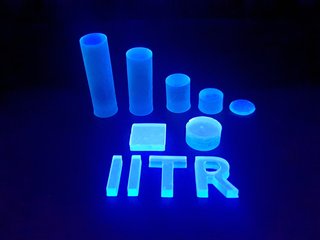
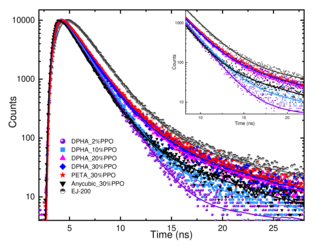
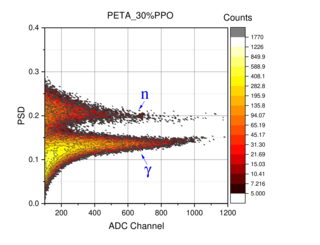
Geant4 Monte Carlo simulations are conducted to validate the advantages of 3D-printed scintillators as filler materials in hetero-structured detector designs for ToF-PET. The simulations of complex sinusoidal plastic fillers embedded in dense matrices (e.g., BGO) demonstrate up to 12% improvement in equivalent stopping power and 20% enhancement in energy sharing for sinusoidal designs compared to straight geometries. These results underscore the advantages of using 3D printing to fabricate complex filler geometries that are otherwise impractical with conventional methods. Prototype sinusoidal scintillators are 3D-printed as a proof-of-concept. Coincidence Time Resolution (CTR) is measured using a γ–γ setup with a 22Na source, yielding a CTR of 225±12 ps, compared to 210±13 ps of EJ-200 measured under the same conditions, thereby validating the suitability of the 3D-printed scintillator as a fast-timing filler in heterostructures.
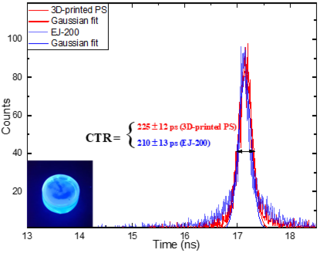
Interesting preliminary results on the radiation hardness of scintillators under γ-ray irradiation will also be presented, demonstrating their potential for long-term deployment in high-radiation environments.
Our findings highlight the viability of 3D-printing as a versatile and cost-effective tool for producing fast, stable, and application-tailored plastic scintillators. These developments mark a significant step towards next-generation radiation detection systems with improved performance, modularity, and design freedom.
References:
The integration of PET with MRI has accelerated the transition from traditional photomultiplier tubes (PMTs) to solid-state photodetectors such as avalanche photodiodes (APDs) and silicon photomultipliers (SiPMs), driven largely by the need for magnetic field immunity. Recent advancements in SiPM technology -including higher photodetection efficiency (PDE), reduced noise and crosstalk, and improved timing performance -have made them strong candidates for time-of-flight PET (TOF-PET) scanners. Moreover, their availability in diverse geometries/sizes, ranging from single units to linear arrays and matrices, has expanded their applicability in detector design.
In parallel, the pursuit of cost-effective whole-body PET devices has led to the exploration of plastic scintillators as alternatives to conventional high-Z materials such as NaI(Tl) or BGO, with TOF performance compensating for lower stopping power.
This study presents a comparative evaluation of conventional PMTs and commercially available SiPMs from Hamamatsu and Onsemi, tested across different sizes and geometries along with the different size and shape of plastic scintillators made in different companies/labs. The results provide insights into the relative performance and suitability of these detectors for future PET systems, particularly in the context of affordable, high-performance TOF full-body imaging.
Ensuring the long-term reliability of electronic components in harsh radiation environment requires a detailed understanding of radiation-induced effects. In the framework of the ATLAS muon trigger upgrade for the High Luminosity–Large Hadron Collider (HL-LHC) [1], we investigated Total Ionizing Dose (TID) effects on Si pn and pin junctions, MOS-based voltage translators and BiCMOS-based Low-Voltage Differential Signaling (LVDS) receivers with Impedance Spectroscopy (IS).
IS is a well-known technique in electrochemistry for studying charge carrier dynamics across a wide range of samples, ranging from solid-state devices to biological tissue, corrosion processes, fuel cells and batteries [2]. It relies on applying a small AC perturbation under a constant bias voltage and measuring the resulting impedance. Analysis of Nyquist plots (imaginary vs. real part of the impedance) through equivalent circuit modeling provides valuable insights into charge transport mechanisms. When combined with Mott-Schottky and capacitance–frequency (C–f) measurements, IS further enables the extraction of key physical quantities such as built-in voltage, doping density, depletion width, trap density distribution, and surface uniformity. We applied IS to investigate the impedance of a Si pn diode, disentangling the contributions of the depletion and diffusion capacitance in forward bias, shedding new light on a problem that is still debated after several decades [3]. Building on such results, we used IS to investigate novel readout techniques of Si pin photodiodes typically used as monitors of fast hadron fluence. Conventional readout techniques are based on measuring the voltage shift in forward bias, typically at 1 mA. In this way, such photodiodes have proven to be almost insensitive to gamma radiation. In contrast, IS analysis revealed permanent changes in the impedance spectra that are difficult (or even impossible) to detect with conventional methods.
In this work, we present the effects of 60-Co gamma irradiation on two components from Texas Instruments: LVDS receivers DS90LV048ATM/NOPB and high-speed bidirectional voltage translators LSF012, to be used in the HL-LHC ATLAS muon trigger. These devices were exposed at 100 Gy and 20 kGy, the latter to investigate high dose effects. For the LVDS receivers, we studied the change in the supply current, as well as the behavior of different device sections, including the power rail, differential input, ESD and output networks. Nyquist plots of the power rail network, the most affected device section, were fitted with a two time-constant circuit. In this case, we found that gamma effects manifested primarily as a pronounced increase in the time constant attributed to trapping/detrapping processes in the semiconductor. For voltage translators, we studied the supply current and, by means of IS, we observed changes in the capacitance and leakage of the MOS transistors with effects on the voltage translation.
IS has demonstrated strong potential for evaluating the radiation tolerance of electronic components, providing valuable insights into the microscopic behavior of irradiated devices. This approach aligns with the ECFA detector R&D roadmap [4], which emphasizes radiation hardness characterization as a priority for future detectors and highlights the importance of bridging macroscopic degradation with microscopic material modification, also through simulation and modelling. Within this context, IS provides a novel and complementary approach for assessing radiation effects on electronics.
References
[1] Casolaro, P., Izzo, V., Vari, R., D'Angelantonio, M., Vanzanella, A., Principe, C., & Aloisio, A. (2025). TID damage assessment on LVDS links for the ATLAS muon barrel spectrometer readout system. Journal of Instrumentation, 20(01), C01023
[2] Lazanas, A. C., & Prodromidis, M. I. (2023). Electrochemical impedance spectroscopy─ a tutorial. ACS measurement science au, 3(3), 162-193
[3] Casolaro, P., Izzo, V., Giusi, G., Wyrsch, N., & Aloisio, A. (2024). Modeling the diffusion and depletion capacitances of a silicon pn diode in forward bias with impedance spectroscopy. Journal of Applied Physics, 136(11)
[4] Colaleo, A., Ropelewski, L., Dehmelt, K., Liberti, B., Titov, M., Veloso, J., ... & Rivkin, L. (2021). The 2021 ECFA detector research and development roadmap.
The High Granularity Calorimeter (HGCAL) is a sampling calorimeter that will replace the electromagnetic and hadronic calorimeters in the forward section of CMS during the high-luminosity phase of the LHC. It is designed to investigate physics processes, particularly those associated with vector boson fusion and Lorentz-boosted topologies. Approximately 6 million silicon sensors will be arranged in a way that would cover regions with higher radiation doses (greater than 3 kGy) and areas with relatively lower radiation, which will be covered by about 240 thousand plastic scintillators with silicon photomultiplier readout. The high volume of data generated from numerous readout channels, combined with approximately 200 pileup collisions occurring at a rate of 40 MHz, presents a major challenge to the back-end (BE) readout system. Thus, the development and validation of trigger primitive generation (TPG) algorithms using sensor data is a critical step to ensure the retention of true signal events in this high-radiation environment. The BE algorithms are structured as a two-tier system. The first tier, or Stage 1, organizes data from the front-end (FE) links, followed by Stage 2 algorithms that calculate cluster properties and the energies of the showers. We are currently engaged in extensive validation of the BE algorithms and the TPG path of the FE application-specific integrated circuits using data collected from detector hardware and associated firmware. A review of the BE and FE algorithms, including emulations and their hardware/firmware validations through test beam and standalone runs, will be presented in this talk.
The Super Tau-Charm Facility (STCF) is a new-generation of electron-positron collider operating in a center mass of energy range from 2 to 7 GeV with a peak luminosity of 0.5×1035 cm-2 s-1 at 4 GeV. The high physics event rate in the presence of high beam background poses a big challenge to the STCF trigger system. In light of the data features and the simulated beam background level in STCF, a FPGA-based hardware L1 trigger architecture was developed for the STCF experiment. The STCF L1 trigger system consists of two sub-trigger logics based on the main drift chamber (MDC) and the electro-magnetic calorimeter (ECAL), respectively, and a global trigger logic (GTL). A L1 trigger prototype system based on common readout board (CROB) was also developed to test the efficiency and latency of trigger algorithms. The MDC sub-trigger logic uses the information of stereo super layers in the MDC, achieving 99% tracking efficiency for tracks with pt above 150MeV/c with a latency of approximately 550 ns. By employing a region-based cluster identification and segmentation method, the ECAL sub-trigger logic has achieved low resource utilization of FPGA and a short latency of less than 150 ns. With an optimized matching logic and trigger table, the GTL can realize a signal trigger efficiency of higher than 99% for most events with charged tracks and higher than 97% for neutral events. The beam background trigger rate can be suppressed to be below 30 kHz.
Searches for long-lived particles (LLPs) have attracted much interest lately due to their high discovery potential in the LHC Run-3. Signatures featuring LLPs with long lifetimes and decaying inside the muon detectors of the CMS experiment at CERN are of particular interest. In this talk, we will describe a novel Level-1 trigger algorithm that significantly improves CMS's signal efficiency for these exotic signatures. The implementation has been done at multiple stages of the Level-1 trigger processing, considering limited FPGA logic resources and tight latency requirements. Events satisfying the Level-1 requirements are passed to a High-Level Trigger (HLT) algorithm that further reduces the rate to the target few Hz level. The developed trigger algorithms have been taking CMS data since 2022. Their performance, implementation, commissioning results, and potential future developments will be reported.
The Imaging Atmospheric Cherenkov Technique (IACT) is the standard method for ground-based
detection of very-high-energy gamma rays from astrophysical sources. IACT telescopes record very
short duration flashes of Cherenkov light produced in extensive air showers initiated by gamma and
cosmic rays entering the Earth’s atmosphere. Traditionally, photomultiplier tubes (PMTs) have been
the dominant choice as photon sensors for IACT cameras. However, recent advances in solid-state
detector technology have made silicon photomultipliers (SiPMs) a viable alternative, offering several
advantages over PMTs.
Our group at TIFR Mumbai has developed a 256-pixel imaging camera based on SiPM technology for
a 4 m class imaging atmospheric Cherenkov telescope. The camera uses SiPMs as pixel-level
photosensors and features a modular data acquisition architecture that enables rapid development,
scalability, and easy maintenance. The front-end electronics condition the pixel signals and provide
load and temperature compensated bias voltages to the SiPMs. The conditioned analog signals are
then routed to the back-end electronics for high-speed sampling, trigger generation, digitization, and
data transfer to an event-builder PC for offline analysis. Pulse digitization is performed using the DRS4
analog sampling chip for ultra-fast waveform acquisition. The camera configuration, operation, and
data acquisition are managed through a suite of in-house developed firmware and software.
This talk will present the design and implementation of the camera data acquisition system, and
associated software framework.
A 256-pixel Silicon Photomultiplier (SiPM) camera developed for a 4-m diameter atmospheric Cherenkov telescope was commissioned in October 2024. The telescope is located at Mt. Abu, Rajasthan, India, and is part of the TACTIC array established by BARC. A dedicated nanosecond light-flasher system was implemented to enable precise and periodic calibration of the camera photosensors and the complete readout chain. The flasher, capable of delivering up to 1000 photoelectrons per pixel, was used to calibrate the photosensors under very low light conditions, allowing measurements of absolute gain, linearity, timing response, and pixel-to-pixel uniformity. Calibration results obtained from laboratory test-bench studies and in-situ telescope operation are presented.
Resistive Plate Chambers (RPCs) are among the core technologies in modern collider experiments. In their traditional form, RPCs operate on the principle of charge induction: ionization within the gas gap induces signals on an external anode plane segmented into pads or strips. Recent advances—particularly the development of one-glass and hybrid RPCs—have enabled significant modifications to this architecture, creating opportunities for functional coatings or embedded readout structures that can enhance signal detection and expand the range of measurable phenomena.
It is well established that, in addition to avalanche charge, scintillation light is also produced during the gas multiplication process. Measuring this light offers a unique avenue to obtain precise timing and spatial information. Building on this insight, our team has been developing RPCs with optical readout, designed to exploit scintillation light generated within the gas gap.
A number of small-scale RPCs (10 cm × 10 cm, 1.3 mm gas gap) were constructed with SiPMs directly in the gas layer which also includes a hybrid RPC with four SiPMs whose windows were coated with TPB (tetraphenyl butadiene), a wavelength shifter that converts UV scintillation photons into the visible range. In parallel, a larger hybrid RPC (32 cm × 48 cm) is under construction, incorporating four TPB-coated quartz fibers embedded in the chamber and read out at both ends by external SiPM assemblies. This configuration demonstrates a scalable optical readout concept for future large-area RPC systems.
All of the RPC prototypes are designed for simultaneous detection of scintillation light and avalanche charge, offering the potential for improved spatial and temporal resolution as well as a deeper understanding of signal formation in gaseous detectors. In this report, we describe the construction of these optically read out RPCs and present recent test results from the different designs.
This work is supported under TÜBİTAK Grant No: 123F304.
Bulk resistivity of electrode materials is very important for the performance of Resistive Plate Chambers (RPCs). Surface resistivity of the electrode plate also play crucial role to reduce the micro discharge inside the RPC. Detailed studies have been made on both the bulk resistivity and surface resistivity of carbon-loaded Polytetrafluoroethylene (PTFE) material commonly known as Teflon. Both the resistivities of the sample are measured via the measurement of leakage current. The experimental setup along with the detailed results will be presented.
The OCTOPUS (Optimized CMOS Technology for Precision in Ultra-thin Silicon) project, established within the DRD3 collaboration, aims to develop a Monolithic Active Pixel Sensor (MAPS) demonstrator to meet the stringent requirements of future lepton collider vertex detectors. This paper presents the architecture, design features, and preliminary simulation results of the first OCTOPUS prototype, named WOLFI, which is being developed as a demonstrator for future beam-telescope sensors.
The project follows a staged approach, allowing for adaptions of the final development targets depending on the future choice of the Lepton-Collider technology. The ultimate goal is to realize a full-sized vertex sensor demonstrator with a spatial resolution of ≤3 μ m, a time resolution of O(5ns), and a high hit rate tolerance of O(100 MHz/cm2). The chip is being designed to be radiation-hard (O(1014neq/cm2)) and to have a low power consumption (<50 mW/cm2). The first test chip WOLFI aims for a time resolution of O(100 ns), with a power consumption of <500 mW/cm2. The demonstrator is being implemented in a TPSCo 65nm CMOS Imaging Technology, which allows for increased logic density and more in-pixel functionality, compared to larger-feature-size processes.
The OCTOPUS design benefits from the extensive experience gained with TPSCo 65 nm technology demonstrators produced and tested in various projects and collaborative frameworks (EP R&D, ALICE ITS3, Tangerine and others). This foundational work, along with ongoing TCAD and Allpix Squared simulations, informs the development of the WOLFI chip. A key feature of the design is a data-driven asynchronous readout architecture that utilizes an Asynchronous Priority Arbiter (APA) for efficient, conflict-free data handling. This approach is intended to reduce latency and provide finer control over data acquisition compared to traditional synchronous methods. The front-end circuit includes time-over-threshold (ToT) measurements for improved time walk compensation.
This contribution will introduce the project's objectives and development strategy. The latest simulation results will be discussed, showing the optimization of sensor layouts to balance efficiency, timing, and spatial resolution. The preliminary design work on the WOLFI prototype, its functionality, and the path towards a final vertex sensor demonstrator will be highlighted.
Future high-luminosity electron–positron colliders demand Monte Carlo generators of unprecedented precision. We present recent developments in KKMCee aimed at this goal. Building on requirements for “high-precision” MC tools—improved higher-order corrections, efficient reweighting, and robust interfaces—we highlight new tests and extensions. In particular, the inclusion of $\tau$ spin information in HepMC3 output enables detailed studies of spin correlations and helicity approximations across energy regimes. Together, these efforts strengthen KKMCee as a validated platform for precision electroweak studies at upcoming experiments. We also present an analysis of Belle II data in comparison with current predictions.
Measurements of Response of LBC, LaBr3:Ce and NaI(Tl) Crystals to Thermal and Fast Neutrons
The upgrade of the High-Luminosity LHC (HL-LHC) will boost the instantaneous luminosity to 5-7 × 10^34 cm⁻²s⁻¹, increasing particle fluxes in the forward region of the CMS detector. The high particle flux can damage electronics and induce spurious signals. This study focuses on the GE1/1 triple-GEM detector’s sensitivity to both neutral and charged background particles, performed using FLUKA and Geant4 simulations. FLUKA provides a comprehensive description of the radiation field around the GE1/1 chambers across a broad energy spectrum. Geant4 delivers complementary insight into the detector response based on realistic geometry, materials, and interaction processes. The results show how the detector’s sensitivity changes with particle energy and incident angle, and how different configurations affect its performance. The talk also includes comparisons with CMS Run 3 data, providing valuable guidance for optimizing GEM operation under HL-LHC conditions. Moreover, this approach can be extended to other forward detectors like ME0 during the HL-LHC era.
The MALTA family of Depleted Monolithic Active Pixel Sensors, fabricated in a modified 180 nm CMOS imaging process, is being developed to meet the stringent requirements of next-generation collider experiments. These sensors are designed to provide high spatial resolution, fast timing, and excellent radiation tolerance. The MALTA2 prototype employs small collection electrodes and optimized front-end electronics, achieving low capacitance, low noise, and efficient charge collection even after substantial irradiation. Sensors have been irradiated up to 5×$10^{15}$ 1 MeV $n_{eq}$/$cm^{2}$ and characterized in laboratory setups, SPS CERN test beams, and using grazing angle techniques. Measurements demonstrate hit efficiencies above 95% up to 3×$10^{15}$ $n_{eq}$/$cm^{2}$ with stable tracking performance under high fluences. Current development focuses on a process modification incorporating ultra-high n-layer doping to further enhance radiation tolerance. This contribution will summarize recent measurement results and highlight ongoing efforts toward the development of future MALTA prototypes.
Resistive Plate Chambers (RPCs) are widely employed in high-energy physics experiments due to their excellent timing and efficiency capabilities. However, the conventional freon-based gas mixtures employed in RPCs contribute significantly to greenhouse gas emissions due to their high Global Warming Potential (GWP). This study examines the performance of a single-gap glass RPC detector (30 cm x 30 cm) with the standard gas mixture (C₂H₂F₄ 95%, i-C₄H₁₀ 4.5%, SF₆ 0.5%) and eco-friendly alternatives based on CO₂ and HFO gases. The detector was tested using cosmic muons, and its performance in terms of efficiency, time resolution, and charge distribution has been evaluated under these gas configurations. The results provide valuable insight into the feasibility of adapting environmentally sustainable gas mixtures without compromising the operational performance of RPC detectors. This study contributes to a larger effort to operate gaseous detectors in particle physics experiments in an environmentally responsible manner.
Keywords: Resistive Plate Chambers (RPCs), Freon-based gas mixtures, Global Warming Potential (GWP), HFO, Cosmic muon detector.
Gaseous Detectors are key components of particle detectors in High Energy Physics (HEP) experiments. The Gas Electron Multiplier (GEM) is one such detector being used in contemporary HEP experiments due to its good timing resolution, High-rate handling capability, good spatial resolution, and radiation tolerance. The optimal performance of gaseous detector depends on the choice of gases being used as ionising medium. Fluorine (F)-based gases, specially CF$_{4}$ are commonly used in particle detectors. Due to environmental concerns, fluorine based gases are no more considered appropriate for gaseous detectors. As a result, there is a need to find environment friendly alternatives while maintaining the performance of the detector. In this direction, we studied the possibility of using HFO gas as a replacement for CF$_{4}$ gas in Ar/CO$_{2}$ based gas mixture in GEM detectors. We performed this study to evaluate the timing resolution of the GEM detectors. The addition of CF$_{4}$ improves the timing resolution to the order of a few nanoseconds. The timing resolution of GEM detectors with only Ar/CO$_{2}$ mixture is more than 10 nanoseconds(ns). In our study, we evaluate the possibility of improving the timing resolution with the use of HFO.
Muography exploits naturally occurring cosmic-ray muons, produced by interactions of primary cosmic rays with atmospheric nuclei, for imaging applications. At sea level, muons are the most abundant charged particles, with an intensity of $\sim$1 cm$^{-2}$ min$^{-1}$. Over the past two decades, muon radiography has been applied in diverse contexts, including nuclear safety (monitoring spent fuel casks), transport security (detection of illicit or hazardous materials), and geoscience investigations of volcanoes, pyramids, tunnels, and mineral deposits. For muography, a wide range of detector technologies has been explored, including plastic scintillators, gaseous detectors, nuclear emulsions, and semiconductor devices.
Resistive Plate Chambers (RPCs) are gaseous detectors widely used in nuclear and particle physics. They are simple to construct, cost-effective, and have high detection efficiency and position resolution. These features make RPCs a compelling choice for tracking detectors in muography telescopes. We report on the development of gas-tight glass-RPCs optimized for multiple muography applications, emphasizing portability, robustness, autonomous operation, and reliability under challenging field conditions.
Modular muon telescope prototypes are being developed in different configurations, each with distinct design features. In one configuration, two standalone glass RPCs with 2 mm gas gaps and 160 $\times$ 160 mm$^2$ active areas are constructed from 3 mm thick electrodes and housed in airtight acrylic casings. Another design employs two 1.1 mm thick electrodes with a 1 mm gas gap and 160 $\times$ 160 mm$^2$ active area, enclosed in an aluminum housing. A third prototype features a double-gap configuration, with two 1 mm gas gaps formed by 1.1 mm thick glass electrodes and a 300 $\times$ 300 mm$^2$ active area. In all designs, the RPCs are sandwiched between orthogonal PCB-based strip readouts, providing bidirectional (X, Y) tracking of muon hits. The RPCs operate in avalanche mode with a standard gas mixture (95.2$\%$ C$_2$H$_2$F$_4$, 4.5$\%$ C$_4$H$_{10}$, 0.3$\%$ SF$_6$). Cosmic-ray muon data are collected using ASIC and FPGA–based acquisition systems. For field applications, sealed-mode operation is pursued to minimize gas consumption.
This contribution will present the detector designs, telescope configurations, and a proof-of-principle study demonstrating muon absorption in a high-Z material (Lead).
A new photosensor module, the multi-PMT (mPMT), has been developed for the Intermediate Water Cherenkov Detector (IWCD) of the Hyper-Kamiokande (Hyper-K) experiment. Each mPMT module consists of 19 three-inch PMTs enclosed within a watertight pressure vessel and integrated with custom readout electronics. Compared to conventional 20-inch PMTs used in Super-Kamiokande and Hyper-K, mPMTs offer significantly improved timing resolution, spatial granularity, and angular sensitivity. A total of 97 mPMTs were deployed and tested in the Water Cherenkov Test Experiment (WCTE), a prototype detector operated at the CERN East Area T9 beamline between October 2024 and June 2025. This presentation will provide a detailed overview of the mPMT design, mechanical assembly, and quality assurance procedures developed for large-scale production. We will present key performance results, including timing, efficiency, and angular response calibrations performed using LEDs embedded within each PMT. We will also share lessons learned from approximately eight months of mPMT operation under beam conditions, offering valuable insights for future mPMT-based detector deployments in Hyper-K and beyond.
A straw tube detector prototype consisting of six straws each having 6 mm diameter and 20 cm length is characterised using premixed gas of Argon and C$O_2$ in volumetric ratio of 70/30 at a flow rate of 3 l/h. F$e^{55}$ X-ray source having characteristic energy of 5.9 keV is used to measure the gain and energy resolution. The primary goal of this work is to study the variation of gain and energy resolution of straw tube detector under prolonged radiation, such studies are important before using straw tube as tracking detector at harsh radiation environment in the future heavy ion collision experiment in high energy physics.
The Aerogel Ring Imaging Cherenkov (ARICH) detector is located in the forward endcap of the Belle II detector to identify charged particles, with the main goal of separating kaons from pions over the full kinematic range. The detector works by collecting Cherenkov light emitted by fast charged particles with Hybrid Avalanche Photo-Detectors (HAPDs). ARICH has been successfully operated from the beginning of the Belle II experiment. We report on the status of ARICH operation, including the stability of HAPDs, and efforts to increase higher DAQ efficiency. We also mention problems that occurred during the operation. In addition, we also report on the study to improve the performance by studying the difference in the expected and observed number of Cherenkov photons arising mainly from gaps between aerogel tiles. To study this effect, we compare photon yields obtained from simulated high-energy muons and real muon data across the detector plane. This comparison allows us to map the tile gaps, quantify their impact on photon yield, and apply corrections to improve the performance of the ARICH detector.
The design and status of developing the Level-0 endcap muon trigger firmware of
the ATLAS experiment at HL-LHC are reported. An ATCA blade with an XCVU13P FPGA
and the firmware to identify muon candidates have been developed. The firmware
uses detector hits from the Thin Gap Chambers (TGC) to reconstruct candidates
and takes the coincidence with data from other inner muon detectors, called
Inner Coincidence, to reject fake backgrounds. The Inner Coincidence logic and
the coincidence pattern were implemented and validated using inputs from TGC
and inner muon detectors. The consistency of the logic outputs was confirmed by
extensive tests with test patterns. Furthermore, a new verification system
utilizing FPGA accelerator cards equipping similar resources was developed to
support efficient trigger logic development. This poster will report the
concept of the inner coincidence, the actual design, the methodology of
validation, and resource usage in the implementation phase. Also, a dedicated
discussion will be given on developing and designing the FPGA accelerator
card-based validation system.
The Tile Calorimeter (TileCal) is a sampling hadronic calorimeter covering the central region of the ATLAS experiment, with steel as absorber and plastic scintillators as active medium. The scintillators are read-out by the wavelength shifting fibres coupled to the photomultiplier tubes (PMTs). The analogue signals from the PMTs are amplified, shaped, digitized by sampling the signal every 25 ns and stored on detector until a trigger decision is received. The TileCal front-end electronics reads out the signals produced by about 10000 channels measuring energies ranging from about 30 MeV to about 2 TeV. Each stage of the signal production from scintillation light to the signal reconstruction is monitored and calibrated. The calorimeter time resolution has been studied with multi-jet events. High-momentum isolated muons have been used to study and validate the electromagnetic scale, while hadronic response has been probed with isolated hadrons. This contribution will present performance results with the LHC Run 3 data, including the calibration, stability, absolute energy scale, uniformity and time resolution.
To cope up with enhanced interaction rates during the High Luminosity operation of the LHC (HL-LHC), the CMS Outer Tracker (OT) is being upgraded with specialized strip-strip (2S) modules with capability of track selection at the hardware level. The assembly of such silicon strip tracker modules consist a multi-step procedure with the usage of several machineries and precision fixtures. Within the CMS, these modules are being built and tested at different institutes/universities across the world passing uniform quality control criteria. In this presentation, vivid procedure and/or the subsequent functionality tests would be highlighted.
The High-Energy Particle Detector 02 (HEPD-02) was launched in June 2025 as a payload on the China Seismo-Electromagnetic Satellite CSES-02. HEPD-02 is equipped with monolithic active pixel sensors (MAPS) arranged to reconstruct the incoming direction of the charged particles entering the detector. It is the first time that MAPS are used in a space application. The technological solutions and in-flight performance of the HEPD-02 silicon tracker will be presented and discussed.
The CMS silicon strip tracker consists of the inner barrel (TIB), inner discs (TID), outer barrel (TOB), and end-cap (TEC) sub-detectors, providing precise measurements for charged particle trajectories up to a pseudorapidity range of |η| < 2.5. During Run 3 with proton-proton collisions at √s = 13.6 TeV, the CMS strip tracker continues to perform exceedingly well superseding its design goals. At present, it has already been exposed to an integrated luminosity of ~400 fb-1 with additional challenges of large number of pile-up events (more than 60 during Run 3). However, the tracker performance is optimized through improved measurements of the signal-to-noise ratio, hit reconstruction efficiency, spatial resolution, cluster properties, Lorentz angle, and energy loss (dE/dx). This presentation would cover the key features of the CMS tracker performance during the LHC Run 3 operational conditions.
We present a comprehensive overview of the construction, operation, and performance of the imaging Time-of-Propagation (TOP) detector of the Belle II experiment at the SuperKEKB e+e− collider. Situated in the central barrel region of Belle II, the TOP detector is a critical component for the charged particle identification (PID). It leverages Cherenkov radiation, which is produced as charged particles pass through the fused silica (quartz) bars. The Cherenkov photons are transported to the ends of the bars via total internal reflection. The detector's innovative design allows for precise measurements that enable excellent particle discrimination. One end of each quartz bar is instrumented with finely segmented micro-channel-plate photomultiplier tubes (MCP-PMTs) to capture the light signal. A mirror is attached to the opposite end, which reflects any photons back toward the instrumented end, thereby maximizing the light collection efficiency. By measuring both the photon propagation times and hit positions, which are directly related to the Cherenkov angle, the TOP detector can effectively distinguish between charged pions, kaons, and protons with momenta up to approximately 4 GeV/c. Our PID performance analysis is based on over 400 fb⁻¹ of Belle II data, demonstrating the TOP detector's capabilities. This work highlights its successful operation in a high-luminosity environment and its vital contribution to the physics program of the Belle II experiment.
The Cosmic Ray Laboratory (CRL) of the Tata Institute of Fundamental Research (TIFR), Ooty, has established an indigenous technology for the fabrication of plastic scintillators using commercially available polymer pellets. Scintillators of dimension 50cm x 50cm x 2cm are routinely produced to meet the requirements of the GRAPE-3 experiment hosted at CRL. In this paper, we present the fabrication process, performance characteristics including light output and timing properties. We also showcase the versatility of the production facility in delivering scintillators of different shapes and sizes, and discuss their broad applicability in particle physics experiments, instrumentation development, and training laboratories.
Modern space-based UV and Cherenkov telescopes require highly integrated electronic systems capable of acquiring signals from large SiPM focal surfaces while ensuring low power consumption, high reliability, and seamless integration with the global telescope data acquisition. Within the SiSMUV project, we have developed a modular front-end electronics architecture specifically tailored to the readout, control, and synchronization of SiPM detector units in distributed focal surface systems.
Each module combines a SiPM array with a custom ASIC-based analog front-end and a digital processing layer implemented on FPGA. The analog stage, based on the RADIOROC ASIC, provides per-channel bias adjustment, dual-gain charge readout, and precise timing and amplitude discrimination, enabling stable operation from the single-photoelectron regime up to large signal amplitudes. The digital back-end is implemented on a Xilinx Artix FPGA and handles slow control, configuration of the front-end parameters, calibration and monitoring tasks, local trigger generation, and event formatting. Communication with the higher-level readout system is performed through a scalable digital interface designed to support large numbers of synchronized modules distributed over curved focal surfaces.
The complete readout chain has been validated through laboratory tests using pulsed laser sources and calibrated optical setups, demonstrating stable performance, reproducible calibration, and robust operation.
About 80% of the greenhouse gas (GHG) emissions at CERN arise from the use of fluorinated gases in gaseous particle detectors, primarily C$_2$H$_2$F$_4$, SF$_6$ and CF$_4$, reaching the order of hundred-thousands of tCO$_2$e per year. This is challenging not only from an environmental perspective, but also due to financial and regulatory considerations. In the following years, the purchase of the necessary gases will pose a challenge due to the F-Gas Regulation update and the upcoming ban on Per- and polyfluoroalkyl substances (PFAS).
To replace and minimise the use of GHGs, the CERN Gas Group has a multi-strategy mitigation plan in place. In addition to reducing the consumption of such gases by means of gas recirculation and recuperation systems, in the long term, we seek eco-friendly gas mixtures that will maintain or even improve the experimental performance of different detector technologies.
In this contribution, the focus will be on Resistive Plate Chamber (RPC) and Micro Pattern Gaseous Detectors (MPGD). Detectors are tested both in laboratory and irradiation facilities to assess their performance with several eco-friendly gas mixtures. The performance is defined by checking detector efficiency, as well as time resolution, charge distribution, cluster size and currents.
To reduce C$_2$H$_2$F$_4$ consumption in the near term at LHC experiments, we present the performance of CO$_2$-based gas mixtures in comparison with the Standard Gas Mixture, including an ageing test on the chosen concentration. As a long-term solution, the results of RPC detectors operated with different Hydrofluoroolefins (HFO) and Novec gases as replacements for both C$_2$H$_2$F$_4$ and SF$_6$ will be shown. Focusing on different gaseous particle detection technologies, preliminary results for MPGDs operated with reduced CF$_4$ concentration will also be presented.
The most important ATLAS upgrade for LHC run-3 has been in the Muon Spectrometer, where the replacement of the two forward inner stations with the New Small Wheels (NSW) introduced two novel detector technologies: the small-strip Thin Gap Chambers (sTGC) and the resistive strips Micromegas (MM). These detectors have been chosen and designed in to cope with the high background levels of LHC run-3, and the even higher levels of the future Hi-Luminosity LHC run.
The NSW detectors are actively contributing to the muon spectrometer trigger and tracking, after the initial commissioning phase during the first months of run-3 in 2022. This presentation will offer a detailed report on the studies on the NSW system, based on the LHC run-3 dataset collected from 2022 to 2025.
The report will cover the performance of the two novel detector technologies, as well as the muon trigger and reconstruction performance in the ATLAS endcaps.
Vision on picosecond timing device
PbWO₄ crystals combined with SiPM readout are promising for compact, radiation-hard calorimetry in future high-energy physics experiments. We present a compact readout circuit developed for PbWO₄ scintillation detectors. The module integrates a 2×2 or 4×4 SiPM array with a preamplifier stage, supporting operation with an arbitrary number of sensors without degrading timing performance. The design features SiPM bias control, adjustable gain and offset via USB/RS485, and EEPROM-based parameter storage in a low-power, compact form factor. The output is compatible with up to 1 V/50 Ω.
Prototype systems were tested with multi-crystal PbWO₄ arrays under beam conditions from 100 MeV to 5 GeV. The measurements demonstrated fast response, good spectral resolution, and stable operation. Full characterization results will be presented, highlighting the potential of this system for next-generation calorimeters in high-radiation, high-rate environments.
INFN, in collaboration with FBK (Fondazione Bruno Kessler), is developing a novel type of Silicon Photomultiplier (SiPM) $-$ the Back-Side Illuminated (BSI) SiPM $-$ within the framework of the IBIS and IBIS_NEXT projects (Innovative Back-Side Illuminated SiPMs). This new sensor architecture introduces a clear separation between the charge collection and multiplication regions of the device, enabling the implementation of a charge-focusing mechanism. This approach offers several key advantages: a near-100% fill factor even for devices with small microcells, significantly enhanced sensitivity down to vacuum ultraviolet (VUV) wavelengths through optimised surface treatments, improved radiation hardness thanks to a reduced high-field region, and simplified integration with readout electronics via bump bonding, as all electrical contacts are located on the same side of the sensor.
The BSI SiPM technology is particularly well suited for experiments employing the Cherenkov technique $-$ such as the ePIC experiment at the EIC $-$ and for future upgrades of ALICE 3 and LHCb. It is also highly promising for noble liquid detectors $-$ such as DUNE $-$ and paves the way towards high resolution imaging with SiPMs in several other applications.
We present the first results from characterisation studies of prototype sensors from the IBIS RUN 1, fabricated by FBK with single-photon avalanche diode (SPAD) pitches ranging from 15 μm to 35 μm. Detailed measurements of key performance parameters $-$ carried out in dark conditions, within a climatic chamber, and at cryogenic temperatures (77 K) $-$ will be reported.
The Timepix3 detector network installed inside the ATLAS cavern [1] has demonstrated reliable performance for measuring particle fluxes and monitoring luminosity during LHC operations [2][4]. As of 2025, the network comprises fourteen operational detectors distributed throughout the ATLAS detector, exposing them to different radiation fields and flux levels. Detectors closer to the interaction point provide high-statistics measurements, while those at greater distance enable cross-validation, systematic uncertainty assessment, and long-term studies of radiation-induced signal degradation.
Each detector operates independently, requiring no external triggers or online information, and the network is fully synchronized with the LHC orbit clock, allowing for bunch-sensitive real time luminosity measurements. Its modular design further allows interventions and manipulation without affecting ATLAS performance, enhancing operational efficiency.
This contribution presents the performance of the Timepix3 network for luminosity measurements during Van der Meer (vdM) scans. The advantages of its design and operational features enabled precise results for the p–O, O–O, and pp scans. Since vdM scans provide the reference for absolute luminosity calibration, these studies show that the Timepix3 network can contribute to absolute luminosity determination. Initial fits to the scan profiles confirm the consistency and reliability of the results.
The results further show how Timepix3 detectors provide detailed analysis of particle signatures, enabling their classification into minimum ionizing particles, highly ionizing particles, gamma rays, neutrons, and electrons, as well as the reconstruction of particle trajectories. These capabilities are used to characterize the radiation environment [3] and to separate the collision peak from the delayed particle tail in each bunch crossing, reducing the overlap of consecutive bunches and improving the signal-to-background ratio [4].
Overall, these results will demonstrate that the Timepix3 detector is a versatile tool for both online and offline beam monitoring. Its highlighted performance shows how it is a strong candidate for luminosity calibration and long-term monitoring in high-luminosity LHC operations, providing an independent and complementary approach to beam monitoring.
[1] P. Burian et al. “Timepix3 detector network at ATLAS experiment” JINST 13 C11024 (2018) \url{https://iopscience.iop.org/article/10.1088/1748-0221/13/11/C11024/meta}
[2] B. Bergmann et al., “Relative luminosity measurement with Timepix3 in ATLAS” JINST 15 C01039 (2020). \url{https://iopscience.iop.org/article/10.1088/1748-0221/15/01/C01039/meta}
[3] B. Bergmann et al., “Characterization of the Radiation Field in the ATLAS Experiment with Timepix Detectors”, in IEEE Transactions on Nuclear Science 66, no. 7, pp. 1861-1869 (2019) \url{https://ieeexplore.ieee.org/abstract/document/8720202}
[4] B. Bergmann et al., “Evaluation of Timepix3 as a luminosity detector at LHC during 2018 pp collisions at \sqrt{s}=13 TeV” Eur. Phys. J. C 85, 904 (2025). \url{https://doi.org/10.1140/epjc/s10052-025-14631-x}
We present an implementation of the digital dual mixer time difference (DDMTD) circuit in an ASIC using current mode logic (CML) and discuss how it can be used to stabilize on-detector systems to a level of less than 1 picosecond. The DDMTD circuit is used extensively in high energy physics applications and other clock distribution systems where precision timing is required. By using CML logic in an ASIC we have been able to optimize the design for the DDMTD application and have achieved a considerable performance enhancement over what has been achieved with logic blocks in an FPGA.
Experiments and applications such as High Energy Physics, Particle physics, Muon Tomography, Positron Emission Tomography (PET) and Light Detection and Ranging (LIDAR) require data acquisition (DAQs) systems with large number of readout channels. A multi-channel and high-resolution Time-to-Digital Converter (TDCs) is also an integral part of the DAQ system of such applications. Optimizing the space, power consumption and throughput performance of the DAQ system is an essential requirement of these applications. In a System-on-Chip (SoC) approach, these performance matrices can be achieved by integrating the DAQ logic with microprocessor and data transfer protocol inside a single chip like FPGA.
Thus, a high resolution TDC was developed and interfaced with MicroBlaze processor in FPGA through the Advanced eXtensible Interface (AXI) bus. The bus is used as a memory mapped interface between the processor and the peripherals. The TDC was built using Flash based architecture [1][2], consisting of coarse and fine measurements. The coarse time was measured using a counter operating at 200 MHz (time period ~ 5 ns), and the fine time within one clock period was measured using a delay line. Eighty delay cells in a delay line are required in the Artix-7 FPGA for fine time measurement within one clock period of 5 ns, resulting in a Least Significant Bit (LSB) resolution of 62 pico-seconds (ps). The TDC was characterized using a commercial delay generator up to 40 µs dynamic range. The measured values of single-shot precisions were less than 50 ps across the dynamic range of the TDC. For the data transfer, the UART AXI peripheral was interfaced with the MicroBlaze processor system. This SoC approach was tested in a commercial AMD AC701 development board.
The paper presents the implementation details of a high resolution TDC integrated with a microprocessor and data transfer protocol in a single AMD Artix-7 FPGA with efforts for further improvements of TDC resolution (LSB) to sub 50 ps and integrating it with high speed 1Gbps Ethernet interfaces in a FPGA.
The Belle II experiment at the SuperKEKB e+e– collider in Tsukuba, Japan holds the luminosity world record of 5.1x10^34 cm^–2 s^–1 and aims to push up to 6x10^35 cm^–2 s^–1.
In such a luminosity range harsh beam backgrounds are expected leading to a maximal hit rate of up to 120 MHz/cm^2 for the inner detection layer.
At such radius, the radiation tolerance also reaches up to 5x10^14 (1MeV) n_eq/cm^2 and 1 MGy.
An intensive R&D program has been established to develop a new pixelated vertex detector (VTX) entirely made from a single type of depleted monolithic pixel detectors (DMAPS), the OBELIX sensor, as a replacement of the Belle II vertex detector.
The VTX strategy entails higher space-time granularity, lighter overall structure and services compared to the current operating vertex detector.
The baseline layout consists of two identical layers composing the inner part (iVTX) and four outer layers (oVTX), all arranged in a barrel-shaped geometry, with minimal material budget.
The ladder design is now being optimized considering the expected background hit rate and related power consumption at the target luminosity. With a power density in the range of 200-300 mW/cm2 depending on the hit rate, the ladder cooling is especially challenging. The system should maintain the sensor at room temperature to preserve the sensor functionality after irradiation, while minimising the material budget. The iVTX concept is exploring passive cooling using some heat-drain material over the ladder. The oVTX design involves thin cooling pipes.
The OBELIX sensor is derived from TJ-Monopix2, originally developed for the ATLAS experiment, and features a 33µm pixel pitch, with the same matrix and column drain readout.
OBELIX implements a new digital periphery specific for the application in Belle II. The new digital trigger logic matches the required 30 kHz average Belle II trigger rate with 10 µs trigger delay. Moreover, two functional blocks for the outer layers have been added to provide hit time stamping and continuous hit-information for track-triggering.
The OBELIX sensor is expected to be submitted in fall 2025.
We will review all project aspects: the latest characterization of the TJ-Monopix2 forerunner sensor in beam after irradiation, design of OBELIX sensor and layers, optimization of the geometry and cooling.
The former CERN RD50 collaboration develops monolithic active pixel high voltage (HV) CMOS sensors for future colliders with the aim of high radiation tolerance, good time resolution, and high granularity pixel detectors. The most recent prototype, the RD50-MPW4, was produced by LFoundry in December 2023 using a 150 nm CMOS process. It features a matrix of 64x64 pixels with a 62 $\mu$m pitch and employs a column-drain readout architecture. Compared to its predecessor, it now has separate analog and digital power domains and a new biasing scheme with a guard ring structure that supports bias voltages up to 500 V.
This contribution will discuss the design and latest results of the MPW4, where tests with unirradiated samples showed > 99.9% efficiency, 16 $\mu$m spatial resolution and 10 ns timing resolution. Efficiencies of more than 99% were achieved for samples irradiated with fluences of 1 x 10$^{15}$ 1 MeV n$_{\mathrm{eq}}$/cm$^2$. A 3D map of the charge collection efficiency from a measurement with two-photon absorption laser is presented that nicely outlines the depletion depth of this radiation hard, high granularity monolithic active pixel sensor.
Cooling substrates based on microchannels provide highly efficient heat removal due to the direct proximity of the coolant to the heat sources. Within the DRD8 (Mechanics) programme, research and development activities focus on advancing silicon- and ceramic-based microchannel cooling technologies with two main objectives: improvements on electronics integration and cost reduction. Three main directions are pursued. First, CMOS-compatible microchannel fabrication and the development of active interposers are being investigated to enable simultaneous efficient cooling and electrical interconnection between detector systems and front-end electronics. Second, a low-cost silicon cooling-plate process is under development, employing hyperbaric bonding—a room-temperature bonding technique using a thin gold layer under hyperbaric conditions—alongside scalable interconnects for the realization of large-area heat exchangers. Third, low-temperature co-fired ceramics (LTCC) are being explored for channel fabrication, offering the possibility to integrate metallization and high-conductivity materials between stacked ceramic layers. The performance of these developments is evaluated along two optimization paths: minimization of material budget (≤ 0.2% X₀) for low power densities (10–100 mW/cm²), and minimal material budget solutions capable of sustaining high power dissipation (~2 W/cm²). The VELO Upgrade 2 at LHCb is the benchmark for the high-power scenario, with requirements including compatibility with evaporative CO₂ cooling at up to 186 bar, stable operation in vacuum, and non-uniform radiation doses up to order of 1017 MeV·neq/cm².
The Vertex Locator (VELO) of LHCb, located at the heart of the collision, needs an upgrade with the upcoming upgrade of LHC (HL-LHC). It needs to maintain the performance by precisely tracking the particles close to the interaction point. The important challenge is to reduce the material budget and improve the timing resolution of the sub-detector to better separate the events. This talk highlights the developments that are planned for the VELO upgrade II to reduce the material budget by considering the possibility of modules being inserted in primary vacuum and appropriate changes in mechanical design. It will also highlight the developments under consideration to improve the timing resolution with fast readout links using silicon photonics and VTRx as well as cooling strategies that are being studied to mitigate the expected radiation damage. Additionally, its backend plans and applications of the R&D to LumiTracker detector shall also be discussed.
In order to cope with the harsh conditions at the High-Luminosity LHC, the ATLAS experiment will replace its inner tracking system with a new, all-silicon inner tracker (ITk) during LHC long-shutdown 3. The core of ITk is a 5-layer hybrid pixel detector. This new pixel detector will feature a sensitive surface of about 13m$^2$ and employ several different silicon sensor technologies as well as innovative new technologies like serial detector powering and evaporative CO2 cooling to unprecedented scales. All detector components went through substantial R&D programs and optimization efforts which have been concluded by now and most of them are currently being produced for the final detector system.
In order to ensure the successful interplay of all the components in the final detector, system level tests are being carried out as an essential part of the evolved testing program of the ITk pixel detector. This presentation will highlight some of the recent system test efforts:
A large serial powering chain made of 14 modules has been set up. This size corresponds to the largest serial powering chain in the detector. It has been connected using a fully realistic off-detector infrastructure including correctly dimensioned cables, patch-panels, and detector power supplies. This unique setup gives outstanding possibilities to validate the serial powering concept, cold detector start-up behavior and power supply performance under the most realistic conditions so far.
In another system test, multiple local support structure with in total 54 modules were operated together for the first time in order to validate the detector grounding scheme and to demonstrate the parallel operation of large detector pieces. Beyond that, it represents a long-term test environment for the infrastructure needed for the operation of the final detector system, including the interlock system, environmental monitoring, data acquisition system as well as detector control system.
All the activities pave the road to a successful detector commissioning at the end of the production and give already a good understanding of the future operation of the ITk pixel detector.
The High-Luminosity LHC (HL-LHC), starting in 2029, will increase instantaneous luminosity by a factor ~ 7.5, posing major challenges for muon triggering and reconstruction in CMS. To address this, new Gas Electron Multiplier (GEM) detectors are being installed in the forward muon system. The first GEM station (GE1/1) was fully deployed during Long Shutdown 2, with the second (GE2/1) entering commissioning following demonstrator installations in 2023–24. A six-layer GEM station (ME0), now in production, is planned for installation during Long Shutdown 3. In Run 3, GE1/1 and GE2/1 chambers are operating with >95% efficiency, and experience gained has guided key design and electronics improvements for future stations. This talk will present the status of the three GEM projects, highlight lessons learned from production and commissioning, and outline the progress and ongoing R&D toward the ME0 station for HL-LHC operation.
The High Luminosity LHC (HL-LHC) phase, scheduled to start in 2030 and deliver 3000 fb-1 in 10 years, will offer unique potential for precision measurements and searches for rare processes. However, it will also pose significant challenges for the detectors due to extremely high radiation levels and the large number of simultaneous interactions per bunch crossing (up to 200). To mitigate the adverse effects of pile-up, the CMS experiment will install a new detector, the MIP Timing Detector (MTD), designed to measure the arrival time of charged particles with a precision of 30-60 ps. The central part of the MTD, the Barrel Timing Layer (BTL), is made of about 166,000 scintillating LYSO:Ce crystal bars with double-ended SiPM readout. Following its design optimisation and successful performance validation through dedicated test beam campaigns on prototypes, the BTL is now in the construction phase. This contribution will give an overview of the key design features of the BTL and will present recent large-scale system tests and the progress on the BTL assembly.
The Super Tau-Charm Facility (STCF) is a high-luminosity electron-positron collider proposed in China. It will operate in an energy range of 2-7GeV with a peak luminosity higher than 0.5*10^35 cm^2 s^-1. The STCF physics goals require efficient and precise reconstruction of exclusive final states produced in the e+e- collisions. This places stringent demands on the performance of the STCF detector. It must provide maximal solid angle of coverage, high efficiency and good resolution for both charged and neutral particles of low momentum or energy, excellent hadron identification in a large momentum range, and powerful muon identification capability. This report presents the physics case of the STCF and the conceptual design and R&D progress of the STCF detector.
The Super Tau-Charm Facility (STCF) is a new-generation electron-positron collider in the tau-charm energy region, with a peak luminosity of ≥$0.5\ast{10}^{35}cm^{-2}s^{-1}$ at 4 GeV. The high luminosity gives rise to a high event rate and high beam background, presenting a significant challenge to the STCF detector. The outmost layer of the STCF detector is instrumented with a muon detector (MUD), which is required to identify high-momentum (p>1GeV/c) muons with an efficiency of ≥95% and a mis-identification rate of ≤3%. Also, about 40% of neutral hadrons produced at STCF deposit a very limited amount of energy in the STCF electromagnetic calorimeter, so the MUD should also be able to provide standalone identification capability for neutral hadrons.
A hybrid detector design has been proposed for the MUD, where 3 inner layers of resistive plate chambers (RPC) and 7 outer layers of plastic scintillator strips are integrated into 10 layers of iron yoke. In this contribution, the STCF hybrid MUD concept is presented. MUD reconstruction and BDT-based identification algorithms for muons and neutral hadrons were developed for this hybrid MUD concept. The MUD design was optimized by examining the muon identification performance based on full simulation in the STCF offline software framework for different iron yoke thickness, numbers of detector layers, combination of RPC and plastic scintillator layers. The MUD particle identification performance was improved significantly as a result of the optimization. The optimization results as well as the MUD reconstruction and identification algorithms will also be presented.
The Super Tau-Charm Facility (STCF) is the next-generation high luminosity $e^+e^-$ collider in China with a center-of-mass energy ($\sqrt{s}$) from $2$ to ~$7$ $GeV$ and a peak luminosity of at least $0.5\times10^{35}$ $cm^{-2}s^{-1}$ optimized at $\sqrt{s}=4$ $GeV$. A high event rate and a high beam background count rate of over 1 MHz per module places new demands on the electromagnetic calorimeter (ECAL): maintaining good energy and position resolution under severe pileup conditions. Meanwhile, the capability of event timing and particle identification is also an important aspect of ECAL R&D, where a time resolution of several hundred picoseconds is expected.
The ECAL design is based on pure CsI (pCsI) crystals coupled with avalanche photodiodes (APD) readout. A complete chain of simulation and reconstruction is implemented under the Offline Software of Super Tau-Charm Facility (OSCAR). The architecture and module geometry of ECAL are designed by optimizing the physical performance. A 5 $\times$ 5 array prototype is developed by applying a novel "wavelength shifting in propagation" scheme, which features fast time response and good signal-to-noise ratio at a reasonable cost.
This talk summarizes the simulation and optimization of the calorimeter system, and also the development and experimental tests of the prototype. Some comprehensive test results, such as the radiation hardness, the uniformity of the light collection and the timing performance are also presented. Besides, a beam test is carried out at CERN recently, and an intial data analysis has proved a good performance of the prototype to meet the requirements of the conceptual design.
The AEgIS experiment aims to measure the free fall of antihydrogen in Earth’s gravitational field with unprecedented precision. This requires overcoming unique technological challenges, among them the detection of antiprotons, in real-time with the highmost spatial accuracy, over a large area. An unexpected, but very effective solution to this problem was obtained through the repurposing of smartphone camera sensors. In this talk, the characterization and the engineering and deployment of OPHANIM, a 3.84 Gigapixel, large area detector based on their use, will be discussed.
With the Upgrade II programme, LHCb plans to upgrade its detector with a target of 2034. It will operate at luminosities of up to 1.5x10$^{34}cm^{-2}s^{-1}$, accumulating over 300 fb$^{-1}$. This will result in about 42 interactions per crossing, producing approximately 2000 charged particles within the detector acceptance.
This higher luminosity requires a new VErtex LOcator (VELO) design capable of handling the increased data rates, radiation levels, and occupancies. New techniques are needed to assign b hadrons to their primary vertices and perform real-time pattern recognition, involving a new 4D hybrid pixel detector with advanced rate and timing capabilities.
Prototype front-end ASICs are being designed in 28 nm technology to handle these extreme hit rates and integrate timing information per pixel. This upgrade requires the sensors to provide time measurements with 35 ps resolution and be resistant to 2.5x10$^{16}$ 1 MeV n$_{eq}$cm$^{-2}$, all while maintaining a spatial resolution per plane of below 11 µm. 3D sensors with multiple different fast timing-motivated designs are being produced and characterised to fulfil this need.
The change from planar to 3D sensors will impact the overall design of the VELO detector due to their inherent characteristics. 3D sensors have reduced overall efficiency from passive material acting as dead areas, which can be partially recovered by angling the sensors with respect to the beam. Angling the 3D sensors also impacts the hit rate and spatial resolution expected at different radii. In addition, the high capacitance of 3D sensors increases the timing jitter expected, which is highly dependent on the 3D sensor design.
This presentation will highlight the promising technologies being investigated for the VELO HL-LHC upgrade, emphasising timing precision for vertexing within next-generation detectors. Recent characterisation results of 3D sensors will be presented, as well as simulation studies considering the impact of 3D sensor usage on the subdetector performance and design.
[Submitted on behalf of ATLAS ITk collaboration]
For the High-Luminosity upgrade of the Large Hadron Collider, the existing ATLAS Inner Detector will be replaced with a fully silicon-based Inner Tracker (ITk). Its installation is planned for the next LHC Long Shutdown 3 (2026–2030). The ITk has been specifically designed to withstand the demanding conditions created by the high collision rates per bunch crossing and the large integrated luminosity expected in this new phase. To address these challenges, the design has been optimized to preserve the current tracking performance despite the far harsher environment. The ITk is composed of a Pixel detector at the innermost region and a Strip detector in the outer region. Both subsystems are organized into a central barrel and two endcap regions, providing nearly hermetic tracking coverage up to a pseudorapidity of η = 4, thereby ensuring efficient reconstruction even in the very forward regions.
For the Pixel Detector, two sensor technologies have been adopted: 3D and planar. Owing to their superior intrinsic radiation hardness, 3D pixel sensors have been selected for the innermost layer of the Pixel Detector, while planar sensors are employed in the outer layers. The pixel cell geometry has been optimized according to the detector region: rectangular cells of 25×100𝜇m2 are used in the barrel, whereas square cells of 50×50𝜇m2 are implemented in the end-cap, in order to maximize the overall tracking performance of ATLAS. The 3D sensors are fabricated by two vendors: Fondazione Bruno Kessler (FBK, Italy) and Stiftelsen for INdustriell og TEknisk Forskning (SINTEF, Norway), and the planar sensors by FBK, Micron Technology (Micron, USA) and Hamamatsu Photonics K.K. (HPK, Japan). Each 3D sensor is hybridized with a single readout chip to form a bare module; subsequently, three bare modules are interconnected via a flex circuit to create a triplet module. This design contrasts with the planar technology, where a single large sensor tile is hybridized to four readout chips to produce a quad module.
The detector performance up to the expected end-of-lifetime fluences (~1.7x10e16 neq/cm2 for 3D and 5x10e15 neq/cm2 for planar) has been investigated in R&D studies using pre-production devices assembled on Single Chip Cards. While these studies demonstrated the excellent intrinsic radiation hardness of both sensor technologies, the main limitation was that only single-chip assemblies were tested, rather than complete detector modules. In this talk, we report on the performance of detector modules in their final hardware configuration, as they will be deployed in ATLAS. For this purpose, triplet modules—comprising of three 3D bare modules connected together in a PCB—and quad modules—comprising of a planar quad bare module connected in a PCB—were built and tested. Both module types were equipped with the production ITkPixV2 readout chips. Assembly and quality control procedures were carried out at ATLAS-qualified production and testing sites. A subset of these modules was subsequently irradiated at the CERN IRRAD facility and at RARiS (Japan). Pre- and post-irradiation performance was tested using a pion beam extracted from the CERN SPS. The collected data were analyzed with the Corryvreckan software framework to evaluate the detector efficiency. Results are presented as a function of fluence, bias voltage, threshold settings, and charge collection, the latter benefiting from the Time-over-Threshold (ToT) measurement capability of ITkPixV2.
To cope with the challenging environment of the High-Luminosity Large Hadron Collider (HL-LHC), the CMS Experiment is being upgraded to include a new detector, the MIP Timing Detector (MTD). The MTD is designed to mitigate pileup effects by providing a time measurement for charged particles with a resolution better than 50 ps. To achieve the necessary time precision, the Endcap Timing Layer (ETL), covering the pseudorapidity region 1.6 < η < 3, will utilize low gain avalanche diodes (LGADs), a novel silicon-based technology, read out by a custom-designed ASIC called ETROC. The ETL module exploits 16x16 pixels LGAD arrays that are bump-bonded to the corresponding ETROC ASICs. Over the past year, the first bump-bonded assemblies featuring ETROC2— the first full-size, fully functional prototype—were produced and tested in beam test campaigns at DESY and SPS. This presentation will provide an overview of the ETL design, focusing on module and sensor performance, and will present the project status and recent achievements.
The smartpixels project is developing radiation-hard ASICs with embedded neural networks, fabricated using a 28 nm CMOS process, to enable data reduction at source using single-layer hit information in highly granular tracking detectors. This technology addresses the strict bandwidth and power constraints of fine-pitch trackers essential for future particle collider experiments, while simultaneously enhancing high-priority physics, especially signatures with heavy quark decays. For instance, smartpixels can improve low transverse-momentum (pT) b-tagging to increase acceptance of Higgs pair production with low invariant mass. The first implementation of the smartpixels ASIC integrates a filtering neural network that classifies the pT of incident particles based on charge cluster patterns in the sensors. This talk will describe the prototyped 1.6 mm^2 ASIC design (featuring two 16x16 pixel matrices of 25x25 um^2 pixels, with total power consumption of <6uW/pixel or <1W/cm^2), along with characterization and performance results evaluated at bunch crossing clock frequency. In parallel, filtering and regression networks to infer incident particle properties are being developed and evaluated for future on-chip implementations. Algorithmic studies assessing the impact of sensor geometry, radiation damage, electronic noise, and Lorentz drift on neural network performance will also be discussed.
Silicon strip sensors have long set the standard for precision tracking, but
next-generation heavy-ion experiments demand detectors that combine ultra
low mass with extreme rate capability. The Silicon Tracking System (STS) of
the Compressed Baryonic Matter (CBM) experiment addresses these unique
challenges: fixed-target operation, very high track multiplicities, and continu-
ous, self-triggered readout, while targeting a 2–7% X 0 material budget across 4
m 2 of active area and hit rates of 10 MHz/cm 2 .
To meet these demands, we employ double-sided, double-metal (DSDM) sil-
icon microstrip sensors (320±15 µm thick) with 2 × 1024 channels at 58 µm
pitch, providing excellent spatial granularity. Sensors are connected via ultra-
light aluminum–polyimide microcables to minimize material while preserving
signal integrity. Readout is provided by the SMX2.2 ASIC, a self-triggering
front end with fast shaping, discrimination, a 5-bit flash-ADC amplitude mea-
surement, and 14-bit time stamping. This architecture delivers timing precision
of ∆t ≈ 5 ns and maintains low noise of about 1000 e. Dense detector in-
tegration, together with optimized grounding and powering, yields a per layer
material budget below 1% X 0 and stable performance under high-radiation, high
occupancy CBM conditions.
We present the current status of STS construction, with nearly three-quarters
of the detector modules produced and tested. Module and ladder level integra-
tion results, including pulse-scan studies under various SMX2.2 configurations,
demonstrate the STS’s readiness for large-scale deployment in the CBM heavy-
ion program.
Straw Trackers are widely used in various High Energy Physics experiments. There are two main straw production technologies – the straw winding and the ultrasonic welding. While the winding technology exists for a long time and there are industrially available producers, the ultrasonic welding process has reached the required quality relatively recently.
A large scale Straw Tracker build of straws produced with the ultrasonic welding is a part of the NA62 detector and operates in vacuum for more than 10 years. Its extremely good performance and operation stability makes this technology attractive for the future experiments as well.
Welded straws have a large dynamic range of elastic deformation of the material. This allows large area trackers to be built without additional engineering techniques increasing the tracker stability, like straw reinforcement in ATLAS TRT, or introducing self-supporting structures in the Panda tracker. In case of welded straw, the stable tracker geometry is maintained by the tension of straw tubes.
Improved welding process and developed quality control of produced straws makes the welding technique attractive for building Straw Trackers of large area, low material budget, high performance and reliable long-term operation stability. Straw welding technology is considered for Straw Trackers of future experiments like SHiP, DUNE, FCCee and SPD.
We overview details of the ultrasonic welding straw production technology, compare requirements to Straw Trackers at several future experiments, and present first prototypes made of the welded straws.
A system of counters with fast organic scintillators, registering high energy nuclei of the
Nuclotron beam, and a set of neutron detectors based on stilbene, used for TOF
measurements of neutron spectra, were developed for the BM@N experiment. The detectors
are operating in a strong magnetic field of the BM@N magnet. Scintillation photons are
registered with fine-mesh and MCP PMTs in the beam counters and with SiPMs in the
neutron detectors. The beam detectors provide fast trigger on nucleus – nucleus interactions
in a target and generation of start pulse for TOF detectors. The neutron spectrometer covers
energy range from 2 to 200 MeV using a short flight path of 30 cm. These tasks require a
picosecond time resolution for both types of the detectors. Also, the neutron detectors provide
n/γ pulse shape discrimination with FOM factor >2. Here we give a detailed description of
design and electronics of the detectors and discuss their performance in BM@N run with 3.8
A GeV Xe ion beam and CsI target.
The HL-LHC will provide instantaneous luminosities up to $7.5 \times 10^{34}~$cm$^{−2}$s$^{-1}$, and this increased interaction rate and particle flux will degrade the ATLAS event reconstruction. The endcap and forward region where the liquid Argon calorimeter has coarser granularity and the inner tracker has worse resolution will be particularly affected. A High-Granularity Timing Detector (HGTD) will be installed in front of the LAr endcap calorimeters for pile-up mitigation and luminosity measurements. The HGTD is a novel detector introduced to augment the new all-silicon Inner Tracker in the pseudorapidity range from 2.4 to 4.0, adding the capability to measure charged-particle trajectories in time as well as space. Two double-sided layers of silicon sensors will provide precision timing information for charged particles with a resolution as good as 30 ps per track to help assign each particle to the correct vertex. Readout cells have a size of 1.3 mm $\times$ 1.3 mm, leading to a highly granular detector with ~3.7 million channels. Low-Gain Avalanche Detectors (LGAD) technology has been chosen as it provides enough gain to reach the large signal over noise ratio needed. The requirements and overall specifications of the HGTD will be presented as well as the technical design and the project status. The R&D efforts on the sensors, the readout ASIC, and the other components, supported by laboratory and test beam results, will also be presented.
We present LIGHT01 (LGAD-based Integrated Granular Hybrid Timing ASIC), the first prototype in a new family of dedicated readout chips for Low Gain Avalanche Detector (LGAD) pixels. LIGHT01 implements an $8 \times 8$ pixel matrix with fully independent channels, each comprising a preamplifier optimized for LGAD capacitances, a fast discriminator, and a time-to-digital converter (TDC), with a target per-channel time resolution of 30ps. Designed in TSMC 28nm technology, the ASIC has undergone detailed post-layout simulations, demonstrating initial performance in terms of noise, jitter, and power consumption. First silicon is expected from fabrication in early 2026, with a complete test bench already prepared for rapid characterization. We also discuss the hybrid integration strategy with LGAD sensors and the roadmap for future iterations, aiming toward scalable, low-power, and radiation-tolerant architectures suitable for large-area timing systems, with potential application in future upgrades of the CMS detector and other collider experiments.
The PICOSEC Micromegas detector is a precise-timing gaseous detector based on a Cherenkov radiator, a semi-transparent photocathode and a Micromegas amplification structure, targeting a time resolution of tens of picoseconds for minimum ionising particles (MIPs). Single-pad metallic prototypes with Cesium Iodide (CsI) photocathodes have demonstrated excellent performance, reaching a time resolution of $\sigma \approx$ 12.5 ps. Ongoing developments aim to adapt the concept for physics applications, with the objective of building robust, tileable multi-channel modules for large-area systems requiring precise timing.
Measurements were carried out both under laboratory conditions and with 150 GeV/c muon beams. Resistive Micromegas technology was integrated into the design and the prototypes maintained outstanding time resolution. Further improvements involved exploring metallic and carbon-based photocathodes, including Titanium (Ti), Diamond-Like Carbon (DLC) and Boron Carbide (B$_4$C). Test beam results show that thinner photocathodes systematically enhance time resolution, with Ti achieving a time resolution of $\sigma \approx$ 29 ps and emerging as a promising compromise between performance and robustness. A key milestone was scaling the prototype to a 100-channel module with 10×10 cm² active area, obtaining a time resolution of $\sigma \approx$ 18 ps for events fully contained within individual pads, thereby confirming the successful transfer of single-pad performance to the multi-channel system. To address rate limitations in large-area resistive readouts, a double-DLC-layer layout with vertical charge evacuation was developed. The prototype assembled with a Ti photocathode achieved a spatial resolution of around 2.5 mm over 10×10 mm² channels and a time resolution of $\sigma$ < 50 ps in a 10×10 mm² area shared between four pads. Additionally, a readout chain using RF-pulse amplifiers and a SAMPIC digitiser was validated, confirming the system’s capability for multi-channel operation. Finally, beyond MIP detection, the PICOSEC Micromegas also holds potential for photon detection. A UV-sensitive prototype based on the 10×10 cm² design is currently being developed and characterised.
Efforts to improve prototype robustness and scalability significantly enhance the feasibility of the PICOSEC Micromegas concept for future experiments, ensuring stable performance while maintaining excellent timing precision.
The Silicon Electron Multiplier (SiEM) is a novel sensor concept for minimum ionizing particle detection, expected to provide excellent timing and spatial resolution through a sub-$10\,\mu m$ pixel pitch and internal gain designed to be radiation-hard. Unlike conventional devices, where the gain layer is formed by ion implantation and tends to degrade under radiation due to acceptor removal, the SiEM employs metal electrodes embedded in the silicon substrate using MEMS technology, and should thus be able to withstand high fluences. The electrostatic potential applied to the embedded electrodes generates a high-field region in which drifting charges multiply. TCAD simulations confirm the promising potential of this technology for future collider experiments in extreme radiation environments, with predicted gain values above 10 and timing precision on the order of 40 ps.
In this contribution, we report on the status of the various fabrication methods and present the first experimental results obtained with pixelated sensors produced by Hamamatsu. These demonstrators were manufactured in several variants, with pixel pitches down to $5\,\mu m$.
IV and CV characteristics of the demonstrators have been measured, providing insight into the sensor behaviour. The current increase observed when varying the voltage of the amplification electrode gives a first estimation of the gain. These studies were further complemented by test-beam campaigns at CERN SPS, where the gain as a function of the amplification bias was measured based on the amplitude of the response to minimum ionizing particles. This confirmed the current measurements and represents the first experimental validation of the gain mechanism underlying the SiEM concept. The results demonstrate the feasibility and potential of SiEM technology for the development of next-generation radiation-hard tracking detectors.
The High Granularity Calorimeter (HGCAL), currently under production by the CMS collaboration for the HL-LHC upgrade, will replace the existing endcap calorimeters with a design offering unprecedented transverse and longitudinal segmentation for both readout and triggering.
Its electromagnetic section and part of the hadronic section are based on hexagonal silicon sensors, while the remaining hadronic section, located in a lower radiation region, uses scintillator tiles read out by SiPMs.
Two dedicated front-end ASICs have been developed: HGCROC3 for silicon sensors and H2GCROC3 for the SiPM-on-tile readout. Both chips measure and digitize the charge collected from the silicon pads or generated by the SiPMs, respectively. They also provide high-precision time-of-arrival (ToA) measurements and transmit digitized data to the back-end electronics. Additionally, they compute, at every bunch crossing, digital sums of neighbouring channels. These sums are compressed and sent to a concentrator ASIC via 1.28 Gbps serial links to build trigger primitives.
The design requirements for the front-end electronics are extremely demanding: a dynamic range equivalent to over 16 bits, low noise, precise timing (better than 25 ps) to mitigate pile-up under high luminosity, and low power consumption (less than 15 mW/channel). The ASICs must also operate in a harsh radiation environment, with expected exposures up to 200 Mrad and 1×10¹⁶ neq/cm² by end-of-life.
Beyond analog performance, the chips incorporate significant digital processing capabilities to manage both Trigger and Data paths. A two-stage memory buffering system is implemented using DRAMs to handle the 12.5 µs Level-1 (L1) trigger latency and the readout buffer, with memory depths of 512 and 32, respectively. Radiation hardening against Single Event Effects (SEE) is achieved through triple modular redundancy (TMR) of all control logic and configuration parameters.
Each ASIC has 72 channels and six 1.28 Gbps outputs (four for trigger, two for DAQ).
While versions 1 and 2 were submitted without the full functionality, version 3 fully implements the features specified in the Technical Design Report (TDR) and meets the target performance.
Four sub-versions of version 3 (A to D) were developed to address performance optimization, bug fixes, and improvements in radiation tolerance, particularly with respect to TID and SEE sensitivity.
This presentation will detail the architecture, performance, and validation of both ASICs.
Extensive validation has been conducted in laboratory conditions, at cold temperatures, under TID stress, and in 70 MeV proton beams. The chips have also been tested in beam campaigns using fully assembled modules with both sensor technologies.
A special focus will be given to observed SEE-induced limitations and the corrective actions implemented across sub-versions.
Achieving excellent time resolution in small pixel cells is a key challenge for the next generation of silicon detectors. In the high-density collision environment of the HL-LHC, detectors will need to cope with extreme pile-up. To disentangle different collisions and restore the efficiency of track reconstruction algorithms, silicon pixel detectors must provide per-hit time measurements with a resolution on the order of tens of picoseconds, enabling 4D tracking. Silicon sensors with a 3D electrode geometry, where vertical electrodes penetrate into the substrate, offer a promising solution due to their intrinsic radiation hardness and fast charge collection properties.
This work presents a timing performance study of the first 3D silicon sensor read out by a Timepix4 ASIC. The sensor is a p-on-n double-sided 3D device, featuring columns of 10 µm diameter etched from both sides of the wafer to form partially penetrated electrodes. Designed with a 55 µm pixel pitch aligns with the Timepix4 pixel size and populates 256 × 256 pixels of the ASIC matrix.
The analyzed data were collected during testbeam campaigns at the CERN SPS North Area H8 beamline, using the Timepix4 beam telescope. The telescope is composed of eight detector planes: four optimized for the spatial resolution and four for timing measurements. The 3D sensor is placed in the center of the telescope as the detector under test (DUT), where the telescope has a pointing resolution of 2.3 μm. Behind the telescope, two MCP-PMTs with a combined timestamp accuracy of about 12 ps are used as the reference time for the telescope and the DUT characterization.
A detailed timing analysis was carried out, including corrections for the time-walk effect and for frequency variations in the Voltage Controlled Oscillators. To achieve the best time resolution, correction parameters must be determined for different areas within the pixel. After applying these corrections, a (currently best) time resolution on order of 160 ps was achieved for the pixel area between the electrodes. The sensor response was examined under both perpendicular and grazing angle incidence of the tracks, with the latter providing insight into the timing behavior at different depths in the sensor. Various studies of the 3D sensor as function of bias voltage, threshold setting and optimal angle tilt will be presented, and the limitations of the tested 3D sensor will be discussed. These results can be further investigated and interpreted by Two-Photon Absorption (TPA) laser measurements, which offers complementary information on the sensor behavior across different depths.
This study can provide valuable input for the developments for the future LHCb VELO upgrade, where 3D sensors are a prominent candidate for achieving precise timing in a dense collision environment.
The dual-radiator RICH (dRICH) detector of the ePIC experiment at the Electron-Ion Collider (EIC) will employ Silicon Photomultipliers (SiPMs) for single-photon Cherenkov light detection. Covering an area of ~ 3 m2 with 3$\times$3 mm$^{2}$ pixels and more than 300,000 readout channels, this will be the first collider experiment to utilize SiPMs at such a scale for single-photon applications in high-energy physics. SiPMs are chosen for their cost-effectiveness, high photon detection efficiency, and robust performance in magnetic fields ($\sim$ 1 T at the detector location). The dRICH will provide crucial particle identification over a broad momentum range ($1-50$ GeV/c) in the hadronic endcap region.
Despite their advantages, SiPMs are not radiation-hard, requiring comprehensive R&D efforts to ensure the preservation of their single-photon counting capabilities and control of dark count rates (DCR) over the experiment’s lifetime. Strategies to mitigate performance degradation include operating the sensors at low temperatures, exploiting precise timing with fast time-to-digital conversion (TDC) electronics, and recovering radiation damage through high-temperature annealing cycles.
In this talk, we present an overview of the ePIC-dRICH photodetector system with highlights from the R&D performed for the operation of the SiPM optical readout in the ePIC experiment, where a large number of SiPMs were tested for usability in single-photon applications in a moderate radiation environment. Irradiated SiPMs underwent various annealing procedures to test their recovery capability from radiation damage. Particular attention was given to an annealing procedure exploiting the Joule effect, where high temperatures were achieved via self-heating of the sensor.
We will also present recent beam test results of a large-area, 2048-channel detector prototype that was successfully tested with particle beams at CERN-PS in October 2023 and May 2024 and will be tested again at CERN-SPS in November 2025. The photodetector surface is modular and consists of novel photodetection units (PDUs) developed by INFN, each comprising 256 SiPM sensors, cooling infrastructure, and TDC electronics within a compact volume. The results demonstrate promising performance for the first SiPM-based Cherenkov detector in a frontier QCD experiment, paving the way for its operation at the EIC.
DarkSide-20k is a direct-detection dark matter experiment targeting candidates from the keV to Planck scale. It employs a 51-tonne dual-phase liquid argon time projection chamber (TPC) and surrounding veto, detecting argon scintillation with large-area cryogenic silicon photomultiplier (SiPM) arrays optimised for high photon detection efficiency and low noise at liquid argon temperatures.
The talk will focus on the production and characterisation of 25 cm² photodetector modules (PDMs) and 400 cm² photodetector units (PDUs), each instrumented with 16 PDMs. Due to stringent radiopurity requirements, all devices are assembled in cleanroom facilities in Italy and the UK and characterised in liquid nitrogen using custom cryogenic test stands to measure single-photoelectron response and noise characteristics. Characterisation measurements are used in quality assurance and quality control of the PDUs during production and inform detector simulations to optimise data acquisition system parameters. With 518 PDUs for the TPC and 120 for the veto, totalling an active SiPM area of 26 m², DarkSide-20k will be the largest deployment of SiPMs in a cryogenic experiment targeting rare-event searches.
Breaking with the paradigm of detection’s transparency, the LiquidO collaboration introduces a novel approach to particle detection. Invented in 2012 and released at CERN in 2019, LiquidO uses an opaque medium with a short scattering length to stochastically confine light near (within centimetres) where energy is deposited. Light, arising from Cherenkov radiation and, optionally, scintillation, is then trapped by a dense lattice of optical fibres (wavelength-shifting or scintillating), read by fast and efficient single-photon sensors, such as SiPM, and fast electronics to generate static and dynamic topological information. For the first time in the low MeV range, LiquidO enables event-by-event topological discrimination of positrons, electrons, and gamma particles. This powerful imaging capability, which extends easily to higher energies, significantly improves background rejection. LiquidO's innovative design, including the pioneering of an opaque scintillation technology that allows for unprecedented high concentrations of metal dopants, opens up a wide range of new physics capabilities in neutrino sciences and rare decay studies (like ββ and proton decay), as well as other applications in fundamental science and innovation (several ongoing projects). In this presentation, we will highlight the results from our latest prototypes, concluding LiquidO's initial demonstration R&D phase and establishing the core principle of its imaging technology.
SABRE is an international collaboration that will operate similar particle detectors in the Northern (SABRE North) and Southern Hemispheres (SABRE South). This innovative approach aims to distinguish potential dark matter signals from seasonal backgrounds: a pioneering strategy only feasible with a Southern Hemisphere experiment. SABRE South is located at the Stawell Underground Physics Laboratory (SUPL), in regional Victoria, Australia.
SUPL is a newly constructed facility situated 1024 metres underground (∼2900 metres water equivalent) within the Stawell Gold Mine. Its construction was completed in 2023.
SABRE South employs ultra-high purity NaI(Tl) crystals immersed in a linear alkyl benzene (LAB)-based liquid scintillator veto, surrounded by passive steel and polyethylene shielding, and topped with a plastic scintillator muon veto.
Significant progress has been made in the procurement, testing, and preparation of equipment for the installation of SABRE South. The assembly of the experiment at SUPL will take place throughout 2025. The SABRE South muon detector and data acquisition systems are already operational and actively collecting data at SUPL, and full commissioning of SABRE South is planned for the first quarter of 2026.
This presentation will provide an update on the overall progress of the SABRE South construction, its anticipated performance, and its potential physics reach.
Water Cherenkov Test Experiment (WCTE) was a CERN experiment that had been operating from October 2024 to June 2025. It aimed to test out the new photodetection system based on the use of a new photosensor module called Multi-Photomultiplier (mPMT), which will be utilized in the new neutrino long-baseline Hyper-Kamiokande experiment currently under construction in Japan. An mPMT will be a base photosensor of the Intermediate Water Cherenkov Detector (IWCD) (~360 mPMTs), and its slightly different version will also be used in the Far Detector – Hyper-Kamiokande (~800 mPMTs), augmenting the main photodetection system based on 20000 20-inch PMTs. The main objective of the IWCD detector will be to minimize the systematic error of the neutrino oscillation analysis. The WCTE experiment made it possible to produce, test out, and improve the full mPMT-based architecture.
This talk will cover the WCTE operation from the electronics and DAQ perspective. The overall architecture of the mPMT high voltage and analog frontend, digital signal processing algorithms for feature extraction, data compression, triggering, and buffering will be presented. The central DAQ, slow control, and synchronisation system will also be described. Finally, this talk will discuss some reliability aspects of the mPMT.
To study the effect of induced by neutron irradiation aging various materials in the BINP SB RAS special stand was developed and created. It uses the infrastructure of the facility to study the Boron Neutron Capture Therapy (BNCT) method. The BNCT facility has option to produce fast neutrons with an energy up to 15 MeV by using deuteron beam. The used to irradiation neutrons are produced in nuclear reactions of deuteron beam with thin layer of lithium: $d + {}^7Li \to {}^8Be + n + 15.028$ MeV and $d + {}^7Li \to 2{}^4He + n + 15.122$ MeV. Integral dose at the level of 10^{14} neq/cm^{2} can be obtained (in the case of continuous generation it takes about 110 hours of irradiation). The uniqueness of this radiation tests in contrast to irradiation in reactor is the precise control of the accumulated dose with continuous measuring of degradation of parameters.
A study of radiation resistance of optical fibers which are used in the Laser Monitoring system of CMS detector (CERN) was performed in 2022. The degradation of transparency at level from 20% to 35% (over the full length of the fibers) was obtained. In 2024 the first tests of radiation aging of SiPMs were performed. In 2025 development of a special stand to study the behavior of SiPMs began. The progress of the stand development and obtained results will be presented.
The High Luminosity upgrade of the Large Hadron Collider at CERN aims to achieve, starting in 2030, unprecedented levels of instantaneous and integrated luminosities, approximately 5 x 10^34 cm-2 s-1 and 3000/fb, respectively. 140 to 200 collisions per bunch crossing are anticipated, which will represent a severe challenge for the detectors. The endcap part of the Compact Muon Solenoid calorimeters will be replaced by a new detector. In the barrel, the lead tungstate crystals and avalanche photodiodes (APDs) of the electromagnetic calorimeter (ECAL) will be preserved, while the readout and trigger electronics will undergo a complete replacement.
Two ASICs were designed for the readout of the APDs. The first, CATIA, is a gain trans-impedance amplifier with two outputs with different gains. The second, LiteDTU, includes two 160 MHz ADCs, one for each CATIA output, the logic to select the gain to read out, compress, format, and serialize the data. The noise increase in the photodetectors, due to radiation-induced dark current, will be mitigated by reducing the ECAL operating temperature from 18°C to 9°C. The trigger primitive formation will be moved off-detector and handled by powerful and flexible FPGA processors. The upgrade of the ECAL electronics will allow maintaining the excellent energy resolution of the current detector and, in addition, greatly enhance the time resolution of electrons and photons.
During the presentation the final design of the full ECAL barrel readout chain will be discussed, together with the status of the individual component R&D. The results from recent test beam campaigns at the CERN SPS will be summarised, focusing in particular on the energy and timing resolution performance of the latest readout electronics prototypes.
Power-over-Fiber Development for DUNE Vertical Drift Photon Detection System
Abstract: The Deep Underground Neutrino Experiment (DUNE) aims to answer fundamental questions about neutrinos, including CP violation, mass hierarchy, and proton decay searches, and to observe neutrinos from supernova bursts. To support these goals, DUNE will implement Power-over-Fiber (PoF) technology to safely deliver power to its Far Detector Vertical Drift (FD-VD) photon detection system. This system operates in a high-voltage environment (~300 kV), where traditional electrical cabling is not feasible. PoF enables optical power transmission through fibers, offering a reliable and scalable solution for supplying power to electronics located near the cathode. Following its successful deployment and operation in one of the DUNE prototypes at CERN, preparations are now underway for full-scale production and integration into the DUNE FD-VD module. This presentation will detail the development, performance, and integration strategy of the PoF system, emphasizing its novel implementation in large-scale neutrino detectors.
Highly compact and granular electromagnetic calorimeters are necessary for luminometers in experiments at electron-positron colliders or for the measurement of the positron multiplicity and energy distribution in the laser-electron scattering experiment LUXE investigating strong field QED. In the former, Bhabha scattering is used as a gauge process. Using a highly compact calorimeter, i.e. with a small Molière radius, the fiducial volume is well defined, and the space needed is relatively small. In addition, the measurement of the shower of a high energy electron on top of widely spread low energy background is improved. In the laser-electron scattering case, the number of secondary electrons and positrons per bunch crossing varies over a wide range, and both the determination of the number of electrons and positrons and their energy spectrum per bunch crossing favours a highly compact calorimeter.
The concept of a sandwich calorimeter made of tungsten absorber plates interspersed with thin sensor planes is developed. The sensor planes comprise a silicon pad sensor of a total area of about $90 \times 90 mm^2$, structured in $16 \times 16$ pads, flexible Kapton printed circuit planes for bias voltage supply and signal transport to the sensor edge, all embedded in a carbon fibre support.
Each sensor plane is read out by front-end (FE) ASICs called FLAME (FcalAsic for Multiplane rEadout), positioned at the edges of the sensor. FLAME comprises an analogue FE and a 10-bit ADC in each channel, followed by a fast data serialiser.
In standard readout mode, fast deconvolution is performed in the FPGA using a 3-sample procedure which allows the reconstruction of amplitude and time of arrival.
An aluminium mechanical holds very precisely manufactured tungsten plates of about $555 \times 100 \times 3.55 mm^3$. The current stack was instrumented with 11 plates and 11 sensor planes, each consisting of two adjacent sensors. Preliminary results on the performance from a test beam at DESY, using an electron beam of 1 to 6 GeV, will be reported.
Gaseous detectors with scintillation light readout allow for low material budget beam monitoring while exploiting the high readout granularity provided by state-of-the-art imaging sensors. The pixellated readout approach of optically read out MicroPattern Gaseous Detectors (MPGDs) enables 2D images of particle and photon beam profiles.
We report on the development and characterisation of a beam monitoring detector prototype based on Gaseous Electron Multipliers (GEMs) under low-energy X-ray irradiation and in particle beams including proton, muon and pion beams. The detector was configured with a variable number of GEMs from a single foil to a stack of 5 GEMs to cope with different beam intensities. In addition to the amplification stage, an ionisation chamber was added for accurate intensity monitoring. A gas mixture of Ar/CF4 was used for visible scintillation light emission matching the QE of scientific CCD and CMOS cameras. A high-resolution, high-sensitivity camera was used for recording integrated beam profiles while a high-frame-rate CMOS camera enabled the acquisition of individual particle tracks.
To minimise material budget, the camera was located outside of the beam path and light was coupled from the amplification stage to the imaging sensors with a mirror and a lens. Together with the use of thin foil windows and electrodes, this resulted in a water equivalent thickness of <700 µm for the configuration with a single GEM foil. Linearity of response under X-ray irradiation and imaging capabilities with wide field X-ray irradiation were verified in lab measurements.
Intensity distributions reflecting particle beam profiles were recorded and match the information provided by reference detectors both for integrated imaging as well as for event-by-event particle counting modes. The 2D pixellated intensity maps enable accurate visualisation of non-uniformities in the beam profiles that may not be apparent on projected 1D profiles.
Real-time image processing can enable the use of optically read out beam monitoring detectors for providing fast feedback on key beam parameters including position, profiles and intensity. An algorithm detecting events from a low-energy X-ray source in real-time was developed and shown to achieve good energy resolution and accurate determination of interaction locations.
The optical beam monitoring approach can be compatible with a wide range of beam parameters and may be employed for dose monitoring in medical applications as well as for secondary particle beams in high-energy physics.
A beam monitoring system has been developed for the Water Cherenkov Test Experiment (WCTE) at CERN to identify sub-GeV e,μ,π, and p as well as tagged γ to study the response of the Water Cherenkov detector. The charged particle identification is performed using time-of-flight (TOF) and threshold aerogel Cherenkov counters (ACTs), which have 10 different indices of refraction ranging from 1.006 to 1.15. The beam momentum was tuned at the pion threshold of the aerogel. A typical light yield of 20-40 photoelectrons was achieved, whereas the muon light yield was about half of the electrons. The tagged γ system uses a compact Neodymium permanent magnet in a Halbach array configuration, which has a peak field of 1.7T and an integrated field of 0.23Tm. The momentum of the deflected positrons by the magnet after Bremsstrahlung is detected by a hodoscope. In this talk, we will present the WCTE beam monitor system and its performance. Three publications are in preparation for the ACT development, compact tagged photon equipment, and the WCTE beam monitor performance and the measurement of the CERN T9 beam flux, demonstrating the feasibility of using sub-GeV pions and muons down to 200MeV/c. The WCTE beam monitor equipment has been donated to the CERN test beam facility and will be made available to test beam users.
.
The HIE-ISOLDE facility at CERN [1] can provide more than 1000 isotopes of about 70 elements at energies around 0.5 – 10 MeV/u. The ISOLDE Superconducting Recoil Separator (ISRS), based on a superconducting particle-storage ring of few meters’ diameter, has been proposed to expand the HIE-ISOLDE physics program [2, 3]. Innovative concepts and cutting-edge technologies will allow ISRS to achieve unprecedented mass-resolving power. Its design features nested-multifunction Canted Cosine Theta (CCT) superconducting magnets [4], and an innovative Fixed-Field Alternating Gradient beam dynamics [5]. During the CERN LS3 (2026-2028) the R&D program will focus on the installation and testing of prototypes [6], such as the new ISOLDE multi-harmonic buncher (MHB) [7] and the protype of CCT superconducting magnet MAGDEM [4], the building block of the ISRS ring. MAGDEM can be integrated into an innovative spectrometer, the so-called ISOLDE Superconducting Linear Spectrometer (ISLS), which can be operative after LS3 and used to resolve light reaction recoils. In this contribution we will discuss nuclear physics opportunities as well as ISRS and ISLS design features and technologies.
References
[1] ISOLDE web site: https://isolde.cern
[2] ISRS web site: https://www.uhu.es/isrs/
[3] I. Martel et al., Nucl. Instr. Meth. B 541, 179 (2023).
[4] G. Kirby et al., IEEE Trans. Appl. Supercond. 35 (2025).
[5] J. Resta-López et al., Proc. IPAC2021, JACoW-IPAC2021-WEPAB180 (2021).
[6] I. Martel, T. Kurtukian-Nieto, I. Bustinduy, J. Resta (Spokespersons), CERN Letter of Intent INTC-I-283 (2023), https://cds.cern.ch/record/2921205/files/INTC-I-283.pdf
[7] J. L. Muñoz et al., Proc. of HB2023, JACoW-HB2023-WEC4C2 (2023).
**This work was partially supported by EU NextGenerationEU/PRTR project C17.I02.P02 - SGI-GICS, subproject C17.I02.P02.S01.S05
We present performance studies and 3D imaging results from an Optical Time Projection Chamber (OTPC).
The prototype is a compact detector, suitable for $^{241}$Am α detection at 1 bar in CF$_{4}$-based mixtures.
Prompt scintillation (S1) is recorded with a PMT, electroluminescence (S2) is imaged with a scientific CMOS (sCMOS) camera and the charge signal is used for gain measurement and timing.
Using a baseline Ar–CF$_{4}$ mixture (95:5), we characterize the electron-transport properties; we then map the performance of different amplification configurations by measuring charge gain and photon yield from electroluminescence in a discharge-free regime.
With a single-step parallel-mesh multiplier we obtain a maximum stable charge gain of $\sim$ 3×10$^3$ for 5.49 MeV α and an emitted photon yield of $\sim$ 1.2 photons per avalanche electron (over 4π at the amplification stage).
With a light-enhancing two-step parallel-mesh multiplier, we demonstrate sCMOS-based 3D reconstruction of α tracks.
These studies establish baseline performance and inform the scaling to a beamline-ready multi-purpose OTPC for neutron-induced reaction studies at SARAF-II.
We summarize the current design/commissioning status of this upcoming detector, together with simulations for background assessment and for initial studies with a neutron source.
The AC-LGAD technology is chosen to be used as the time of flight detector and out track for the Circular electron-positron collider (CEPC). As suggested by the CEPC board, the time of flight is urgent for the flavor physics in CEPC, especially for the k/p and k/pi separation in the low-energy part. The AC-LGAD based ToF & out tracker would be located between the TPC and ECAL which would cover 90 m2 area. The expected performance is the 50 ps time resolution and 10 um spatial resolution. This study will show the current test results with the strip AC-LGADs. The time resolution is ~37 ps and the spatial resolution is ~8.5 um.
The proposed Super Tau-Charm Facility (STCF) is a next generation high-luminosity $\textit{e}^{+}\textit{e}^{-}$ collider with the designed peak luminosity exceed $0.5×10^{35} cm^{-2}s^{-1}$. To achieve high-precision particle detection at high event rate, especially for low-momentum particles, the inner tracker (ITK) should feature high spatial resolution, low power consumption, low material, and possess precise time measurement capability to distinguish pipe-up events. Monolithic Active Pixel Sensor (MAPS) is a promising candidate for the ITK, and we have developed two prototypes based on the CMOS pixel sensor processes. In this talk, we will describe the sensor structures and readout architectures of the MAPS prototypes, and the detailed test results will also be given.
The ALICE experiment will install the Inner Tracking System 3 (ITS3) during LHC Long Shutdown 3 (2026–2030), replacing the three innermost ITS2 layers with the first fully cylindrical, wafer-scale silicon vertex detector. ITS3 employs Monolithic Active Pixel Sensors (MAPS) fabricated in a 65 nm CMOS process, thinned to 50 µm and bent to radii of 19, 25, and 32 mm. Wafer-scale stitching enables 27 cm-long seamless sensors, with integrated power and signal distribution that eliminates flexible printed circuits over the sensors and drastically reduces passive material. Bending allows for self-supporting layers of the ultra-thin sensors without the need for heavy support structures, while maintaining >99 % detection efficiency and ~5 µm spatial resolution even after bending. Carbon-foam supports with air cooling replace traditional integration methods, further reducing the material budget to less than 0.09% X₀ per-layer .
The ITS3 sensor R&D program has been validated through laboratory characterisation and in-beam measurements of prototype pixel matrices. Early devices (MOSS, MOST) demonstrated stitching feasibility, large-scale yield, and radiation tolerance under TID and NIEL. Development has advanced toward the final integrated ITS3 sensor prototype (MOSAIX), supported by full-scale engineering models that verified the integration and cooling concept for the nominal 40 mW/cm² power dissipation, achieving <1 µm vibration with 8 m/s airflow.
This contribution will summarise ITS3’s key R&D advances in stitched sensor development, thinning, bending, radiation hardness, mechanical integration, and air-cooling through engineering models to the final qualification model.
The ALICE experiment at the CERN LHC is preparing to upgrade its innermost vertex detector to the third-generation Inner Tracking System (ITS3) during the Long Shutdown 3 (LS3, 2026–2030). ITS3 will pioneer the first truly cylindrical, wafer-scale monolithic pixel tracker in high-energy physics. The detector concept relies on wafer-scale stitched CMOS sensors bent to radii of 19, 25, and 32 mm, forming three concentric layers, each composed of two half-layers, supported only by lightweight carbon-foam structures and air-cooled. With a material budget of 0.09% X₀ per layer and power consumption of ~40 mW/cm², this novel design enables excellent tracking performance.
As a technological stepping stone, two prototype stitched sensor ASICs — the 25.8 cm-long MOSS (MOnolithic Stitched Sensor) and MOST (MOnolithic Stitched sensor with Timing) — were developed in the 65 nm TPSCo CMOS process. These prototypes explore complementary design approaches: MOSS focuses on stitched power and signal distribution as well as front-end qualification, whereas MOST pushes density limits, validating power-domain segmentation and defect-mitigation strategies. Laboratory and beam tests demonstrate the feasibility of wafer-scale stitched CMOS sensors for HEP: prototypes achieved detection efficiencies above 99%, fake-hit rates below 10⁻⁶ pixel⁻¹ event⁻¹, and radiation tolerance up to 4 × 10¹² 1 MeV neq/cm² and 400 krad.
This contribution will present an overview of ITS3 sensor prototype performance, focusing on performance validation of MOSS and MOST, recent results from powering, functional, and matrix characterisation tests, and their implications for the final sensor design for ITS3.
In view of LHC Run4 the ALICE experiment will upgrade the innermost three layers of its Inner Tracking System with an innovative vertex detector based on wafer-scale bent Monolithic Active Pixel Sensors. Each layer is realized with only two 50µm thick sensors which are bent to form a cylinder and held in place with carbon foam supports.
The application of air cooling and the integration of all control, data, and power distribution lines directly into the ASIC leave only the silicon sensor and carbon foam in the detector acceptance, resulting in a material budget of 0.09% $X_\mathrm{0}$ per layer.
The design and validation of the first wafer-scale silicon detector for High Energy Physics requires an extensive R&D program, which is now culminating in a full-size and full functionality prototype of ITS3's sensors: the MOnolithic Stitched Active piXel (MOSAIX).
MOSAIX is a stitched sensor of 19 × 266 $\mathrm{mm}^2$. It consist of several components, corresponding to expositions of different portions of the same photolithographic mask connected together. A left end cap contains the readout controller, high speed transmitters and powering pins, 12 identical Repeated Sensor Units host 12 independently powered and controlled pixel matrices each, and a right end cap encloses a further set of powering pins.
The high level of integration poses new verification and qualification challenges, such as validating long-distance signal integrity across stitched interconnects and synchronizing hundreds of pixel matrices, and qualifying high-speed data transmission at wafer level.
A modular test system has been developed for this purpose. It is centered around an FPGA processor card and thanks to a series of adapter boards supports several testing procedures and scenarios, including probing the full chip on wafer, testing individual wire-bonded segments mounted on a large carrier PCB, and qualifying full-scale layers with the same mechanical and electrical configuration as the final ITS3.
This contribution will focus on the design and qualification of MOSAIX, highlighting its requirements, the main R&D results from previous prototypes that drove its design and the development of the test system.
High-Voltage CMOS (HV-CMOS) pixel detectors, with excellent radiation hardness and fast signal collection enabling nanosecond-level timing and micron-level spatial resolution, are chosen as the promising candidates both for the CEPC Inner Silicon Tracker and LHCb Upstream tracker upgrade II. Our R&D using a 55 nm process has produced the COFFEE series of prototype chips. Following verification with COFFEE2, the COFFEE3 chip was designed and submitted for tape-out in spring 2025. COFFEE3 implements two readout architectures: one digitizes within each pixel and transmits data in parallel to the array bottom for time stamping, while the other uses a pixel-level Time-to-Digital Converter (TDC) with column-level readout. Both aim for sub-5 ns timing, optimized differently for hit-rate handling and power. This talk will present the COFFEE series R&D, the COFFEE3 design and performance, preliminary test results, and future plans.
The physics programs of the future circular electron-positron colliders with high energies such like CEPC (Circular Electron Positron Collider) in China and FCCee (Future Circular Collider electron-positron) in Europe consist of experiments at the Z-pole energy region where production about 10$^{12}$ Z-bosons is expected. Such number of the Z-bosons will allow us to perform precise investigations of many flavour physics phenomena and search for new physics phenomena in this energy range. To perform such physics program a dedicated PID system with reliable pi/K-separation up to momentum P=25-30GeV/c is required. Several concepts of RICH detectors based on highly transparent ultra-light aerogels (refractive index less or equal to 1.008) are considered with help of simulations in the GEANT4 framework. Results of the simulation demonstrate the possibility to provide pi/K-separation at the level better than 3 STDEV up to momentum 25 GeV/c. Requirements to photon detectors parameters are evaluated from the simulation results. Several samples of aerogel with refractive indexes less or equal to 1.008 were produced, their optical parameters were investigated with help of testbench at lab and beam tests at the Budker Institute of Nuclear Physics in 2025. The results of the simulation are presented. Results of the measurements of ultra-light aerogel optical parameters are given as well as results of the first beam test with relativistic electrons of the RICH prototype based on ultra-light aerogels.
System of the Cherenkov counters based on FARICH (Focusing Aerogel RICH) technique today is considered as an main option to provide reliable $\pi/K$-separation in momenta range from 0.5 to 5.5 GeV/c for the SPD (Spin Physics Detector) experiment at the NICA (Nuclotron-based Ion Collider fAcility) collider to be launched in operation at the JINR (Dubna) at the end of 2025. Since 2004 the FARICH technique has beed proposed for the several HEP experiments and now it is under optimisation for the SPD experiment. Parameters of multilayer focusing aerogel radiators were optimised. Several optimised aerogel samples were produced in 2025 and then tested with relativistic electron beams. Beam tests results are in good agreement with simulation results. Main ideas of the optimisation and beam test results are presented. As a position-sensitive detectors for the SPD-FARICH system square MCP (MicroChannel Plates) based PMT with multi-anode readout are considered. Such MCP PMTs were produced in Russia for the first time in 2025. Their design is described. The first results of their main parameters measurements are given as well.
Digital pulse shape discrimination methodologies, used in neutron gamma discrimination application are mostly offline based due to computational burden and hardware limitations. This research work describes a new pulse peak reference based, real-time pulse shape discrimination algorithm, implemented on FPGA. The detection of the start of a pulse is very much sensitive to noise floor, as it just crosses the baseline. Also, the performances of discriminators are dependent on time walk, jitter and noise. Whereas, the pulse peak position can be easily measured and less prone to noise. This algorithm is based on pulse peak position, and reference to that, integration of pulse to two different pre-defined regions, to have good pulse shape discrimination. The algorithm is implemented on KC705 FPGA board for real time pulse shape discrimination application and neutron gamma discrimination study is performed with 5 inches by 5 inches (length by diameter) liquid scintillator-based detector (BC501A), coupled with Hamamatsu photomultiplier tube (PMT) R4144.
In 1992, a new detection technique was proposed for threshold aerogel counters with light collection using re-emitting light guides in the G.I. Budker Institute of Nuclear Physics, Novosibirsk. Based on this technique, an identification system was developed and build for the KEDR detector conducting experiments at the VEPP-4M e+e- collider. The system includes 160 counters, total volume of aerogel is 1000 l. MCP PMTs are used as photon detectors. The re-emitting light guides have a characteristic cross-section of 3x17 mm and a length of up to 600 mm. The production technology of special acrylic glass for these re-emitters was developed jointly with the Kargin Polymer Institute, Dzerzhinsk. Later, this technique found application in threshold aerogel counters of the SND detector (VEPP-2000, Novosibirsk). This detector uses 2 sets of counters with refractive indices of 1.05 and 1.13.
The experience gained in developing these detectors was successfully used to create large-area scintillation detectors for the TAIGA experiment. These detectors have an area of 1 m^2, a scintillator thickness of 10-20 mm and are read using the FEU-85 with a photocathode diameter of 25 mm. Currently, developments are underway to modernize this technology in order to replace traditional PMTs with silicon PMTs. This will significantly increase the signal amplitude. Accordingly, this gives new opportunities for identifying particles in the momentum region close to the threshold of Cherenkov radiation, as well as in the region slightly above the threshold of Cherenkov radiation, which was previously impossible. Currently, a prototype for the identification system for the future VEPP-6 project at BINP is being tested, as well as for the Super Tau Charm factory in China.
In the coming years, the LHCb Ring Imaging Cherenkov (RICH) sub-detectors will go through a major upgrade of its opto-electronics architecture as part of the LS3 Enhancement and Upgrade II programs. Due to the prompt nature of Cherenkov radiation, photons from a single track reach the Photon Detector planes with a spread of ~10 ps. The introduction of time tagging capabilities in the RICH system will allow to further improve the LHCb particle identification and will serve as a key pathfinder for the entire LHCb Upgrade II programme. The new electronics will be redesigned to operate with time resolutions which are better than 100 ps, with higher data bandwidths, and should achieve better granularity with smaller sensor elementary cells.
The core of the next generation of RICH fast-timing readout chains is a novel ASIC, the FastRICH, that was designed to meet the requirements of the RICH single-photon electronics chain. The ASIC design is a collaboration effort between CERN and University of Barcelona and includes a radiation-hard integrated circuit with digital-on-top design implemented in a 65 nm CMOS technology node. It features 16 input channels that can work either in positive or negative polarity. Its input dynamic range is between 50 μA to 5 mA, which allows the coupling to various single-photons sensitive devices such as: MaPMTs, silicon photomultipliers (SiPMs), or micro-channel plates sensors (MCPs). A built-in TDC with 24.41 ps bins and auto-calibration capabilities is used inside the chip. It allows measurements of TOA with 24.41 ps per bin and of time-over-threshold (TOT) with bins of 390.62 ps - up to a maximum range of 100 ns. The output of the TDC is filtered through a digital gate that has configurable start time in 195.32 ps steps. The maximum width of the gate is 6.25 ns and it can be configured in steps of 24.41 ps. To transmit the data, a data-driven readout protocol is used to dynamically adapt to the hits arriving in the same event. The commercial Aurora 64b/66b protocol is used to encode the data stream and to send it through serializers with a configurable speed between 0.32 Gbps and 5.12 Gbps. The FastRICH chip will be packed in a 10 mm x 10 mm plastic molded QFN88 package. The overall power consumption has been optimized to be less than 16 mW/channel with the ASIC powered at 1.2 V nominal voltage.
The ASIC was received from the foundry in May 2025, and considerable effort was already devoted to evaluating the prototypes using various test benches. This covers both single-ASIC and multi-ASIC tests. A prototype RICH LS3 Enhancements photo-detector module is being produced to integrate multiple ASICs in a close-to-real readout architecture, and it is foreseen that it will be used in the lab and in future test-beam campaigns at CERN PS/SPS facilities. The module comprises several components which build a ready-to-use system and will introduce new ASIC technologies, lpGBT and VTRX+ for data transmission and slow control and bPOL12V for providing power.
The FastRICH prototype validation and its proposed electronic readout chain are a very important milestone to reach for the future RICH upgrade programs. Single ASIC tests have been successfully carried out in the lab and the first results will be presented. An irradiation qualification campaign is currently undergoing to test the ASIC in radiation environments with very high total ionizing dose (TID), and we aim to extract the probability of single-event-effects (SEEs) in the chip. Results from the ASIC validation campaign and the actual progress on the prototype readout electronics design tests will be presented for the R&D program connected to this LS3 Enhancement of the LHCb RICH detectors.
The ASHIPH (Aerogel, SHifter, PHotomultiplier) Cherenkov counters are successfully operating in the KEDR and SND experiments in Novosibirsk at the Budker Institute of Nuclear Physics. We have proposed such counters with a SiPM (Silicon PMTs) array as photodetectors as an alternative version of the particle identification system for the detector at the future Super Tau Charm facilities.
This report presents the current status of R&D on the ASHIPH system for the Super Tau Charm facilities in Hefei, China.
Square multianode MCP PMTs with working area 27.5x27.5 mm were produced in Russia for the first time in 2025. The design of MCP PMT is described. The first measaured parameters are presented. Several potential applications of these devices in HEP experiments are given. The plans for further R&D including development of PMT with larger working area are discussed.
Cerium-doped Lutetium–Yttrium Oxyorthosilicate (LYSO:Ce) was originally developed for medical imaging but has recently attracted considerable interest in nuclear and high-energy physics due to its high light yield, fast decay time, and excellent timing capabilities. In this work, we investigate the calibration, energy resolution, and timing performance of SiPM-coupled LYSO:Ce ([Lu(1−x)Yx]2SiO5:Ce) crystals using a 22Na source, which provides back-to-back photon pairs. The results provide insights into the suitability of LYSO:Ce for applications requiring precision timing and energy measurements of gamma-rays at the 50 keV to MeV range.
Cherenkov detectors are pivotal for particle identification and velocity measurement in high-energy physics, astrophysics, and neutrino experiments. Their performance is critically dependent on the efficiency of the optical modules used to detect Cherenkov photons. Modern Cherenkov detectors have an incredible active volume like 258 kton of water in Hyper-Kamiokande. The veto system of Hyper-Kamiokande will have an area of approximately 4800 square meters and it leads to the need to optimise methods of photon registration. One of these methods is the use of WLS plates, which allow increasing the light collection area using an optimal number of 3-inch PMTs. This work presents the development of optical modules based on a hybrid design integrating PMT and wavelength-shifting plate. The modules are engineered to maximize photon capture and collection efficiency and their design focuses on enhancing the effective photosensitive area. Presented results include production and machining of WLS plates, various testing methods for plate’s light yield, comparative performance of WLS plates with different dopants and their concentrations, studies of the dark rate and aging.
High Rate Picosecond Photon Detectors (HRPPDs) are large area photosensors, based on Micro-Channel Plate (MCP) technology, that result from a long-lasting collaboration between academy and industry. These photon detectors have excellent time resolution down to 20 ps for single photon detection. They have high Quantum Efficiency ($>$30%) and low Dark Count Rates (few kHz/cm$^2$). HRPPDs are a short stack of fused silica glass window with multi alkali photocathode on one side, two $\sim$10$\times$10 cm$^{2}$ MCPs with capillary diameter of 10 $\mu$m and pixel anode of pitch 3.25 mm . Typical HRPPD gain is $\sim$10$^7$ at the recommended operating bias of 700 V across each of the MCPs. HRPPDs are the baseline photosensor of a proximity focusing RICH (pfRICH) of the Electron-Proton/Ion Collider (ePIC) experiment at the Electron Ion Collider (EIC). They are also considered for a high performance DIRC (hpDIRC) of the same experiment.
In this contribution, we present the results of aging studies performed with an HRPPD photosensor in 2025. Simulation studies show that the HRPPD photosensors, that will be installed near the beampipe in the ePIC detector, will receive substantial radiation. In order to simulate the effects of the radiation accelerated ageing studies are performed. The measurement strategy is to expose a small area of the photocathode to substantial light illumination and monitor a degradation of the Quantum Efficiency and the effective Photon Detection Efficiency as a function of the integrated photon flux as well as the output charge generated in the electron multiplication process. We will also present the HRPPD response as a function of rate. Both studies are performed in INFN Trieste laboratory.
Magnetron sputtering is one of the most widely employed techniques for depositing metallic and insulating thin films on a variety of substrates. Its versatility lies in the precise control it offers over film thickness and morphology, which can be tuned by deepening our understanding of key aspects of the sputtering process: ionization of the working gas, plasma dynamics, sputtering of the target material, and subsequent deposition on the substrate. Such control is especially important in the development of particular high-energy physics detectors, where thin, uniform, and functional coatings—such as those used in hybrid Resistive Plate Chambers (RPCs)—play a crucial role in enhancing detector performance, stability, and signal quality.
A particularly promising approach to advancing this understanding is through the study of the light emitted by the plasma. The emission provides a window into the identity, density, and dynamics of atoms and ions from both the working gas and the sputtered material. However, most previous measurements have either been limited to external observation outside the vacuum chamber or relied on methods that disturb the plasma environment.
To overcome these limitations, we are developing a high-timing-precision, multi-parameter optical monitoring system to probe the plasma light directly within the chamber. The setup samples plasma emission at critical points along the path from target to substrate, achieving a timing resolution of up to 320 picoseconds. It employs quartz optical fibers strategically placed inside the vacuum chamber, connected via a dedicated feedthrough to an external optical measurement system. The readout system uses Silicon Photomultipliers (SiPMs) mounted on a custom-designed board to capture and analyze the light signals.
This experimental framework provides critical insight into the formation and evolution of magnetron plasmas, enabling us to better understand and address issues that affect thin-film growth. Ultimately, such studies will inform the optimization of coatings for advanced detector systems in high-energy physics, ensuring improved functionality, reliability, and scalability for future collider experiments.
This work is supported under TÜBİTAK Grant No: 124F091.
The role of Research & tech infrastructures in the innovation process: the view of the EC
An exemplary implementation of the measures to integrate research & innovation at EU level
The role of Research & tech infrastructures in the innovation process: the view of INDIA
PCBs for High Reliability Applications

