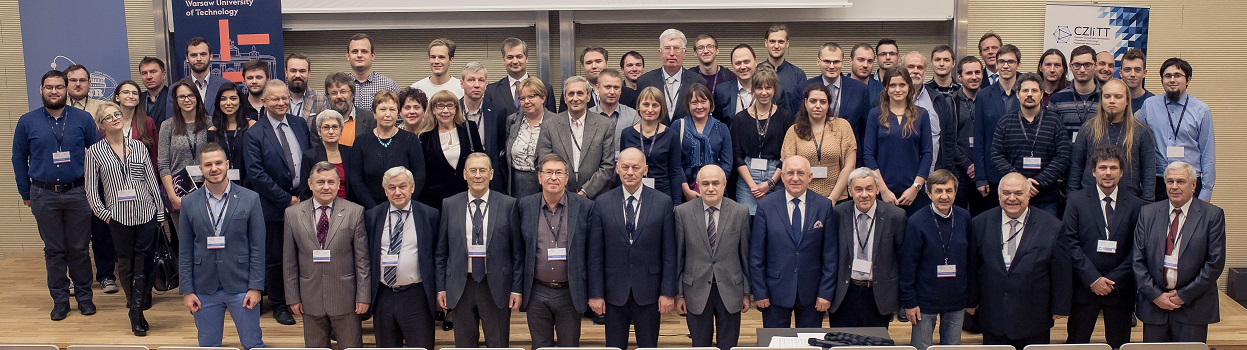
Conveners
Session 3; 9-nov 2017
- Vadim Babkin (JINR)
-
Marek Guminski09/11/2017, 15:00NICA acceleration and experimental complexTalk
Presented paper describes the data stream sorting and merging architecture, fitting triggerless HEP experiments.
The presented architecture is implemented in FPGA and is expected to merge multiple streams of coarsely sorted data with single output stream throughput of up to 320 Mwords/s.
In triggerless HEP experiments multiple detectors record “continuous" stream of small (i.e., 32 bit) data...
Go to contribution page -
Maria Stefaniak (Warsaw University of Technology)09/11/2017, 15:15NICA acceleration and experimental complexTalk
Collisions of heavy-ions are major method used to study properties of matter. Such studies are performed with comparison of experimental data and model simulations.
One of theoretical description is Parton-Based Gribov-Regge theory included in the phenomenological model EPOS. It was originally created to explain the processes at the highest energies obtained with LHC complex. EPOS gives...
Go to contribution page -
Diana Pawłowska09/11/2017, 15:35NICA acceleration and experimental complexTalk
Heavy-ion collision experiments are developed to study the properties of strongly interacting matter at high energies. The main aim is to investigate the Quark-Gluon Plasma (QGP), which consist of free quarks and gluons. Using the femtoscopic methods, the information about the space-time characteristics of the particle emitting source, like the radii of such source, is obtained. For needs of...
Go to contribution page -
Adrian Pawel Byszuk (University of Warsaw (PL))09/11/2017, 15:50NICA acceleration and experimental complexTalk
OMTF is one of CMS trigger subsystems, tasked with analysing detector data on the boundar of barrel and endcap regions.
Go to contribution page
OMTF firmware is running on large, high-end FPGA; consuming more than 80% of FPGA resources. Main algorithm runs at 160 MHz, while data transmission subsystems run at 80, 160 or even 250 MHz. With a large FPGA utilisation it can be considered high frequency, which poses... -
Piotr Podlaski (University of Warsaw (PL))09/11/2017, 16:25NICA acceleration and experimental complexTalk
NA61/SHINE is a fixed target experiment operating at the CERN Super-Proton-Synchrotron (SPS). The NA61/SHINE Collaboration aims to study the properties of strongly interacting matter on the onset of deconfinement. The SPS beam energy range allows creating nuclear matter around the critical point. Beam momentum in the range 13A-150A GeV/c and a wide selection of the system size (p+p, Be+Be,...
Go to contribution page -
Malgorzata Anna Janik (Warsaw University of Technology (PL))09/11/2017, 16:40
Activities of WUT group in ALICE.
Go to contribution page -
Sebastian Siejka (Warsaw University of Technology)09/11/2017, 17:05NICA acceleration and experimental complexTalk
Through experiments with heavy-ion collisions at high energies we can study the properties of nuclear matter under extreme conditions. The information on the sizes of the particle-emitting sources can be inferred via the method of femtoscopy. The femtoscopy method uses Quantum Statistics effects and the Final State Interactions to determine the space-time properties of the...
Go to contribution page -
Mr Daniel Dąbrowski (Warsaw University of Technology)09/11/2017, 17:20NICA acceleration and experimental complexTalk
The Time-of-Flight (TOF) will be one of the detectors used for particle identification in nascent Multi-Purpose Detector (MPD) at NICA (Nuclotron-based Ion Collider fAcility) complex. To work properly it needs system which provides gas under the correct pressure and with specific properties, like mixture composition and purity. Requirements, construction, properties and operation principles of...
Go to contribution page -
Ms Karolina Kmiec (Warsaw University of Techology)09/11/2017, 17:40NICA acceleration and experimental complexTalk
BM@N Experiment is the first, which will be realize at the accelerator complex of
Go to contribution page
NICA-Nuclotron-M in Joint Institute for Nuclear Research in Dubna, Russia.
The aim of the BM@N experiment is to study interactions of relativistic heavy ion beam with fixed target. Particles identification is provided by combining the information from Central Tracking modules (inside of analyzing...