Speaker
Description
Chanwoo Doo1, Jibum Kim1, Jiho Lee1, Jungwon Kang1, 2, *
1. Department of Foundry Engineering, Dankook University, Yongin-Si, 16890, Gyeonggi-Do, Republic of Korea
2. Department of Semiconductor Convergence Engineering, Dankook University, Yongin-Si, 16890, Gyeonggi-Do, Republic of Korea
* Corresponding author: jkang@dankook.ac.kr
Perovskite-based radiation detectors are attracting attention as next-generation radiation detectors due to their high charge mobility and tunable bandgap (Fig. 1a). However, limited charge collection at the transport layer interface is reported to be a major cause of degraded detection performance. In this study, changes in detection sensitivity were observed by sequentially doping the electron transport layer (ETL: PCBM) and the hole transport layer (HTL: PEDOT:PSS) with molybdenum disulfide (MoS2). In Fig. 1b, the external quantum efficiency (EQE) graph of perovskite MAPbI3 shows that it matches well with the emission spectrum of the CsI(Tl) scintillator used in the indirect detector. Molybdenum disulfide (MoS2) used for charge transport layer doping was selected because it possesses tunable bandgap characteristics and can enhance charge mobility and reduce interfacial defects. Prior to device fabrication, 2D MoS2 nanocrystals were fabricated by centrifugation following liquid exfoliation. Size analysis according to changes in centrifugation speed showed that the average particle size decreased as the centrifugation speed increased from 4,000 rpm to 8,000 rpm, and uniform nanocrystals with an average size of approximately 28 nm were obtained under the 8,000 rpm condition (Fig. 1c).
When the amount of MoS2 added to the HTL was fixed at 1 wt% and the detection sensitivity according to the size of MoS2 was measured, the highest sensitivity of 2.499 mA/Gy·cm² was observed when 28 nm MoS2 was added (Fig. 2a) under X-ray irradiation conditions of 80 kVp, 63 mAs, and 1.57 sec. Experiments were conducted to add MoS2 to the ETL layer using the same method, and the highest sensitivity was observed when 28 nm MoS2 was added. To determine the optimal concentration of MoS2 nanocrystals, the amount of MoS2 added to each transport layer was varied from 1 wt% to 4 wt% (Fig. 2b). When 3 wt% of MoS2 was added to both the ETL and HTL simultaneously, a maximum sensitivity of 2.774 mA/Gy·cm² was obtained (Fig. 3a). This represents a 24.84% improvement compared to the detector without added MoS2, which showed a sensitivity of 2.222 mA/Gy·cm². The defect density and charge mobility were evaluated using the space charge limiting current method (SCLC) (Fig. 3b). As shown in Fig. 3c, the detector with MoS2 added to both HTL and ETL exhibited the lowest defect density of 9.46 × 10¹⁵ cm⁻³ and the highest mobility of 2.23 × 10⁻³ cm² V⁻¹ s⁻¹, indicating improved charge transport and reduced recombination loss compared to the detector without added MoS2.
PCBM : Phenyl-C61-butyric acid methyl ester
PEDOT:PSS : Poly(3,4-ethylenedioxythiophene):Poly(styrenesulfonate)
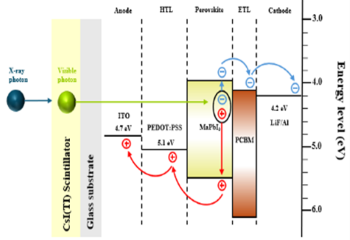
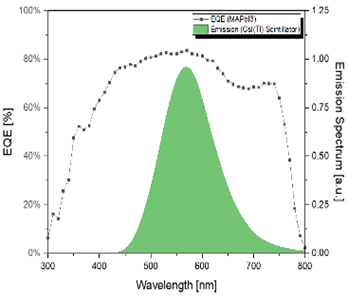
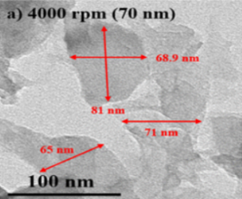
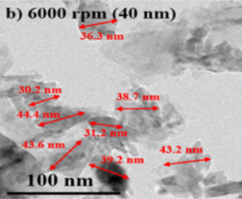
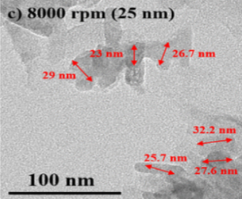
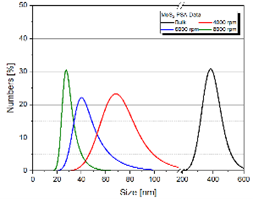
Figure 1. (a) Energy band diagram and carrier transport mechanism of the indirect MAPbI3 X-ray detector. (b) External quantum efficiency (EQE) of the MAPbI3 X-ray detector and the emission spectrum of the CsI(Tl) scintillator (c) TEM images and size distribution of 2D MoS2 nanocrystals obtained at centrifugation speeds of 4000, 6000, and 8000 rpm
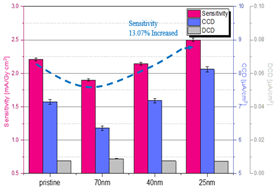
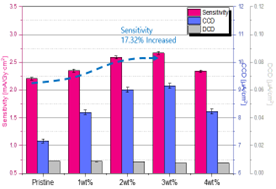
Figure 2. (a) Radiation parameters with different size of MoS2 in the HTL (b) Radiation parameters with different amount of MoS2 in the HTL
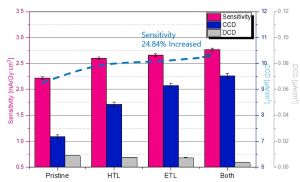
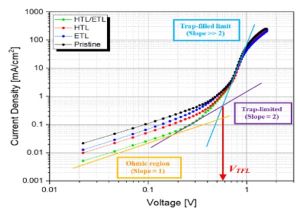
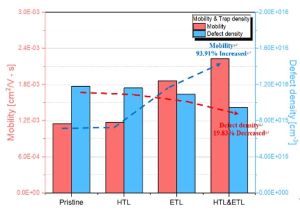
Figure 3. (a) Radiation parameters when MoS2 is added to each transport layer and simultaneously (b) Space charge-limiting current method (SCLC) (c) Defect density and mobility when MoS2 added to each transport layer and simultaneously
The authors acknowledge funding from the Korea Institute for Advancement of Technology(KIAT) grant funded by the Korea Government(MOTIE) (RS-2025-02214408, HRD Program for Industrial Innovation) and National R&D Program through the National Research Foundation of Korea(NRF) funded by Ministry of Science and ICT (RS-2021NR057239)